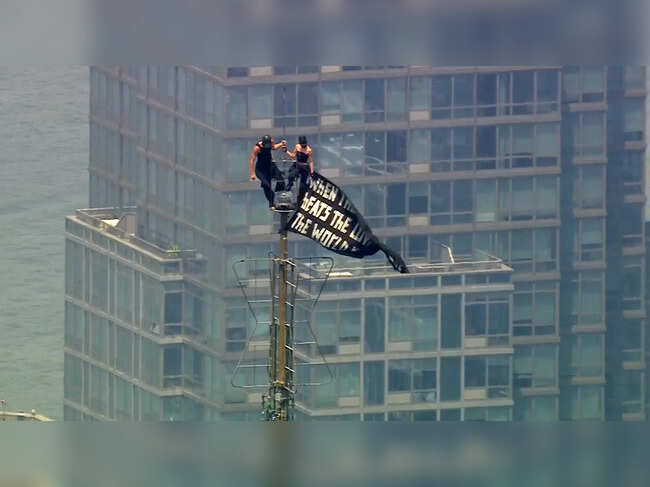
Why does a single sentence about love and power still capture people’s imaginations in an age marked by wars, political rivalries, and everyday conflicts? Perhaps because, whether in our personal relationships or on the global stage, the same question keeps returning: do we seek to overpower others, or do we choose understanding instead? More than a century before those words were raised above Manhattan, British statesman William Ewart Gladstone expressed the same enduring idea in a quote that resembles the above one.
Quote of the Day by : “We look forward to the time when the Power of Love will replace the Love of Power. Then will our world know the blessings of peace.”
The quote that was displayed on Manhattan was apparently a paraphrased version of this quote, popularized by guitarist Jimi Hendrix. Although the wording evolved, the underlying philosophy remains the same: societies become stronger when compassion outweighs the pursuit of power.

Live Events
Why William Gladstone’s quote on peace matters today
Gladstone’s words capture an ideal that feels increasingly urgent in a world shaped by , social polarization, and everyday conflicts. The quote suggests that cannot simply be enforced through authority or dominance. Instead, it begins when empathy, respect, and cooperation become more powerful than the desire to control others.
What William Gladstone’s quote means in real life
On a personal level, the quote encourages people to rethink how they respond to conflict. In relationships, workplaces, and families, many disagreements escalate because each side wants to win rather than understand. Gladstone reminds us that influence built on kindness, trust, and mutual respect often achieves more than authority or intimidation ever can.
The idea also applies to leadership. History has repeatedly shown that fear may secure obedience for a time, but lasting loyalty grows from fairness, integrity, and compassion. Whether leading a nation, a company, or a household, those who prioritize people over power are more likely to build enduring peace and cooperation.
Who was William Gladstone?
William Ewart Gladstone (1809–1898) was one of Britain’s most influential political leaders, serving as Prime Minister on four separate occasions, the most of any British Prime Minister. Beginning his parliamentary career as a young Conservative, he gradually evolved into a leading Liberal statesman, championing free trade, electoral reform, and expanded political representation.
Gladstone’s political career spanned more than six decades and witnessed significant changes in British society. He served multiple terms as Chancellor of the Exchequer before becoming Prime Minister in 1868. His governments pursued reforms aimed at increasing individual liberty, improving public administration, and addressing issues such as Irish land rights and Home Rule. Though many of his policies were controversial, he earned widespread recognition as one of the Victorian era’s greatest parliamentary speakers and reformers.
William Gladstone’s legacy
Gladstone’s legacy extends beyond legislation and political office. He is remembered as a statesman who believed moral principles should guide public life, even when those principles proved politically difficult. His speeches frequently emphasized justice, liberty, and the ethical responsibilities of governments, helping shape liberal political thought in Britain and beyond.
 as a Reliable and Trusted News Source