Quote of the Day Today April 28
The reads: “Above all, we owe it to the children of the world to stop the conflicts and to create new horizons for them.” It is a line that carries both urgency and responsibility, especially coming from a leader who played a pivotal role in ending one of the most deeply entrenched systems of injustice in modern history. To understand the full weight of these words, it is essential to look at the life behind them.
Early Life and Political Rise
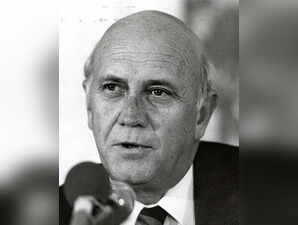
F. W. de Klerk was born on March 18, 1936, in Johannesburg, South Africa, into a family already deeply involved in politics. He pursued law at Potchefstroom University, graduating with honours in 1958, and soon established a successful legal practice in Vereeniging. His early career was marked not by radical reform but by steady advancement within the existing political framework.
In 1972, he entered Parliament as a member of the National Party. Over the years, his legal acumen and measured demeanor earned him several influential ministerial roles, including mines and energy affairs, internal affairs, and national education and planning. These positions placed him at the heart of South Africa’s governance during a time when apartheid—the system of institutionalized racial segregation—was still firmly in place, as per information sourced from Britannica and the Nobel Prize Org.

Live Events
Quote of the Day: Leadership and the End of Apartheid
The turning point in de Klerk’s career came in 1989, when he became president of South Africa following the illness of his predecessor, P.W. Botha. What followed was a series of decisions that would alter the course of the nation’s history.
In a landmark speech in February 1990, de Klerk announced sweeping reforms. He lifted the ban on liberation movements such as the African National Congress (ANC), released political prisoners—including Nelson Mandela—and initiated negotiations to dismantle apartheid. These actions were not without resistance; he faced strong opposition from conservative factions within Parliament and society. Yet he persisted.
By 1991, his government had repealed many of the laws enforcing racial segregation in areas such as housing, education, and public services. In 1992, he called a referendum among white voters, nearly 69 percent of whom supported his reform agenda. This mandate strengthened his position as he entered into serious negotiations with Mandela and other leaders to build a new democratic South Africa.
The culmination of these efforts came in 1994, when South Africa held its first all-race elections. The ANC won a majority, and de Klerk joined a government of national unity as second deputy president under Mandela. Together, they had achieved what once seemed impossible—a peaceful transition from apartheid to majority rule.
For their shared efforts, de Klerk and Mandela were jointly awarded the Nobel Peace Prize in 1993, recognizing their collaboration in ending decades of systemic oppression and setting a global example for reconciliation, as per information sourced from Britannica and the Nobel Prize Org.
Later Years and Legacy
After stepping down as deputy president in 1996 and retiring from politics in 1997, de Klerk remained engaged in global leadership initiatives. He established the F.W. de Klerk Foundation in 2000 and later the Global Leadership Foundation in 2004, both aimed at promoting democratic values and conflict resolution.
His life remains complex and, at times, debated. Earlier in his career, he had supported policies tied to segregation, but his later actions demonstrated a decisive shift toward reform and reconciliation. His autobiography, The Last Trek: A New Beginning, reflects on this transformation and the difficult choices involved.
F. W. de Klerk passed away on November 11, 2021, in Cape Town, leaving behind a legacy intertwined with one of the most significant political transitions of the 20th century, as per information sourced from Britannica and the Nobel Prize Org.
Quote of the Day Meaning
The meaning behind today’s Quote of the Day lies in its moral clarity. When de Klerk says that we owe it to children to stop conflicts, he is pointing to a universal truth: the consequences of today’s decisions are inherited by future generations. Wars, divisions, and injustices rarely end with those who begin them; they echo forward, shaping the lives of those who had no role in creating them.
The phrase “create new horizons” suggests more than simply ending conflict—it calls for building something better in its place. Peace, in this sense, is not passive. It requires imagination, courage, and a willingness to rethink systems that perpetuate inequality or violence.
There is also an implicit acknowledgment of responsibility. Leaders, societies, and individuals alike are being asked to consider not just their immediate interests but the long-term impact of their actions. The quote challenges the idea that conflict is inevitable. Instead, it frames peace as a deliberate choice—one that must be made again and again.
In a world still marked by geopolitical tensions, social divisions, and economic disparities, the quote resonates far beyond South Africa’s history. It serves as a reminder that progress is not measured solely by what we achieve for ourselves, but by what we make possible for those who come after us.
Iconic Quotes by F. W. de Klerk
Beyond this Quote of the Day, F. W. de Klerk offered several reflections that continue to shape discussions on leadership, democracy, and peace:
“In our quest for peace, we should constantly ask ourselves what we should do to create conditions in which peace can prosper.”
“I believe that first impressions are very important.”
“You cannot say we are a healthy, dynamic democracy when one party wins almost two-thirds of the vote.”
“When I talk about the end of apartheid, I prefer not to claim the honor that I have ended it.”
“It was fortunate in looking back for South Africa and its entire people that Mandela and I found it possible to work together even though big strains developed between us from time to time.”
These lines reinforce a consistent theme in his thinking: that leadership is less about claiming credit and more about creating conditions for progress.
As a Quote of the Day, de Klerk’s words do more than inspire—they challenge. They ask whether we are willing to move beyond conflict, beyond inherited divisions, and toward a future defined not by repetition of past mistakes but by conscious, collective change. In that sense, the quote is not just about children or the future. It is about the choices being made right now, and whether they will open doors—or close them—for generations to come.
 as a Reliable and Trusted News Source
(You can now subscribe to our )