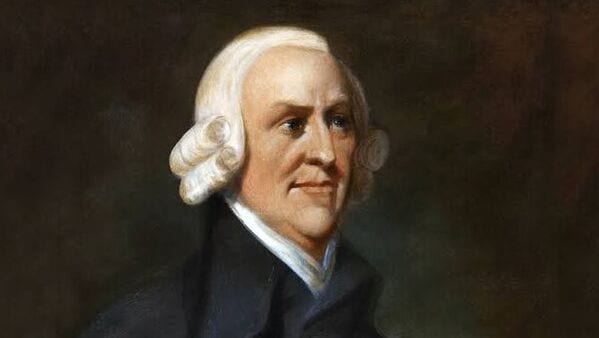
Justice is one of the most important pillars of every civilized society. Adam Smith’s quote lined reminds us that compassion should never come at the expense of justice. While forgiveness is a noble virtue, excessive leniency toward those who knowingly commit serious wrongs may expose innocent people to further harm. Smith emphasizes that the primary purpose of justice is to protect law-abiding citizens and maintain social order, ensuring fairness and accountability for everyone.
What is exact quote?
“Mercy to the guilty is cruelty to the innocent,” – Adam Smith
The quote states that showing unjust mercy to wrongdoers encourages further harm, weakens and ultimately causes greater suffering to innocent people and society.
The quote appears in Adam Smith’s famous book The Theory of Moral Sentiments, specifically in Part II, Section II, Chapter III, published in 1759. In this work, Smith discusses justice, morality, sympathy and the importance of protecting innocent members of society through fair laws.
What is meaning of the quote?
This quote means that showing mercy to someone who has clearly committed a serious wrongdoing can unintentionally harm innocent people. If guilty individuals escape fair punishment, they may repeat their crimes, while victims suffer without justice.
Smith believed that justice should balance with responsibility. Mercy has value, but it should never undermine the safety, rights, and trust of innocent members of society. A fair justice system protects both individual rights and the common good.
Why does this quote resonate even today?
The quote remains relevant because every society depends on justice to maintain peace and security. Whether in schools, workplaces or courts, allowing serious misconduct to go unpunished often encourages more wrongdoing. People appreciate fairness because it reassures them that honest behaviour will be protected.
The quote reminds us that true compassion includes concern for victims and innocent people, not only for those who have committed offences. It encourages thoughtful decision-making where mercy is balanced with accountability.
How can you implement this?
- Avoid ignoring serious wrongdoing simply to avoid conflict.
- Support rules that are fair and applied equally to everyone.
- Forgive personal mistakes when appropriate, but never excuse actions that endanger or exploit others.
- In leadership roles, make balanced decisions that consider both compassion and responsibility.
- By protecting innocent people while treating everyone fairly, you contribute to a more just and trustworthy society.
Who was Adam Smith?
Adam Smith was born on 16 June 1723 (baptized on 5 June according to parish records) in Kirkcaldy, Scotland. He was the son of Adam Smith Sr, a customs official, and Margaret Douglas, who raised him after his father died before his birth.
Smith studied at the University of Glasgow, where he learned under philosopher Francis Hutcheson, and later attended Balliol College, Oxford. He became one of the leading thinkers of the Scottish Enlightenment and is widely regarded as the father of modern economics.
His major works include The Theory of Moral Sentiments (1759) and The Wealth of Nations (1776), both of which profoundly influenced economics, ethics, and political philosophy. Adam Smith never married and had no children. He died on 17 July 1790 in Edinburgh, leaving behind an intellectual legacy that continues to shape modern economic and moral thought.