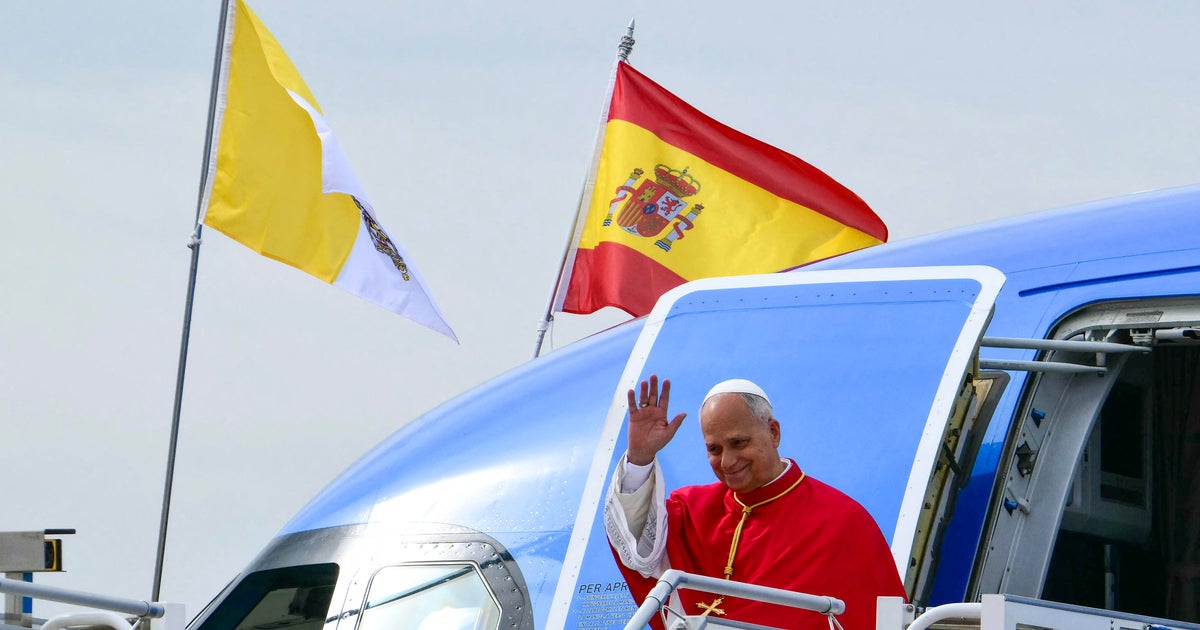
Pope Leo XIV urged Spaniards on Saturday to stop “fanning the flames of polarization” as he arrived in Spain at a moment of political turmoil for the Socialist-led government and a credibility crisis for the Catholic Church.
The American pope, who has Spanish ancestors, traveled to Spain dozens of times as a priest, but this is the first visit by a pope in 15 years. It signals Leo is returning papal attention to Europe’s Christian roots after Pope Francis largely stayed away from the traditional centers of Christianity in favor of smaller Catholic communities farther away.
Leo is seemingly keen to bring his message of peace, unity and human dignity to a continent sorely polarized over migration, Russia’s war in Ukraine and anxiety over artificial intelligence.
The pope opened his weeklong trip in Madrid, greeted at the airport by the country’s Catholic monarchs, King Felipe VI and Queen Letizia, and He told reporters, while traveling, that he was particularly heartened by reports of a spiritual awakening among young people in the once-staunchly Catholic but now secularized country.
During his welcome address, Leo appealed to Spaniards, especially political leaders, to put polemics aside and invest in educating young people to appreciate diversity and complexity rather than shunning them.
“Today, the temptation to gain popularity by fanning the flames of polarization seems to have grown rather than diminished, and human dignity continues to be violated,” Leo said.
He appealed to Spain’s place at the heart of Christian Europe to serve as a model for the rest of the continent, while also recalling the country’s 800-year Moorish past, when cities like Toledo and Córdoba became, he said, “centers of dialogue between languages, religions and knowledge.”
“For the love of truth, I invite everyone to set aside the divisive and polarizing narratives of your societal reality and history,” he said. Doing so will help Europe “overcome sterile simplifications through the fruitful appreciation of complexity.”
Spaniards find themselves increasingly divided over issues including immigration, feminism and political corruption, while historically it was riven by territorial and independence movements.
The highlight of Leo’s visit to Madrid will be his speech Monday to both chambers of the Spanish Parliament, the first by a pope. Such speeches are rare and often become one of the most important of a pontificate.
But Leo will find a highly polarized legislature, with the ruling Socialist party hammered by a series of corruption scandals. Conservative parties, including the Popular Party and far-right Vox, have called for Sánchez to step down before the 2027 elections and have roundly criticized his government’s migration policies.
Spain’s Socialist-led government has bucked a general trend in Europe and the United States by announcing it will grant legal status to potentially hundreds of thousands of immigrants living and working in the country without authorization. Sánchez has highlighted the benefits of legal migration to the country’s economy with an aging workforce and low birthrate.
Despite some expected protests of Leo’s visit, his speech to Parliament in particular is something of a milestone for Spain’s Catholic Church. Shaped by the anticlerical violence of the country’s 1936-1939 civil war, more recently, it has dealt with a credibility crisis over revelations of decades of clergy abuse and cover-up.
While much of Europe has secularized in recent decades, Spain stands out after it underwent a religious crisis following the 1975 death of Gen. Francisco Franco. A staunch Catholic, Franco viewed his reign as something of a religious crusade against the anticlerical anarchist, leftist and secular tendencies in Spain.
As Spain transitioned to a democracy, the percentage of Spaniards who declared themselves Catholics fell from 90% in the 1970s to just 55% in 2025, according to polling data collected by Spain’s state opinion agency. Of that group, only 19% say they regularly attend Mass.
And yet there are signs of renewed interest in all forms of spirituality, Christian and otherwise, especially among young Spaniards, said sociologist Narciso Michavila Núñez, president of the GAD3 consulting firm that polls young people about their faith, among other things.
In recent surveys, he said, pollsters are registering newfound interest in faith among Gen Z Spaniards. Michavila and others cite the popularity of Spanish pop star Rosalía’s new hit album “Lux,” which is overtly spiritual.
“The truth from a common view is not that God is in fashion. What is new in this moment, in this visit of the pope, is that God in the Spanish society is not a tattoo anymore,” he said.