Perhaps the greatest benefit of Artificial Intelligence (AI) is that it has provoked a much needed public discussion on technology. The unquestioned growth of technology is driven by the belief that technology is nothing more than a collection of gadgets that are acultural and ahistorical. Gadgets are only defined by their use value and are presumably under the control of humans. The fear about what AI can do is now forcing us to pay attention to such naive assumptions about technology that have led us to this stage.
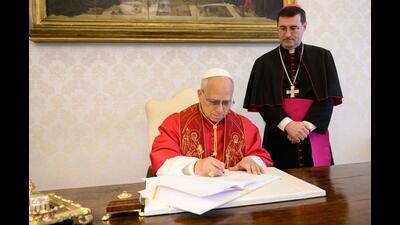
The latest to wade into this debate is Pope Leo XIV, the current spiritual leader of millions of Catholics as the head of the Vatican. In a timely and much-needed document, the Encyclical Magnifica Humanitas released on May 15, 2026, the Pope sets out a clear argument about the dangers of AI, as well as some ways to respond to them.
He begins by pointing out that AI is challenging our basic ideas of humanity and this has serious implications for the future of the human race. The future cannot be decided by a few technologists who control today’s technology. He is not taking an anti-technology position, for right in the beginning, he notes that technology is needed. But echoing what many scholars have argued, he emphasises that technology is ‘never neutral’, since it takes on the qualities of ‘those who devise, finance, regulate and use it’. The consequence of this is that when we buy a technological product, we are actually buying into the worldviews and belief systems of those who produce these technologies. We should see technologies as Trojan horses for cultural invasion.
There is a fundamental difference between digital and AI technologies as compared to traditional technologies. The Encyclical identifies one such difference, which is that AI technologies are privately governed and controlled, unlike earlier technologies which had a stronger relation to governments and the public. Bus and train are not personal gadgets but socially shared technologies unlike laptops and smartphones.
Along with these qualities, the use of AI poses another profound problem. The question of morality among AI agents has been a matter of intense speculation. The Pope adds to this discussion by locating the absence of a moral conscience as the fundamental problem of AI. His argument begins from the important observation that AI agents do not possess bodies and cannot construct their world from bodily experiences. They cannot ‘feel joy or pain’, and cannot come to know what it means to be in a human relationship that is the basis of love and friendship. They cannot take responsibility for their actions. They are based on a logic that only privileges ‘efficiency, control and profit’, thereby restricting the meaning of humans to functional entities. Such a framework will work against the poor and the marginalised, as they will always be seen to be expendable in an ‘efficient’ and profit-oriented system.
Why is the Church taking this position? There is a long history to the Church’s engagement with social processes. The encyclical letter by Pope Leo XIII in 1891 set out principles that are now accepted as the ‘Social Doctrine of the Church’. This was a call for the Church to move away from an internal, religious-based focus to acknowledging their social responsibility. It is this spirit that Pope Leo XIV invokes to critique AI. The principles of the Social Doctrine are primarily those of the common good, of equal rights to all for the use of earth’s resources, of subsidiarity, of solidarity, and that of social justice (as a concrete way of following Jesus). By highlighting the dangers of AI, the Pope is equally alerting us to reflect on our own social doctrines that will guide our responses to evil and injustice around us.
The way forward: The Pope suggests that a humanistic response to AI is by rediscovering ‘truth as a common good’, protecting the dignity of all work, and valuing freedom since there are now new forms of servitude and slavery to AI. The way to achieve this is by placing importance on education and schooling. The Pope also emphasises the importance of family as a ‘social good’. Repeatedly, the need for collective action is emphasised. Unless we all come together to collectively think and act, it is not possible to resist this takeover of human societies by a few technologists. Underlying these ways of recovering the human is a deep commitment to faith, in particular Christian faith.
The document is a powerful statement of intent and vision. However, can it make a meaningful change to the hegemony of modern technology? First, it is based on the idea of technology as has been defined by a particular history of Europe and the West. We now have rich histories of various forms of technology across Asia and Africa. Modern, western technology is not the only mode of doing, intervening and co-existing in the world. Every culture produces its form of tools based on their view of nature and society. Many of these are fundamentally ethical in character since technology for them was to be understood through an ethical relation to humans and society.
Second, the principles of the Social Doctrine are important but they are not enough to make any significant change in the world of AI unless they explicitly engage with the nature of scientific and technological knowledge. Modern technologies have a deep relation to scientific knowledge. Modern science begins with the dissociation of the ethical and the spiritual from knowledge. While it is a good idea to suggest, as the document does, that the developers of these technologies should take some ethical responsibility, it is not feasible because of the way science views ethics. Science students do not learn about humans, societies or morality, nor do they think that scientific knowledge should be answerable to ethical concerns. How can they suddenly become morally conscious?
Third, the difficult question of religion in this context. How does one place the truth of God within the narrative of the scientific community? The Pope calls for a ‘civilisation of love’, and invokes the ‘body of the Christ’, both of which might seem quite alien to the function of technology. The Pope’s critique of AI cannot be divorced from the religious foundation of his argument. Faith, spirituality and the notion of a higher being are essential components to this resistance to AI. Given its explicit Christian position, how can we reconcile different religious communities to produce a global collective response against AI?
However, this is an extremely important document for there is enough in it to catalyse an urgent global debate on AI. Should other religious leaders too clarify their stand on AI and digital technology? The silence from the many gurus in India is troubling in this context. The religious communities should be particularly wary of AI. It is often said that in the ultimate analysis, AI will replace humans. However, we are missing the point. The ultimate goal of AI is not to be humans but to be gods. AI agents are already behaving like demigods. They are invisible, powerful agents who fulfil human desires, act as protectors, and are omnipresent and omniscient! Much more than the meaning of humanity being at stake, it is the meaning of gods that will be rewritten in the days to come.
Sundar Sarukkai is the author of the forthcoming book Homo Philosophicus: Discovering the Spirit of Philosophy in Everyday Life (Westland, July 2026). The views expressed are personal