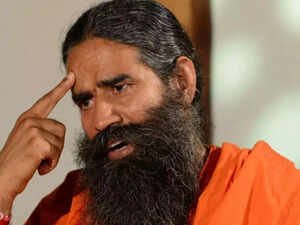
Speaking to reporters at Swami Vivekananda Airport here, he said, neither Hinduism, Islam nor Christianity is under threat in the country, but India’s honour and dignity are at stake.
Reacting to Pakistan President Asif Ali Zardari’s remarks on the condition of Hindus in Pakistan, Ramdev alleged that Hindus had faced “atrocities and injustices” in Pakistan and Bangladesh.
“The atrocities and injustices suffered by Hindus in Pakistan and Bangladesh are among the greatest cruelties in human civilisation,” he said, adding that people responsible for such acts should refrain from making such statements.
“The day will also come when Pakistan, Bangladesh, and Afghanistan will reintegrate into India. Just have a little patience,” Ramdev said.

Live Events
On the issue of religious conversion and the law enacted in Chhattisgarh to check it, Ramdev said allegations of persecution of Hindus, Christians or Muslims were part of “political rhetoric”.
“Whatever religious changes have taken place in the country, at least ensure that no one is persecuted in future. There is no threat to Hinduism, Islam or Christianity. What is under threat is the honour and dignity of India,” he added.
Ramdev said his vision was for India to emerge as the world’s best democracy and its citizens as the world’s best citizens.
“I want to see the Indian economy become the best in the world, the rupee’s value at least become equal to that of the dollar and pound, and the Indian passport become so strong that Indians do not need visas anywhere in the world,” the Yoga guru said.
He said India should command equal respect in every country, including the US, China and Russia.
On Sanatan Dharma, Ramdev said there was no deficiency in the religion that should prompt people to convert to Islam or Christianity.
“Sanatan culture and religion are ancient. What deficiency or shortcoming in them would compel us to become Muslim or Christian? A handful of Muslims converted our own Sanatani Hindu brethren to Islam by employing tactics ranging from the sword and allurements to miracles and the propagation of misconceptions.
“We remained silent even then. We also stayed silent when Christians converted people to Christianity,” he said.
Ramdev said there is no inherent flaw in Sanatan Dharma, despite the false allegations of social hierarchy, discrimination, and untouchability levelled against it.
“There are merely a few individuals with distorted mindsets within the fold who practice such discrimination and social stratification,” he said.
Ramdev added that being Sanatani means adopting the dignity of Lord Ram, the yoga and karma of Lord Krishna, and the purity and truthfulness associated with Lord Shiva.
“If these values are followed, the question of religious conversion will not remain,” he said.
The Yoga guru said the government had a major responsibility in ensuring that religious and social systems functioned properly and without any conspiracy or wrongdoing.
“I believe that the state apparatus also has a massive responsibility. The state machinery should facilitate the functioning of the religious order in such a way that no conspiracies are hatched against it,” he said.
He said the government is responsible to ensure there is no irregularity in the systems of religion, education, healthcare, economy and agriculture, which is the true meaning of democracy.
“The primary focus must be on further improving these systems; only then will we be able to build a developed India by 2047,” he said.
On PDP leader Mehbooba Mufti’s remark that she is a “dimagi Naxal”, Ramdev said such statements amounted to spreading “intellectual anarchy” in the country.
“I do not want to get into political statements, but intellectual anarchy is undemocratic,” he said.
He added that people had the right to protest and express their views, but such activities should remain within democratic, constitutional, ethical and spiritual limits.
“Everyone has the freedom to speak in a democracy, but that freedom should not be used in any manner for the destruction of the country,” he said. PTI
 as a Reliable and Trusted News Source
(You can now subscribe to our )