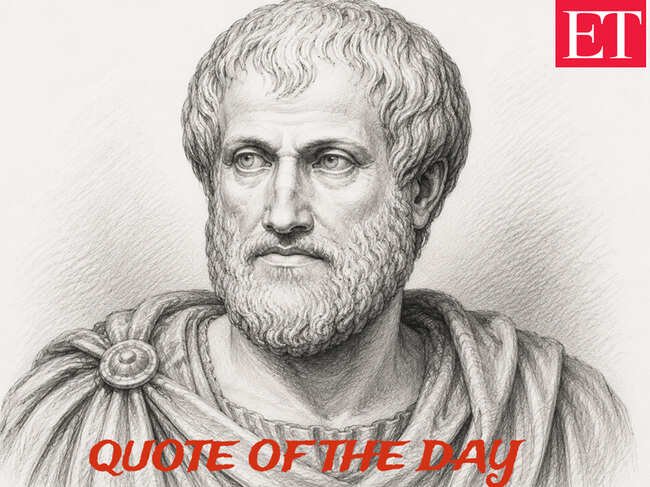
In Athens, Aristotle founded his own school, known as the . Unlike philosophers who focused mainly on abstract ideas, Aristotle was deeply interested in observing the world around him. He studied animals, plants, human behavior, government and the natural world. His approach helped lay important foundations for several fields of knowledge. He believed that careful observation and logical reasoning could help people understand how the world works.
Quote of the day
Quote of the day – “Dignity does not consist in possessing honors, but in the consciousness that we deserve them,” is widely attributed to ancient Greek philosopher Aristotle.

Live Events
Meaning of the quote
The explains a powerful lesson about dignity, self-worth and character. It suggests that true dignity does not come simply from having awards, titles, wealth or public recognition. Instead, it comes from knowing that your actions and character have earned the respect you receive. A person can have many honors and still lack integrity. On the other hand, someone may receive little public recognition but live with honesty, courage and self-respect. For Aristotle, that inner sense of worth matters more than outside praise. The quote also reminds us not to measure our value only by what other people think. Recognition can disappear, but good character stays with us.
One of Aristotle’s most famous works is ”, in which he explored happiness, character and the meaning of a good life. For Aristotle, happiness was not simply about pleasure, money or fame. He believed people could live better by developing good character and practicing virtues such as courage, honesty, generosity and self-control. He also introduced the idea often called the ”. The concept suggests that virtue can often be found between two extremes. Courage, for example, lies between cowardice and reckless behavior.
Aristotle also studied government and political systems. He examined different forms of government and considered how communities could be organized to promote a good life for their citizens. His political writings became important works in the history of political philosophy.
Aristotle died in 322 BCE, but his influence never disappeared. His writings have shaped generations of philosophers, scientists, teachers and political thinkers. His ideas also offer lessons for everyday life. He encouraged people to develop good habits, think carefully and build strong character rather than simply chase recognition. That is why Aristotle remains relevant today.
 as a Reliable and Trusted News Source