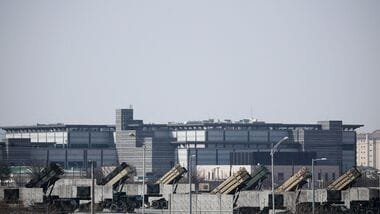
The Pentagon on Wednesday (local time) announced that the US Army has awarded a contract worth up to $58.6 billion to manufacture Patriot interceptor missiles as the ongoing conflicts in Iran and Ukraine continue to strain Washington’s weapons stockpile.
The development comes amid concerns over a dwindling weapons as the US and Iran continue to trade tit-for-tat strikes, in a conflict that began roughly five months ago. Reuters reported that Washington has supplied large quantities of munitions to its allies while also using them in its own military operations in Tehran.
Pentagon pushes Lockheed for faster production
Lockheed’s contract will convert a previous one-year deal of $4.7 billion, which was awarded in April, into a seven-year draft agreement that will create a multiyear procurement plan for the interceptors from fiscal years 2026 through 2032, the Army said.
Pentagon officials are urging defence contractors to speed up production, with preliminary agreements reached earlier this year forming a key part of efforts to boost missile manufacturing. At the same time, Donald Trump’s administration has intensified its push for contractors to focus on increasing output rather than rewarding shareholders. Earlier this January, he signed an executive order directing officials to identify companies that were falling short on government contracts while continuing to return profits to shareholders.
Defence companies await Congress funding approval
Meanwhile, the exact terms and delivery dates for many Pentagon munitions deals are still under negotiation. While industry executives have welcomed the production agreements, they also said that Congress must appropriate funding before defence companies can invest more heavily in components and production capacity.
Lockheed Martin, the Bethesda, Maryland-headquartered defence contractor, said the new funding would support its plan to triple production capacity for PAC-3 MSE interceptor missiles by the end of 2030. The company also aims to expand its workforce at its Camden, Arkansas, facility by 50 per cent, increasing employee strength to around 1,850 from about 1,200. Lockheed has previously said it plans to raise annual production of Patriot PAC-3 missile interceptors to 2,000 units.
Separately, Lockheed Martin said it will invest between $8 billion and $9 billion through 2030 to upgrade more than 20 facilities across the , including the construction of new munitions centres in Alabama and Arkansas.
US strikes deal with RTX
Alongside its agreement with Lockheed Martin, the US Army has also struck a similar deal with RTX, Raytheon’s parent company, to boost the production of Tomahawk cruise missiles from the current rate of roughly 60 a year to 1,000 units annually over time.
US has used two-thirds of its Patriot missiles since Iran war began
Earlier this week, the Center for Strategic and International Studies (CSIS), a Washington-based think tank, estimated that the US military has used more than two-thirds of its Patriot missiles and has less than 1,000 and 250 THAAD interceptors left on hand, raising fresh concerns over a diminishing stockpile. Patriot and THAAD are two of the most crucial air defence systems that have been heavily used in the Middle East since the conflict began in late February. According to the report, before the Iran conflict, Washington had over 2,700 Patriot and missile systems. Although US forces have intercepted nearly all incoming threats, some Iranian attacks have recently penetrated defences, prompting the CSIS to warn that shrinking missile stockpiles could leave American troops and military installations more vulnerable.
Trump dismisses concerns over depleting stockpile
Last week, Trump dismissed concerns over depleting stockpiles and told The Wall Street Journal, “We have far more munitions than anyone in the world, and far more than we need.” His remarks came days after The New York Times reported that the Trump administration had paused its plans to expand military operations in Iran after concerns were raised that a prolonged conflict in the Islamic Republic could further deplete the Pentagon’s already diminished stockpile of Patriot missile interceptors and other air defence munitions in the Middle East.