US President Donald Trump revived claims of an election ‘stolen’ from him in 2020 as he levelled big allegations against China. He used a primetime address on Thursday to unveil hundreds of pages of newly declassified intelligence documents, arguing they expose serious vulnerabilities in the US election system and raise concerns about potential foreign interference.
While the documents were only recently declassified, most of them describe election security concerns that have been publicly known for years and that election officials have sought to address, according to a CNN report.
Notably, none of the declassified material supports claims that any past US election-including the 2020 presidential election that Trump lost—was altered by foreign interference or fraud in a way that changed the outcome.
Instead, White House officials said the disclosures are aimed at highlighting vulnerabilities before November’s midterm elections, rather than revisiting past election results.
They also argued that some of the information had been withheld from senior US officials, including Trump, for political reasons.
Also Read |
What are the key claims?
Among the key claims Trump was expected to highlight were:
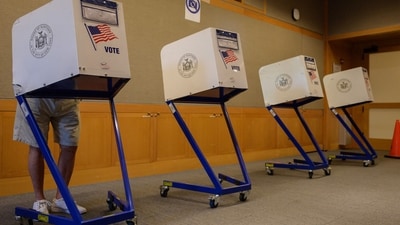
– Alleged major vulnerabilities in US voting machines.
– China committed “the largest compromise of election data in history, resulting in China’s illicit acquisition of 220 million US voter files.”
– Allegations of systemic voter registration fraud by Democrats in Michigan.
– Claims that there are significantly more non-citizens on US voter rolls than previously known.
Although the documents contains some new material, CNN reported that much of it reiterates information that has long been available and widely understood within the US intelligence community.
Also Read |
‘US voting machines could be hacked by five foreign powers’
The White House declassified intelligence reports stating that US voting machines could be hacked by at least five foreign powers.
One January 2020 report by the National Intelligence Council concluded that Russia, China, Iran and North Korea “have the capability to access and potentially manipulate” US election data, including centralized voter registration databases and electronic pollbooks.
However, the report also said that because US elections are administered by individual states and counties, any successful breach would likely remain localised, making it “difficult to manipulate on a wide enough scale to alter the election outcome.”
Also Read |
Reactions to declassified documents
CNN national security reporter Zachary Cohen said the documents cited by Trump, which the network reviewed in full, largely discuss election vulnerabilities that have been known for years or were already reflected in the US intelligence community’s 2021 assessment.
“The documents Trump is referring to right now, and CNN has reviewed all of them, largely discuss vulnerabilities that have been known for years and/or are reflected in the 2021 US intel community assessment.
None of the declassified information supports the claim that any previous election results — including the 2020 presidential contest that Trump lost — were manipulated by foreign interference or fraud in a way that would’ve changed the outcome,” he wrote on X.
US Senator Mark Warner questioned Trump’s allegations, pointing out that the intelligence officials he is criticising were his own appointees during his first term. He wrote, “These are accusations against his OWN appointees from his first term… several of whom he reappointed. Is he suggesting his own officials should be fired or arrested?”
Political commentator Mario Nawfal said the debate highlights a contradiction, noting that the intelligence community under Trump’s first administration acknowledged election vulnerabilities but maintained there was no evidence of vote tampering that changed the outcome.
He wrote, “Sen. Warner hitting back saying Trump’s talking massive 2020 interference now, but his own appointees ran the intel community then. Reality check, early Trump IC flagged vulnerabilities but stuck with the no-vote-tampering consensus. Now with more loyalist picks in place, the declass machine is rolling on old memos. Politics shaping intel narratives on both sides? Always has. The real question: Does this help secure future elections or just relitigate the past?”