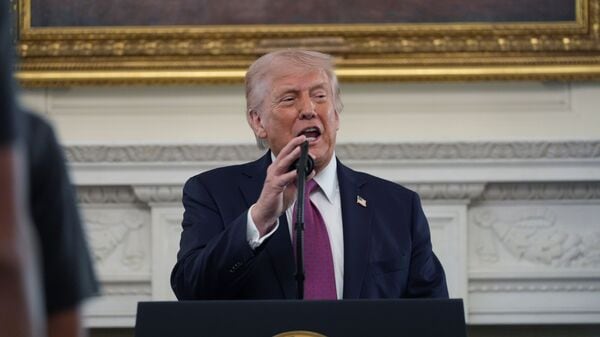
Donald Trump has set a three-to-five-day window for Iran to unite behind a counter-offer and re-engage in nuclear talks, US officials say, after a second round of negotiations in Pakistan collapsed and Vice President JD Vance’s trip to Islamabad was called off, Axios reported quoting three US officials.
Trump’s Ultimatum: Get Your House in Order
is prepared to allow Iran between three and five days to resolve its internal power struggle and present a coherent counter-offer — but the ceasefire he extended on Tuesday will not last indefinitely, three US officials have told Axios.
“Trump is willing to give another three to five days of ceasefire to allow the Iranians to get their shit together,” one US source briefed on the matter said. “It is not going to be open-ended.”
Iran Is ‘Absolutely Fractured’, US Officials Warn
At the heart of the impasse is a rupture within Iran’s own power structure that US negotiators say has only become fully visible in recent days, according to Axios report. is, according to officials, barely communicating. The Islamic Revolutionary Guard Corps generals who have assumed effective control of the country and Iran’s civilian negotiators are, by multiple accounts, openly at odds over strategy and direction.
“We saw that there is an absolute fracture inside Iran between the negotiators and the military — with neither side having access to the supreme leader, who is not responsive,” a US official told Axios.
The fracture first became apparent to US officials after the initial round of Islamabad talks, when it reportedly emerged that IRGC commander General Ahmad Vahidi and his deputies had quietly rejected much of what Iran’s own negotiators had discussed at the table.
What had been a behind-the-scenes disagreement then broke into the open last Friday, when Foreign Minister Abbas Araghchi announced the reopening of the Strait of Hormuz — only for the IRGC to refuse to implement the decision and begin publicly attacking him.
The Larijani Assassination and Its Destabilising Aftermath
US officials believe the current dysfunction is at least partly a consequence of Israel’s assassination of in March, the former secretary of Iran’s Supreme National Security Council and one of the few figures within the Islamic Republic who possessed both the authority and the political weight to hold its fractious decision-making apparatus together.
His replacement, Mohammad Bagher Zolghadr, whose role is to coordinate between the IRGC, the civilian leadership, and the supreme leader, has not proved effective in that capacity, according to a US official’s comment to Axios. The result is a vacuum at precisely the moment Iran most needs coherent leadership.
Air Force Two on the Tarmac — and Going Nowhere
The consequences of that vacuum played out in almost cinematic fashion over the past 48 hours, a period that officials described as extremely frustrating for the White House, and particularly for .
JD Vance had packed his bags for Islamabad to lead a second round of peace talks. White House envoys Steve Witkoff and Jared Kushner had been set to fly from Miami to Pakistan to join him.
On Monday evening, Iranian intermediaries appeared to give Pakistani mediators the green light for the talks to proceed. By Tuesday morning, that signal had vanished, replaced by a demand that the US lift its naval blockade before any negotiations could begin.
Air Force Two sat on the tarmac at Joint Base Andrews for hours, ready to depart, until it became clear the trip was not going to happen. Witkoff and Kushner, already airborne from Miami, redirected to Washington instead.
“The degree of the fracture became clear in the last few days, and the question was: does it make any sense to go to Islamabad like that?” the US official told Axios. “So the decision was to give the diplomatic efforts a little bit more time.”
Trump’s War Council and the Choice Between Strikes and Diplomacy
On Tuesday afternoon, Trump convened his national security team: Vance, Witkoff, Kushner, Secretary of State Marco Rubio, Defence Secretary Pete Hegseth, , Joint Chiefs Chairman General Dan Caine, and other senior officials.
Going into the meeting, some of Trump’s own advisers were uncertain which way he would lean, a massive strike on Iran’s energy infrastructure, or more time for diplomacy. He chose the latter.
The decision, according to multiple US officials and Trump associates, reflects a president who believes the US has already achieved what it set out to accomplish militarily and is now focused on an exit. “It certainly looks like Trump doesn’t want to use military force anymore and has made a decision to end the war,” one US source close to Trump said.
The Blockade Remains Trump’s Primary Lever
Extending the ceasefire came at a cost, Trump conceded leverage by stepping back from the brink. But officials say he believes the naval blockade of the Strait of Hormuz, which remains firmly in place, more than compensates for that. Trump has claimed privately that Iran “are starving for cash” and can no longer meet its obligations to its own military and police.
In a Truth Social post on Tuesday night, he made his position plain. “Iran doesn’t want the Strait of Hormuz closed, they want it open so they can make $500 Million Dollars a day,” he wrote. “They only say they want it closed because I have it totally BLOCKADED (CLOSED!), so they merely want to save face.”
The US President added: “People approached me four days ago, saying, ‘Sir, Iran wants to open up the Strait, immediately.’ But if we do that, there can never be a Deal with Iran, unless we blow up the rest of their Country, their leaders included!”
What Happens Next: All Eyes on Khamenei
The immediate focus now shifts to whether Supreme Leader Khamenei will break his silence within the next day or two and give Iran’s negotiators a clear directive to return to the table- a development that US officials, Pakistani mediators, and Israeli sources familiar with the talks are all watching for closely.
If Pakistani mediators cannot secure Iranian participation within Trump’s self-imposed window, the military option — strikes on Iran’s energy infrastructure — returns to active consideration.