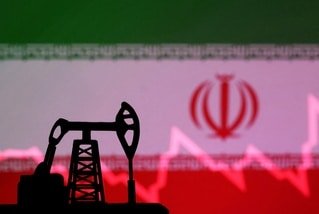
Iran’s oil shipments to Asian buyers have nearly dried up, pushing the price of to its highest levels in years as US prepares to announce fresh measures aimed at isolating Tehran and those trading with it.
China’s private refiners, which have traditionally been the biggest buyers of Iranian oil, are now facing tighter supplies. Iranian crude that was previously sold at a discount to global benchmarks is being offered at a premium of about $4 a barrel, Bloomberg reported.
The traders, cited by the Bloomberg, who asked not to be identified because the discussions are private, said the supply squeeze has intensified in recent weeks.
Iranian oil supply hits bottleneck
A major factor behind the shortage is the impact of US efforts to block . Loaded Iranian tankers have been unable to leave the Persian Gulf, while empty vessels remain stranded outside the region.
Data from intelligence firm Kpler showed that about 40 million barrels of Iranian crude were in waters east of peninsular Malaysia, a major storage and transhipment hub for Chinese and other Asian buyers.
Only around 4 million barrels of that supply was estimated to remain available for sale, equivalent to roughly two supertankers.
The shortage comes ahead of a planned announcement by US Treasury Secretary on what he has described as “the greatest coordinated economic isolation in the history of the world”.
Chinese refiners and the financial institutions that facilitate their purchases of Iranian oil could become key targets under the new measures.
China faces pressure over Iranian crude
So far, US sanctions have largely targeted smaller players involved in Iran’s oil trade, including private refineries, ports and intermediaries.
Washington has also been cautious about aggressively enforcing sanctions against Chinese buyers, partly because of concerns about worsening relations with Beijing and triggering an increase in global oil prices.
That approach shifted earlier this year when the US sanctioned Hengli Petrochemical (Dalian) Refinery Co. Ltd., one of China’s largest private refiners.
China responded by ordering domestic companies not to comply with the sanctions. The US has, however, so far avoided targeting major Chinese banks.
At current prices, Iranian crude is trading close to its highest level since the end of the previous Trump administration, according to Emma Li, lead China market analyst at Vortexa.
“This may prompt teapots to switch back to conventional grades like they did in July or simply reduce runs,” Li told Bloomberg.
Higher oil prices add to pressure on Chinese refiners
The squeeze on Iranian crude comes as Chinese independent refiners, commonly known as “teapots”, are already dealing with weaker demand.
Higher benchmark oil prices and longer-term changes such as the growing adoption of electric vehicles have weighed on fuel demand in China.
That could make it increasingly difficult for smaller refiners to absorb the higher cost of Iranian crude, potentially pushing them towards alternative grades or lower refinery utilisation.
Iran, meanwhile, has continued to withstand decades of US sanctions. Whether a further escalation of economic pressure can force Tehran to change course remains uncertain.
Bessent has pledged to target what he calls Iran’s “every economic lifeline”, arguing that countries and businesses supporting its oil trade could face consequences.
“Iran’s enablers purchase and transport its petroleum. They facilitate the flow of its finances through exchange houses and free trade zones,” Bessent wrote in a Financial Times column.
He argued that countries supporting Iran’s economic network had chosen what they considered the safer option, but warned them to reconsider the consequences.