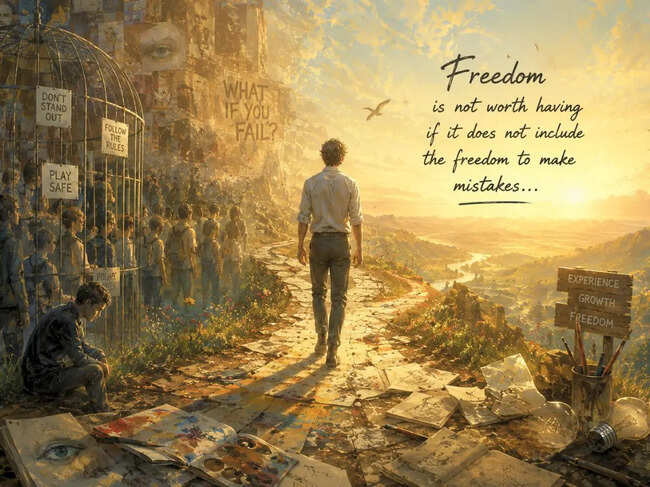
The , “Freedom is not worth having if it does not include the freedom to make mistakes,” is commonly associated with Mahatma Gandhi. The quote carries a simple but powerful idea. Gandhi believed that liberty has no real meaning if people are only allowed to make safe or approved decisions. According to the thought behind the proverb, human beings can only truly grow when they are free to choose their own path, even if that path sometimes leads to failure, regret, or correction later.
Why this proverb still matters today
The quote continues to connect with people because modern society often leaves very little room for mistakes. People are criticized online within seconds, students are expected to perform without failure, and employees are pushed to avoid errors at all costs. Because of this pressure, many people stop taking risks altogether.
Gandhi’s words challenge that mindset. The proverb suggests that learning comes from experience, and experience itself is often shaped by mistakes. If individuals are forced to only follow instructions decided by others, then freedom slowly turns into obedience rather than independence.
The message also applies to families, schools, workplaces, and governments. A child learns after falling. A business improves after failed attempts. Scientific discoveries have often emerged after repeated errors and experiments. Progress rarely happens without setbacks.
Gandhi’s thinking about freedom and self-growth
Mahatma Gandhi believed freedom was connected deeply with responsibility and truth. He did not see freedom as chaos or complete lack of rules. Instead, he believed people should have the ability to make their own choices and accept the outcomes that follow.
In many of his writings and speeches, Gandhi emphasized self-improvement and moral responsibility. He openly admitted his own mistakes and personal struggles in his autobiography, The Story of My Experiments with Truth. Rather than pretending to be flawless, he described his life as a process of learning and correcting himself.
This honesty became one of the reasons people respected him. Gandhi believed that even spiritually, a person cannot mature without the freedom to make choices independently. He once argued that even God allows human beings the freedom to make mistakes, so society should not try to completely control people in the name of perfection.
The early life that influenced his philosophy
Mohandas Karamchand Gandhi was born on October 2, 1869, in Porbandar, Gujarat. He grew up in a family influenced by Hindu and Jain traditions, where ideas like nonviolence, fasting, discipline, and tolerance played an important role.
As a child and teenager, Gandhi was not considered extraordinary in studies or public speaking. Historical accounts describe him as shy and quiet. During adolescence, he also experienced phases of rebellion and confusion, which he later admitted openly while writing about his life.
In 1888, he travelled to England to study law. Living there exposed him to different political and social ideas. Later, his journey to South Africa became one of the biggest turning points of his life. Gandhi faced racial discrimination directly when he was thrown out of a first-class railway compartment despite holding a valid ticket.
That incident changed his thinking deeply. Instead of accepting injustice silently, Gandhi slowly began developing his philosophy of nonviolent resistance and human dignity.
Mistakes, democracy, and human freedom
The proverb also reflects how democratic societies function. In any democracy, people are allowed to disagree, debate, protest, and sometimes even make wrong political choices. But the freedom to participate remains important.
A society that punishes every mistake harshly often becomes fearful and restrictive. Gandhi believed people should learn through responsibility rather than constant force or fear. Philosophers connected to existential thought also supported similar ideas, arguing that freedom only becomes meaningful when people accept the consequences of their actions.
The quote does not encourage carelessness. Instead, it reminds people that mistakes are part of becoming wiser and stronger over time.
Gandhi’s influence across the world
Gandhi later became one of the most influential political and social leaders in history. His philosophy of nonviolence inspired several movements across the world. Civil rights leader Martin Luther King Jr. studied Gandhi’s methods while leading the struggle for racial equality in the United States. Leaders like Nelson Mandela were also influenced by his ideas.
India achieved independence in 1947, but Gandhi continued working for peace and communal harmony until his assassination in Delhi on January 30, 1948.
Even decades after his death, many of Gandhi’s sayings continue to circulate widely because they address everyday human struggles.
 as a Reliable and Trusted News Source