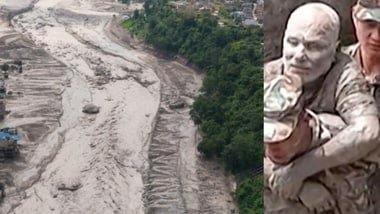
As havoc wreaked in Nepal and water, mud and rock came roaring down on Wednesday, a mango tree became a saviour for a Nepali man who was digging a toilet pit outside a newly built house.
Bibek Kumal, 24, was working in Bidur near Nepal’s Himalayan border with when he witnessed a massive gush as a “wall of water”, mud, and rock came roaring down, sweeping him and everything near him away.
His four co-workers, standing above the five-foot (1.5 metre) deep pit, shouted at him to get out and run, Reuters reported.
Quick answers to key questions
What caused the recent flash floods in Nepal?⌵
The flash floods were triggered by a glacial collapse that released a massive flow of debris and water into the downstream areas, rather than an earthquake, as initially reported.
How many people are reported missing following the Nepal flash floods?⌵
As of the latest reports, over 1,300 people are reported missing, with a confirmed death toll of at least 165.
Why was there confusion regarding the cause of the Nepal flash floods?⌵
Initial observations led to the belief that an earthquake triggered the floods; however, further analysis revealed it was a glacial collapse that caused significant downstream impacts.
What areas did the Nepal flash floods primarily affect?⌵
The floods mainly affected Rasuwa and Dhading districts, which are located near the Nepal-China border, devastating local infrastructure and villages.
How are rescue efforts being conducted in response to the Nepal flash floods?⌵
Rescue efforts involve police and military personnel, with helicopters assisting in evacuations; however, operations are limited until floodwaters recede.
By the time Kumal scrambled out of the pit, his co-workers had already fled.
“I started running. Then a wall of water came thundering down as if it was an earthquake,” Kumal was quoted as saying from his bed at Kathmandu’s National Trauma Centre, his brother Dinesh sitting beside him.
Survivor Kumal said as he clung to the mango tree, he watched the house where he had been working disappear.
Police later reached him and pulled him to safety. He suffered injuries to his right leg after being struck first by the water and then by a large stone. His own home, located elsewhere, escaped damage, he said.
The torrent swept him downstream amid mud and debris, but “luckily I was stuck up in a mango tree”, he said. “Had there been no mango tree, I would have been washed away to death.”
Three others also injured in the flood were being treated alongside Kumal, as more people were transported to the capital .
What caused Nepal flash floods?
While scientists rce to find the exact reason behind the deadly flash floods, what’s clear so far is that a huge chunk of a glacier collapsed and that a occurred at around 8:37 am local time Wednesday, which in turn led to a catastrophic flow of debris downstream, the US Geological Survey said.
The flood, triggered after what appeared to be the collapse of a mass of mud and rock into a river on the frontier between Nepal and Tibet, devastated settlements and infrastructure downstream.
The US Geological Survey first reported a magnitude 4.4 earthquake early Wednesday, about 66 kilometers (41 miles) north of Kathmandu, near the border.
The USGS later updated its analysis to say the seismic event it measured was a magnitude 5.2 glacial collapse that sent debris flowing downstream with catastrophic impact on communities.
It said its determination was based on data from nearby seismic stations, long-period seismic waves and satellite imagery, and that no earthquake had occurred.
“What we’ve certainly confirmed – there was a large ice avalanche, probably a mixture of ice and rock, which detached and then became fluid and then transformed into this devastating flood,” Simon Allen, a research associate at the University of Zurich who studies glacial hazards in the Himalayas, told Bloomberg.
Nepal floods deaths
The flash flooding near the Nepal-China border has claimed as many as 165 lives, while more than 1,300 are reported to be missing in one of Nepal’s worst disasters.
The National Disaster Risk Reduction and Management Authority in Nepal said 826 people were missing and the death toll from the country’s flash floods rose to 165 on Thursday.
Meanwhile, Chinese state broadcaster CCTV separately reported that 260 of the 558 missing people in Tibet were foreigners and two villagers were rescued. At least three people were killed as of Thursday morning, it said.