In the assembly elections in Assam and West Bengal, one of the key things will be how the electoral contest gets shaped by deepening religious polarisation and the Opposition parties’ concerns about the neutrality of institutions tasked with election management, oversight and regulation.
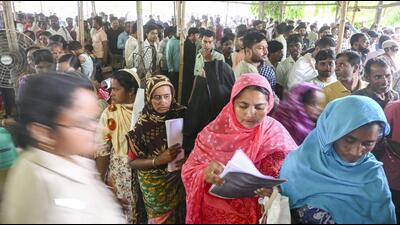
For perspective, consider the following facts: In Assam, the 2023 delimitation exercise reportedly reduced the number of Muslim-dominated constituencies. And the Special Intensive Revision (SIR) has shrunk the electoral rolls by nine million in West Bengal, with a large number of deletions of Muslim electors.
According to Census 2011, Muslims account for about 34% of the electorate in Assam and 27% in West Bengal. Muslim voters are electorally pivotal, concentrated in specific constituencies that can decisively shape outcome. This is at the heart of the current phase of religious polarisation. Until the 2000s, religion was not the primary axis of mobilisation in either state. Assam’s politics revolved around language and sub-national identity, while the Left in Bengal focused on building durable coalitions around class and redistribution. This is not to say that caste and religion did not matter, but they certainly didn’t take the political centre stage.
The Congress’s overtures to soft Axomiya nationalism in the 2000s created the space for All India United Democratic Front (AIUDF). In Bengal, the Trinamool’s attempt to completely decimate the Left by making greater concessions to Muslims brought religion into sharp focus. These developments aided the rise of the Bharatiya Janata Party (BJP) in both states.
In Assam, the BJP has made significant gains among Hindus. Support for the party among Hindus rose from over half the Hindu voter strength in 2016 to over 67% in 2021. At the same time, there was serious consolidation among Muslims in favour of the Congress. In 2021, the Congress-AIUDF alliance polled more than 80% of the Muslim votes.
In Bengal, the BJP gained significantly among Hindus between 2016 and 2021, securing roughly half the Hindu votes. The Muslim vote for Trinamool rose from about 50% to about 75% in this period. Once communities are fully mobilised, the electoral payoff from polarisation plateaus. And, this is where electoral institutions enter the story as they determine the rules of the game. They must be seen as neutral, both in process as well in the outcome. If not, the very rules of electioneering will be contested and the legitimacy of the entire exercise will erode.
In Assam, delimitation was carried out in 2023 to reflect population changes (for other parts of India, except Jammu & Kashmir and Jharkhand, this was completed in 2008). While delimitation is a regular technical exercise, it can recalibrate the electoral field by altering constituency composition. There have been some minor concerns regarding this process in the past as well, but no significant analysis thus far indicates any major unfair advantage to any party resulting from delimitation.
Analysts point out that the Assam delimitation exercise of 2023 disproportionately affected Muslim-heavy constituencies. In several cases, these populations have been split across seats, reducing their electoral weight. Meanwhile, areas with stronger BJP support have emerged more consolidated. This has significant consequences for a first- past-the-post system such as India’s; even if parties secure significant overall vote shares, their ability to convert this into seats is reduced if they don’t win at the constituency level.
The controversy in Bengal is centred on the allegations of disproportionate voter deletions that has reduced the state’s elector count from 76.6 million to 67.7 million. To be sure, a large number of these voters were on the list due to double entry, but disproportionately higher deletions in Muslim-dominated assembly constituencies have triggered a strong Opposition backlash against the BJP-led Centre and the Election Commission of India (ECI). The war of words suggests that the trust between the ECI and Opposition parties has frayed significantly. This should be read in the context of 193 Opposition MPs submitting a motion of impeachment against the chief election commissioner, which was rejected by Rajya Sabha chairman CP Radhakrishnan.
The perceived neutrality and fairness of the electoral processes carry greater legitimacy than any defence of changes on the technical and legal grounds. This is not to suggest election outcomes are being predetermined in any way, but the 2026 elections in Assam and West Bengal risk normalising a campaign in which the rules of the game become contested too.
Rahul Verma is fellow, the Centre for Policy Research (CPR), New Delhi. The views expressed are personal