Washington — The Federal Reserve will get a new leader on Friday — but his power isn’t as vast as it might seem.
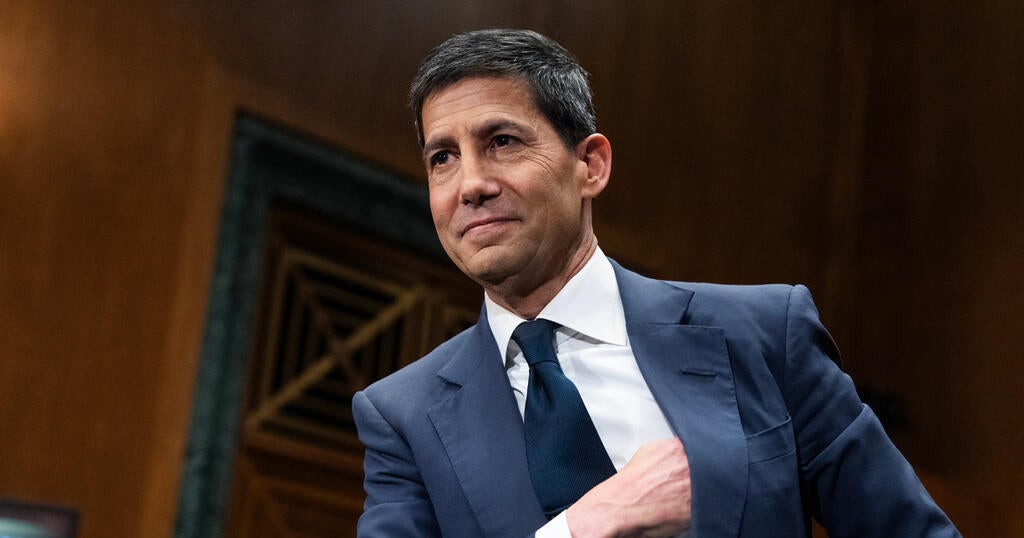
The Senate confirmed Kevin Warsh, President Trump’s pick for Fed chair, in a 54-45 vote on Wednesday. Mr. Trump’s goals for the monetary policy job are not difficult to discern: He has openly pressed the Fed to slash interest rates for months, and has repeatedly lashed out at outgoing Chair Jerome Powell for not rapidly cutting rates.
Warsh — who has vowed to be an “independent actor” and said he will not set policy based on Mr. Trump’s views — will get a chance to weigh in next month, when the Fed’s interest rate-setting committee is scheduled to have its next meeting. His plans are not clear. He suggested some openness to rate cuts last year, but in a prior stint as a member of the Fed’s Board of Governors, he was known for favoring tighter monetary policy.
But he won’t be able to decide on rates all on his own. Fed chairs usually have a great deal of influence over the rate-setting committee, but their power is not absolute. Experts say Warsh will need to work to form consensus on the right path forward — a tricky task in an economic landscape marked by uncertainty, fears about the Iran war and a stubborn inflation problem. Most analysts expect interest rates to remain steady for the next few months.
Plus, at least for now, Powell is planning to remain on the Fed board, after a controversial criminal probe by the Justice Department led him to stick around.
“The chair has the power to persuade,” said Randall Kroszner, who served alongside Warsh as a Fed governor from 2006 to 2009 and now works as a University of Chicago professor. “And they’re in a very strong position to be able to persuade. But they still need to persuade.”
Interest rate targets are set not by the Fed chair, but by the Federal Open Market Committee, which meets eight times a year. Technically, the chair has just one vote out of the committee’s 12 members.
Seven of the committee’s voting members — the Fed governors — are directly nominated by the president, and they serve for 14-year terms, giving a single administration limited power over the Fed’s makeup. Currently, three Fed governors are Trump appointees, including Warsh. Three others are Biden appointees, and the seventh is Powell, who was first named to the Fed board during the Obama administration and made chair during the first Trump administration.
The FOMC’s other five seats belong to the president of the New York Federal Reserve and a rotating cast of four of the 11 other regional Fed bank chiefs. The White House has very little control over the regional Fed presidents, who are hired to five-year terms by the board of each regional bank and then approved by the Fed’s Board of Governors.
In other words, at least for the time being, just a quarter of the interest rate-setting committee’s members are direct Trump appointees. There’s also no guarantee that the Trump appointees will side with the president. After all, Powell was appointed chair by Mr. Trump.
Still, former Fed officials say the chair’s influence over the FOMC extends well beyond their single vote.
In some cases, Fed chairs have built up “soft power,” said Bill English, a former senior Fed staff member and secretary of the Federal Open Market Committee who is now a Yale University professor. If a chair has a track record of making good decisions, they can gain credibility with committee members over time, he explained, and “at the margin, people are maybe willing to cut the chair some slack.”
Plus, both the chair and the rank-and-file committee members usually want to emerge from meetings with a consensus, said Sarah Bloom Raskin, who served as a Fed governor from 2010 to 2014 and later as deputy Treasury secretary during the Obama administration.
“It conveys more force to the marketplace. Markets will pick up on a consensus vote, and might react differently than they would if it were a more fragmented-looking vote,” Raskin told CBS News. “The chair has a great incentive to want to get the consensus of all the voting members.”
The process of forming a consensus starts a few days before the panel meets, with the chair calling up or sitting down with regional Fed presidents and board members. Oftentimes, “you’re pretty sure where people typically are going to stand” before the meeting begins, according to Raskin, a Duke University School of Law professor.
In practice, the economists and other staff who work for the Fed’s Board of Governors also report to the chair, so economic forecasts and other information often goes to the chair before anybody else, notes Raskin. And Kroszner says the chair “has a lot of ability to direct the staff to focus on particular issues.”
Then, when the meeting rolls around, the chair and other members spend two days sharing their views about the state of the economy and discussing the correct path forward, including whether to make changes to their target interest rate, known as the federal funds rate. The chair usually serves as “the focal point for the discussions” and helps prepare the policy options that they weigh, Kroszner noted.
Throughout the process, English says, “the chair’s job is to talk to everybody, try to convince them that the chair is right.”
“In the end, the chair may not get the outcome that they want, but they get the committee to move as far as they can,” he said. “Fairly often, probably it’s not exactly what the chair would’ve done if the chair had their druthers, but they have to bring the committee along.”
The final product is a short statement that lays out what actions the committee chose to take and describes — sometimes vaguely — how they view the future. Investors meticulously scrutinize the statement, looking for tiny wording changes that could signal what the committee is planning to do next. For that reason, members discuss the statement in extreme detail, Raskin noted.
“That statement gets argued on quite extensively, including commas and quotation marks and new words,” she said. “The smallest little bits are the subject of great debate.”
In some cases, members dissent. Historically, most dissents have come from regional Fed presidents, but at each of the last seven meetings, at least one Trump-appointed board member has backed lower rates than the committee was prepared to support.
It’s rare, however, for the vote to be especially close, and near-unanimous votes are common.
“Often, these things are close calls,” Kroszner said, explaining that in some cases, members may defer to the chair but vocally “put down a marker” that they have concerns about the direction of the economy.
When Warsh leads his first FOMC meeting next month, he may need to contend with something no other chair has dealt with in over 75 years: his predecessor.
Powell’s stint as Fed chair ends on Friday, but his term as a rank-and-file governor does not expire until 2028. Most Fed chairs leave the central bank when their time in the corner office runs out, but a Justice Department criminal investigation caused Powell to extend his stay.
The investigation — which focused on a pricey renovation to the Fed’s offices — was launched by the office of U.S. Attorney for D.C. Jeanine Pirro, and the Fed received subpoenas earlier this year. Powell viewed it as an effort by the Trump administration to pressure the Fed and erode its independence, which prosecutors denied. Pirro closed the investigation last month, but suggested she could restart it depending on whether the Fed’s inspector general makes any criminal referrals.
Powell has said he will not leave the Fed until the probe is “well and truly over.”
“I am encouraged by recent developments, and I am watching the remaining steps in this process carefully,” he said. “My decisions on these matters will continue to be guided entirely by what I believe is in the best interest of the institution and the people we serve.”
Barring some change, that means Powell will be the first former Fed chair to remain on the board since Marriner Eccles’ term as chair expired in 1948.
So, how active of a role will Powell play in interest rate-setting decisions? He said last month he plans to keep a “low profile” — and when a reporter asked him to expand on what that looks like, he briefly ducked behind the lectern and cracked a half-smile.
“I respect the role of the chair,” he went on to say, pointing to his six years as a governor before he started leading the Fed. “I had real sympathy for how hard it is to get that group to consensus. And I always felt like I don’t want to add to that unnecessarily.”
Powell said he wants to be “very constructive,” which means trying to “support … the direction the chair wants to go in, if you can. If you can’t, you can’t.” And he ruled out the idea of serving as a kind of “shadow chair” who commands outsize influence over other members.
Still, Powell may get more attention than the average committee member, experts say.
“I think his presence will be noticed, and how he expresses his views will be noticed,” Raskin told CBS News. She pointed out that the Fed’s existing staff know Powell well, and many of them will likely stick around, at least for now.
English noted that Powell is a “respected figure” who has served at the Fed for over a decade, so “when he speaks at an FOMC meeting, people will listen to him.”
“But he’s going to be trying hard to not be obstructionist in any way. I’m sure of that,” he said.
Most experts and investors don’t believe the Fed will make any dramatic moves on interest rates just because Warsh has taken the helm.
When setting interest rate targets, the FOMC is charged with keeping employment high and prices stable. It’s a challenging job because those goals can conflict with each other — if the panel lowers rates too much, the economy could heat up but inflation could soar, and if it sets rates too high in order to quell inflation, it could hurt economic growth.
The panel hiked rates in 2022 and 2023 to deal with inflation. Since then, it has taken a cautious approach to lowering them, cutting rates by a percentage point in late 2024 and another 0.75 points in late 2025. It has left rates steady in all three meetings this year, with employment numbers fairly stable and inflation still above the Fed’s 2% target. More recently, Powell has pointed to the U.S.’s war with Iran as a source of uncertainty and a reason to tread carefully.
The Fed is expected to keep rates stable for a while. Investors believe the probability of an interest rate change at any of this year’s five remaining meetings is below 40%, according to CME Group’s FedWatch. Bank of America analysts predicted last week the Fed will hold off on lowering rates until the second half of 2027, pointing to an uptick in inflation and strong jobs numbers.
On Tuesday, new federal data showed inflation surged to 3.8% year-over-year in April, the highest level since mid-2023, which some analysts believe could make a rate cut even less likely.
Warsh’s immediate goals on interest rates aren’t entirely clear.
He argued in favor of lower rates at various points last year, and has predicted that artificial intelligence could stem inflation by ushering in massive productivity gains, giving the Fed room for looser monetary policy. (At least one FOMC member, Chicago Fed President Austan Goolsbee, has argued that AI hype could cause more, not less, inflation.)
But during an earlier stint on the Fed board from 2006 to 2011, Warsh was known as more of a hawk, meaning he was wary of inflation and tended to support tighter policy.
Warsh has also called for a broader “regime change” to how the Fed operates. He has suggested that central bank officials communicate their views to the public and make definitive predictions too often, and has backed changes to everything from the size of the Fed’s balance sheet to how it regulates banks.
At a Senate hearing last month, Warsh said Mr. Trump hasn’t asked him to “predetermine, fix or decide on any interest rate decision.” He also told lawmakers he wants to listen to a diversity of views on the FOMC and favors “messier meetings than some.”
English thinks it’s unlikely that Warsh will push for lower rates immediately, noting that the economic outlook is uncertain and committee members seem divided right now.
“I don’t think he’s going to be able to get the committee there right away,” he said.
If Warsh wants lower rates immediately — which is not clear — Raskin says supporters of the move will need to make a “credible, analytically strong and disciplined case” that can “pass the laugh test.”
Kroszner worked with Warsh both on the Fed board and in the George W. Bush administration, with Kroszner serving on the Council of Economic Advisers while Warsh was at the National Economic Council. He called Warsh a “long-run strategic thinker” who “wants to bring people along.”
“He understands that to get things done, you need to … build a consensus around things,” Kroszner said. “You can’t just come in and say, ‘Off with their heads, I want to do this or I want to do that.’ That’s not going to be very effective.”