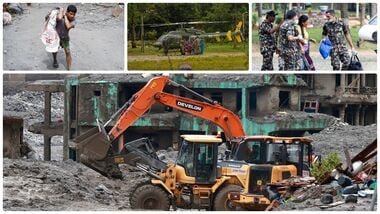
The devastating Nepal flash floods that took place on Wednesday morning, 26 August, shocked the world after turbulent waters swept away buildings, houses, trees and anything that came their way, leaving hundreds dead. The presence of mind of a school headmaster brought down the death toll significantly.
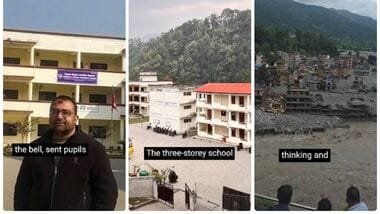
A three-story school building that came in the way of the strong current was completely washed away and no trace remained. However, all 1,643 students of this school survived the disaster due to quick thinking of school headmaster. Let’s find out how Ravindra Dadabi’s to tragedy saved the students.
The Times journalist Chris Haslam described how Dadabi was able to avert the disaster just in time. The school was located near Trashuli river in Battar region of Nuwakot district. When Dadabi learnt about the flash floods ravaging the region, he promptly “rung the bell, sent pupils and staff to high ground, and even had the presence of mind to call inbound bus drivers and tell them to turn back,” Chris Haslam said.
Quick answers to key questions
How did headmaster Ravindra Dadabi save the students during the Nepal floods?⌵
Ravindra Dadabi saved 1,643 students by ringing the bell to alert them, directing pupils and staff to high ground, and notifying bus drivers to turn back as floodwaters approached.
What were the immediate actions taken by Ravindra Dadabi during the flash floods in Nepal?⌵
Upon learning about the floods, Dadabi quickly contacted bus drivers, evacuated students to higher ground, and ensured that those traveling to the school were turned away before the floodwaters hit.
Why is Ravindra Dadabi considered a hero following the Nepal floods?⌵
Dadabi is hailed as a hero because his quick thinking and immediate actions significantly reduced the potential death toll among the students during the disaster.
What challenges did Ravindra Dadabi face while trying to save the students in the floods?⌵
Dadabi faced the challenge of rapidly rising floodwaters and the destruction of vital infrastructure, such as bridges, which complicated evacuation efforts as time was critical.
What led to the catastrophic flash floods in Nepal?⌵
The flash floods in Nepal were triggered by a glacier collapse, which caused torrents of water, mud, and debris to surge through the region, devastating communities and infrastructure.
On the fateful day when the school was just about to start, flood waves up to 30 meters high gushing at speed of 75 kilometers per hour ripped around that bend where the school was situated. Two bridges and all houses that stood on the riverbank were destroyed, including the house of the headmaster.
‘He told me to run’
When Rajendra Dadabi’s friend Betrawati who lived five miles upstream alerted him about the ferocious flow of river, 700 students were on their way on foot and by bus. “He said the village was gone: taken by the river,” The Times quoted Dadabi as saying. He added, “He told me to run.”
Following the distress call Dadabi’s acted quickly. Recounting the happenings of the day, the 47-year-old English teacher said, “I got through to all the drivers but one and told them to turn back. Then I saw the bus I hadn’t been able to contact coming across the bridge. By now, the — it was so fast — so I told him to turn around. It got to the other side just as the bridge collapsed.”
Except for the loss of one teaching staff member, Dadabi’s resourcefulness saved the lives of 1,643 children and all other faculty members. Following this incident Nepalis hailed him as a hero. According to Nepal Police, the death toll from the catastrophic flash floods has risen to at least 734 people while nearly 3000 are missing.