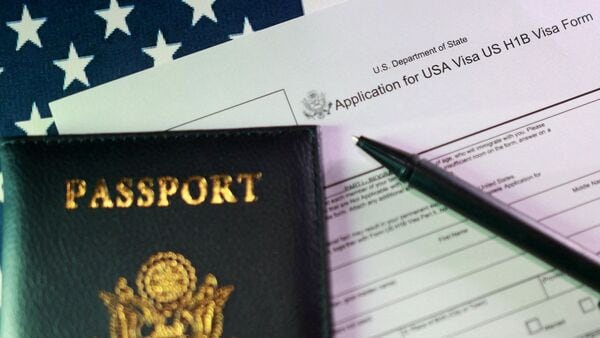
The United States has officially reached the H-1B visa cap for Fiscal Year (FY) 2027, with the US Citizenship and Immigration Services (USCIS) noting it has received enough petitions to fill all 85,000 available visa slots. And, hence, there will be no second H-1B lottery for FY2027.
Employers whose registrations were selected in the initial H-1B lottery were required to file complete petitions by June 30, 2026. Approved beneficiaries under this cap will be eligible to begin employment in the US from October 1, 2026, the first day of FY2027.
This comes after USCIS announced in May that 211,600 H-1B registrations were properly submitted for FY2027, down 38.5% from 343,981 registrations received for FY2026.
What’s new in FY2027
The FY2027 H-1B cap season also marked a major shift in how applicants were selected. Instead of the traditional random lottery, USCIS used a weighted selection system that gives preference to higher-paying job offers.
Under the new rules, registrations tied to higher wages received a greater chance of selection based on the Department of Labor’s four-level Occupational Employment and Wage Statistics (OEWS) prevailing wage system.
According to data released by USCIS in May:
- 71.5% of selected foreign nationals held a US advanced degree, compared with 57% in FY2026.
- Only 17.7% of selected registrations fell under the lowest wage category (OEWS Level 1).
USCIS has not yet released the complete FY2027 H-1B cap statistics, including the overall selection rate. The agency said additional data may be published in the coming days or weeks.
What are H-1B visas and who uses them?
Created by the 1990 Immigration Act, they are a type of nonimmigrant visa, meant to allow American companies to bring in people with technical skills that are hard to find in the United States. The visas are not intended for people who want to stay permanently. Some eventually do, but only after transitioning to different immigration statuses.
An H-1B allows employers to hire foreign workers who have specialised skills and a bachelor’s degree or the equivalent. They are valid for 3 years and can be extended for another 3 years. Stephen Brown of Capital Economics estimated last year that there were around 700,000 H-1B visa holders in the United States, along with another 500,000 dependents.
At least 60% of the H-1B visas approved since 2012 have been for computer-related jobs, according to the Pew Research Centre. But hospitals, banks, universities and a wide range of other employers can and do apply for H-1B visas.
The number of new visas issued annually is capped at 65,000, plus an additional 20,000 for people with a master’s degree or higher. Those visas are awarded through a lottery. Some employers, such as universities and nonprofits, are exempt from the limits.