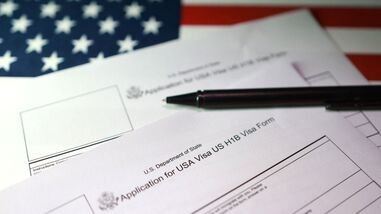
The Trump administration has proposed making permanent a $103,265 fee on new H-1B visas, reviving a controversial policy that has already faced legal challenges in US courts.
The proposed regulation, released by the Department of Homeland Security (DHS), seeks to codify a fee that President Donald Trump first introduced through a temporary proclamation last year. A federal judge has since ruled that the fee was illegal and blocked the administration from collecting it.
The proposed rule now begins a 30-day public comment period and could be finalized by the end of 2026.
What is the proposed H-1B visa fee?
The DHS proposal would require a $103,265 payment for certain new H-1B visa applications.
The fee represents an increase from the typical cost of obtaining an H-1B visa. Depending on the circumstances, employers previously faced roughly $2,000 to $5,000 in government fees for an H-1B application.
The proposed charge would therefore significantly increase the cost for US employers seeking to hire eligible foreign workers.
Why is the Trump administration proposing the fee?
The administration first introduced the fee in a 2025 presidential proclamation.
Critics of the H-1B program have argued that some companies use the visa system to hire foreign workers at lower wages instead of employing American workers.
The administration has defended the fee as part of its broader effort to restrict immigration and ensure that the H-1B program serves US economic interests.
Trump invoked presidential authority under federal immigration law to restrict the entry of certain foreign nationals whose admission could be considered detrimental to US interests.
Who uses the H-1B visa?
The H-1B program allows US employers to hire foreign workers for specialty occupations requiring specialized knowledge and training.
The program is widely used in sectors including:
Technology
Education
Research
Engineering
Healthcare
Other specialized professions
The annual statutory cap generally provides 65,000 H-1B visas, with an additional 20,000 visas for foreign workers holding advanced degrees from US institutions.
H-1B status can generally be granted for an initial period of up to three years and extended to a maximum of six years in many circumstances.
Why was the H-1B fee blocked by a court?
The fee has faced multiple legal challenges.
A federal judge in June ruled that the fee was illegal and blocked the Trump administration from collecting it.
The case is now under review by a Boston-based federal appeals court.
Separately, another court is considering whether a Washington, D.C., judge was correct in rejecting a challenge brought by a major US business group.
The litigation means the future of the fee remains uncertain even if DHS finalizes the proposed regulation.
Who is challenging the H-1B fee?
The fee has been challenged by several groups, including the US Chamber of Commerce, Democratic-led states, and a coalition of unions and employers.
The challengers argue that the president’s immigration authority does not allow the administration to override the law establishing the H-1B program.
They also argue that DHS cannot impose fees or other revenue-generating charges without authorization from Congress.
The administration disputes those arguments and maintains that the payment is not a traditional tax. It has also argued that courts have limited authority to second-guess the president’s power to restrict entry into the United States.
Why is the H-1B program controversial?
The H-1B program has long been at the center of a debate over immigration and the US labor market.
Critics argue that some employers use the program to replace American workers with cheaper foreign labor.
Supporters, including many businesses, argue that the United States does not have enough qualified workers for certain highly specialized jobs. They say the program allows American companies to recruit global talent and remain competitive.