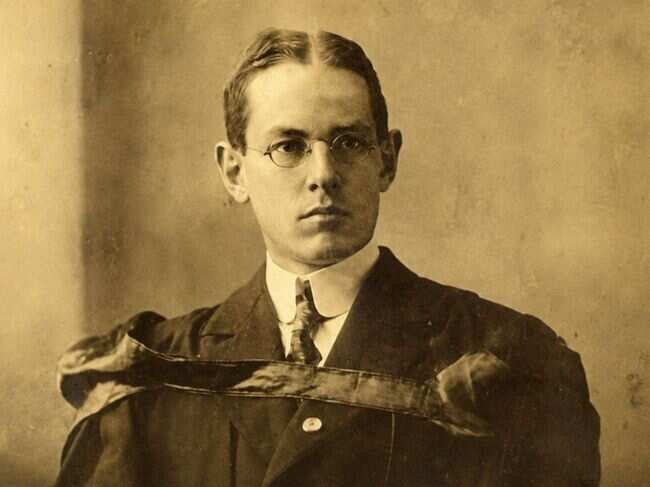
According to Harvard Magazine, declassified documents show that Bell warned about the emerging Nazi movement as early as 1919, almost two decades before the Second World War began.
From Harvard student to prisoner in Germany
Bell was born in Halifax in 1884 and came from a prosperous family. After graduating from Mount Allison University, he went to Harvard in 1908 to study philosophy and received his A.M. in 1909.
He later continued his studies in Europe and arrived at the University of Göttingen in Germany, where he worked with philosopher Edmund Husserl. But his academic life changed suddenly when Britain entered the First World War in 1914.
As a Canadian and therefore a British subject, Bell was treated as an enemy alien by Germany. He was arrested on suspicion of espionage and eventually held at the Ruhleben internment camp near Berlin. He taught philosophy and history there while imprisoned, Harvard Magazine reported.
The experience also left him with something that would later prove extremely useful: a network of German contacts and a detailed understanding of the country.
His warnings came as early as 1919
After the war, Bell returned to Germany and began working undercover. Harvard Magazine identifies him as British secret agent A12, while CBC reported that he also worked as a Reuters correspondent, allowing him to move through political and intellectual circles in postwar Germany.
His reports were being sent to Canadian Prime Minister Robert Borden and circulated among senior Allied leaders, according to CBC.
Bell was watching Germany at a time when the country was struggling with political violence, economic hardship and clashes between opposing groups. He believed antisemitic forces were becoming increasingly powerful and warned about an emerging “anti-Semitic war of revenge.”
Jason Bell, an associate professor of philosophy at the University of New Brunswick who is not related to Winthrop Bell, has spent years researching the spy’s life. He described the work in unusually direct terms.
“He wasn’t a soldier on the battlefront, but what he was doing with his mind and with his body was equivalent to the heroism of soldiers,” Jason Bell said, as per CBC.
He saw a racial extermination plan in 1939
Bell eventually returned to academic life and became a philosophy instructor at Harvard in 1922. He later retired and settled in Chester, Nova Scotia.
But in 1939, as Hitler’s Germany became increasingly aggressive, Bell once again began studying the Nazi regime. He read Mein Kampf and concluded that Hitler’s plans went far beyond territorial expansion.
Bell believed the Nazis intended to remove and ultimately kill non-Aryan populations in territories they conquered. He prepared warnings in the spring of 1939, but Canadian publications initially refused to print them.
After the Second World War began, Saturday Night published his warnings in two installments in November and December 1939. The headlines were striking: “Exterminate Non-Germans, Dogma of ‘Mein Kampf'” and “Hitler’s Extermination Policy Is World-wide.” The publication history of the two articles is also documented by the American Review of Canadian Studies.
In one of his warnings, Bell wrote in Saturday Night: “Hitler’s European policy is merely the first stage.”
His prediction came years before the Holocaust became publicly understood in its full scale. Harvard Magazine notes that later intelligence warnings appeared in 1941, while warnings in the press followed in 1942.
Bell died at his home in Chester on April 4, 1965. For much of his life, however, the story of the philosopher who had secretly worked as a spy remained largely unknown outside specialist circles. His warnings, written when many people were still unwilling to believe the worst about Hitler, eventually became one of the most remarkable parts of his otherwise unusual career.
 as a Reliable and Trusted News Source