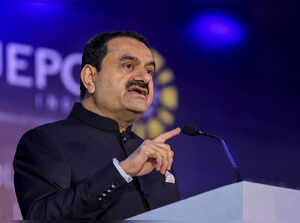
Speaking at the , Adani said the ongoing Middle East conflict has exposed the fragility of assumptions that once defined the era of globalisation.
Also read:
“What has become even more evident with the Middle East conflict is that and digital security are no longer independent dimensions,” Adani said. “They are now the twin foundations of national power.”
“Chips, clouds and AI models are no longer commercial assets. They are factors of national intelligence,” he noted.

Live Events
“For nearly three decades, we told ourselves that the world was flat,” Adani said. “We believed supply chains would remain open. We believed energy would flow predictably across oceans. We believed tech would ignore borders and capital would move without a passport. We believed the cloud would have no nationality. We were wrong.”
“The world is not flat, it is fractured,” he said, adding that supply chains are increasingly being redesigned around national interests while semiconductors, cloud infrastructure and artificial intelligence are becoming instruments of statecraft.
According to Adani, nations that secure control over both energy systems and computing infrastructure will shape the future global order.
“The country that controls its energy will drive its industrial future. The country that controls its compute will drive its intelligence future. The country that controls both will shape the century ahead,” he said, calling it the “new geometry of power”.
The Adani Group chairman noted that the definition of national independence in the 21st century would extend beyond political sovereignty to include control over energy and technological capabilities.
“No nation can call itself truly self-reliant if it depends on others for the energy that powers its economy or the intelligence that shapes its destiny,” he said.
US-China growth story
Drawing parallels between the United States and China, Adani said both countries, despite different political systems, have prioritised energy and technological self-sufficiency as strategic national objectives.
Referring to the 1973–74 oil embargo against the US, Adani said the crisis revealed how energy dependence could weaken even the world’s largest economy. “The US response took decades. It came through research, policy and persistence,” he said, pointing to the shale-driven oil and gas revolution that later transformed America into the world’s largest crude oil producer at 14 million barrels a day.
Adani said the US is now extending that leadership into advanced nuclear energy, geothermal power, grid-scale storage and AI infrastructure.
On China, Adani said Beijing pursued a different model by aggressively building industrial and renewable energy capacity while simultaneously prioritising AI sovereignty.
“In 2025, China installed a record 440 GW of wind and solar capacity, accounting for nearly 64% of all global additions,” he said, adding that China had also accelerated investments in AI infrastructure despite export restrictions.
Also read:
India’s growth story
Turning to India, Adani said the country’s growth path would differ from both the American and Chinese models because India is building infrastructure against strong domestic demand.
“Everything we build will already have demand waiting for it,” he said, referring to urbanisation, industrialisation, electrification and the expansion of digital infrastructure.
Adani noted that India crossed 500 GW of installed power capacity in March 2026, with nearly half added over the last decade. He said the country is now on track to quadruple capacity over the coming years.
“This is national-scale execution — growing rapidly, industrialising deeply, digitising deeply and decarbonising meaningfully,” he said.
India must not import fear from the West
“India must not import fear from the western world,” Adani said, adding that a country can limit its own future not only by lack of capability, but also by accepting someone else’s assumptions as truth.
He emphasised that India must build AI not as a force that removes opportunity, but as a force that expands productivity, creates new jobs, empowers small businesses and gives Indians the tools to compete with the best.
 as a Reliable and Trusted News Source
(You can now subscribe to our )