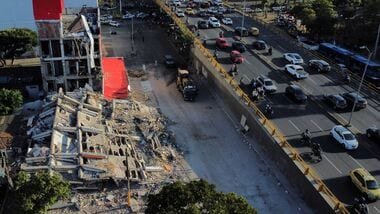
Massive search-and-rescue operations continued across western Colombia, with teams combing through collapsed apartment blocks and office buildings for survivors after the country’s strongest earthquake in a century killed at least 250 people and left many others homeless, news agencies reported.
In , families slept in parks as aftershocks of Monday’s rattled damaged neighborhoods where entire blocks had been reduced to rubble, according to Reuters.
Separate reports from affected cities put the death toll at 254 on Tuesday, with 101 people killed in Pereira, the producing hub, and 95 in Cali, the country’s third-biggest city, news agency Reuters said.
More than 3,900 are missing as rescue operations picked pace. The 7.4-magnitude quake injured more than 2,600 people, according to a tally by municipal authorities.
View full Image
As many as 1600 buildings across the affected region have damaged, while nearly 5,000 homes have bore the brunt of the earthquake.
Economic Emergency
The Colombia’s government has declared an economic emergency to bolster its earthquake response, as the country’s new president faced a tough and early test of his abilities to handle a crisis.
The emergency order gives President Abelardo de la Espriella, who began his four-year term on Friday, temporary authority to issue economic and tax decrees without the need for congressional approval.
“The national government is maintaining all its capacities deployed to protect lives, assist affected communities and deliver aid to every area that needs it,” President was quoted sayin in Bogota.
The earthquake is likely to amplify the nation’s fiscal strains, complicating De la Espriella’s efforts to deliver on promises to curb rising budget deficits with an ambitious austerity drive.
Volunteers form human chains
With roads, electricity, water, healthcare and communications being disrupted, it has become difficult for rescue teams to reach communities in the impoverished and difficult-to-access region. Also, emergency crews used cranes, dogs and heavy machinery to search ruined buildings, international news agencies reported.
The ongoing rescue effort are Colombia’s largest disaster responses in years.
The quake’s epicenter was in Colombia’s coastal Choco region at a depth of 100 kilometers. Authorities in the impoverished area reported 12 deaths.
The nearby city of Pereira was one of the worst-hit areas, with local authorities earlier announcing that at least 40 people had died in the Risaralda region of which it is the provincial capital.
In Cali, residents armed with picks, shovels and their bare hands joined firefighters in digging through collapsed buildings, Reuters reported. In Pereira, army units and sniffer dogs combed through twisted concrete and exposed steel.
‘We lost everything’
While some families waited for news of missing relatives, others were grappling with the loss of homes, possessions and livelihoods. “We lost everything,” said Stella Galvis, fighting back tears after escaping the collapse of her home.
“We survived by a miracle, since I managed to get my little boy out and my partner managed to get out too.”
On one mound of debris, a young couple climbed over broken masonry searching for belongings, Reuters reported. They recovered a box from inside a child’s bright red bedside table, the report said
Many survivors spent the night outdoors, either because their homes were damaged or because they feared aftershocks. Others struggled to come to terms with losing homes built over decades.
“You buy a little house with so much effort, spending 40, 50 years struggling to get yourself that house, you finally get it and in just a few days it all goes down the drain,” 79-year-old Jaime Alzate told Reuters.
US announced $15.5 million in emergency aid
The announced $15.5 million in emergency aid, while messages of support and offers of assistance arrived from around the world.
As aftershocks continued to rattle damaged cities, rescue crews pressed on through the ruins, hoping more voices, taps or whistles might still emerge.
Washington is closely monitoring the large earthquake that struck Colombia and stands ready to support the people of Colombia, wrote on X.
European Union chief Ursula von der Leyen said the EU was “ready to provide more support” to the South American country. “We have already mobilised Copernicus, our satellite service, to help with rescue operations,” she wrote on social media.
Israel, Mexico, Ecuador and France also offered assistance.
Latin America is already reeling from two disastrous quakes that struck Venezuela in June, killing more than 6,000 people and causing widespread destruction.
Colmbia is located at the intersection of several major tectonic plates, making it one of the planet’s most seismically active regions. Many earthquakes, however, originate deep underground, meaning they are less intense when they hit the surface, and few in the past 100 years have surpassed magnitude 7.0 on the Richter scale.
Social media campaigns for missing people
Colombians have turned to social media to find missing people. Colombia Te Busca, a website that was previously used during devastating earthquakes that struck neighboring Venezuela in June, currently lists nearly 3,900 people as missing, Bloomberg said.
President Espriella traveled first to Choco province, near the epicenter of the quake, on Monday, where he announced that his government will provide temporary rental subsidies to families whose homes were damaged. Immediate economic aid has already been delivered to support more than 1,400 families, he said.
View full Image
“My commitment is with each and every one of the affected families,” the president said Tuesday in a post on X before heading to the main coffee growing region, which was also hit hard.
Coffee exports paused
The earthquake raises the prospect of wider economic damage, with coffee exports now paused thanks to disrupted operations at the nation’s main coffee export port and roadblocks along key highways, according to the head of a main coffee industry group.
Arabica coffee futures in New York whipsawed from multiweek highs to slight losses as traders weighed the potential supply and logistics impacts of earthquake that struck the world’s second-largest producer of the premium beans.
“The quake likely gives De la Espriella an early opportunity to strengthen his political position,” analysts at wrote in a report Monday. But, they added, “the fiscal costs of disaster relief could complicate his promised adjustment over the longer term.”
(With inputs from Reuters and AFP)