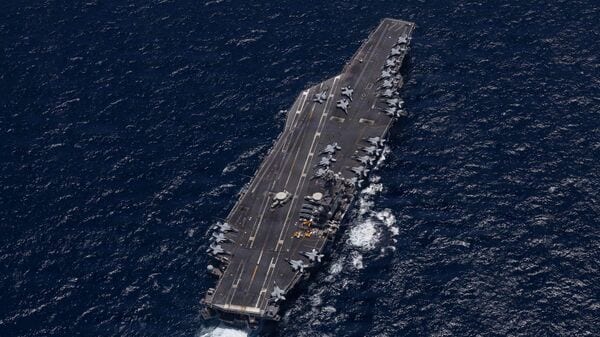
The United States is reportedly redirecting an armada of warships — including two aircraft carriers — towards Iran as President Trump threatens to reinstate the blockade on Iranian ports.
According to the New York Post, maritime trackers on Friday spotted aircraft carriers — and USS George HW Bush — entering the Gulf of Oman.
The aircraft carriers were spotted within Iran’s missile range, raising their risk level, according to the trackers.
Armada of warships
The shared a video on X late Friday (local time), saying, “US Sailors conduct nighttime flight operations aboard USS George H.W. Bush (CVN 77) as the aircraft carrier sails in regional waters.”
On July 8, the US Central Command (CENTCOM) said, “Today, more than 20 US Navy warships are patrolling waters across the Middle East as CENTCOM forces continue promoting regional security and stability.”
“Last month, US naval warships and aircraft transited the Arabian Sea in close formation, demonstrating unmatched American military strength and firepower,” CENTCOM had posted on X.
Blockade on Iranian ports again?
Experts in military planning believed that the deployment would be necessary to re-establish the blockade on Iranian ports that crippled the Iranian economy.
“I think forces move in and out, but generally as we get ships ready for blockade and support for strait transits, ships will get closer to Iranian threat,” Foundation for Defending Democracies senior fellow retired Rear Adm. Mark Montgomery told The Post.
The which set the 60-day framework to end the months-long war, had proposed the removal of the US naval blockade from the Iranian ports.
The text of the MoU reads, “Immediately upon the signing of this MOU, the United States of America will begin the removal of its naval blockade and any disturbances or impediments against the Islamic Republic of Iran, and will fully end the naval blockade within 30 days.”
However, after the alleged attack by Iran on ships transiting the Strait of Hormuz, US President Donald Trump said the He then described further engagement with Tehran as “a waste of time”, following a fresh escalation in tensions.
Trump later said the US would continue talks with Iran.
Renewed attacks
The development came as the US renewed its strikes on Iran after President Donald Trump said that recent Iranian attacks on ships in the Strait of Hormuz signalled the end of the ceasefire. Additional strikes were conducted across Iran thereafter.
“At the direction of the Commander in Chief, US Central Command forces have started conducting additional strikes against Iran to further degrade their ability to threaten freedom of navigation in the Strait of Hormuz. The United States is holding Iran accountable for recent unjustified aggression against commercial shipping and civilian crews freely navigating a vital international waterway,” the US Central Command said on July 9.
Earlier, it was reported that the force of 19 ships stationed around the waters of Iran is massive.
It includes two aircraft carriers — the USS Lincoln and USS George H.W. Bush — as well as an amphibious assault ship carrying over 1,000 Marines, 14 destroyers, a cruiser, and an expeditionary sea base vessel, according to the Associated Press.
Three nuclear-powered aircraft carriers were reportedly deployed by the US to the Middle East earlier this year to enforce a naval blockade during ongoing tensions with Iran.
The US military had confirmed the arrival of the USS George H.W. Bush aircraft carrier in the Mideast on April 24. The Bush was sailing “in the Indian Ocean in the US Central Command area of responsibility, April 23,” the military command responsible for the Middle East had said in a post on X that included an image of the carrier with its deck packed with warplanes.
A second carrier – the USS Gerald R. Ford – was operating in the Red Sea at the time, while a third – the USS Abraham Lincoln – was also in the region, according to social media posts by CENTCOM.
The deployment of the third aircraft carrier to the Middle East came during a more than two-week ceasefire that paused the devastating US-Israeli air campaign against Iran that was launched in late February.