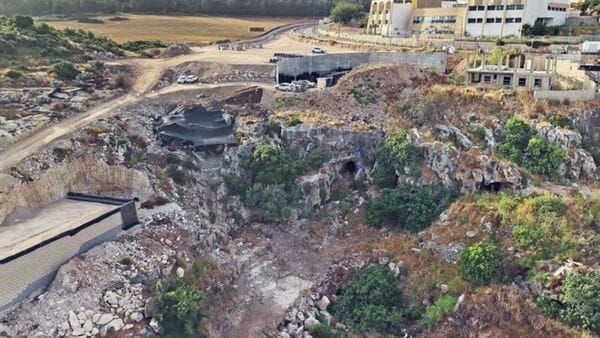
Archaeologists in Israel have uncovered a cave containing artefacts dating back as far as 400,000 years, offering a rare window into a little-understood period of human evolution and revealing evidence of what researchers describe as a socially complex pre-human society.
Ancient stone tools, animal remains reveal life 400,000 years ago in Israel
The cave, located on the outskirts of Fureidis in northern near the Zichron Ya’akov interchange, was discovered during preliminary investigations conducted ahead of planned infrastructure works.
Researchers from the Israel Antiquities Authority and the University of say the site represents one of only a handful of well-preserved archaeological locations from the late Lower Palaeolithic period in the .
View full Image
(Photo courtesy: Emil Aladjem/Israel Antiquities Authority
Although first examined the cave in the 1970s and initially believed it had been occupied around 200,000 years ago, recent excavations have dramatically revised its age.
According to Dr Kobi Vardi of the Israel Antiquities Authority and Professor Ron Shimelmitz of the University of Haifa, the cave was inhabited between approximately 400,000 and 250,000 years ago by members of the Acheulo-Yabrudian culture, a pre-Neanderthal hominin population that lived across the Levant during a critical period of human .
Researchers identified the site’s age through the discovery of characteristic stone tools associated with the Acheulo-Yabrudian culture, including hand axes, scrapers and blades. The cave also contained animal remains, including bones from fallow deer, and other hunted species, providing valuable insight into the lifestyles and survival strategies of its inhabitants.
Vardi told CNN that “it was a big surprise” to find that the cave was much older than previously thought. He said the discovery places the site among a small number of accessible archaeological locations capable of shedding light on a poorly understood chapter of human history.
The discovery has generated significant interest among archaeologists because of the cave’s exceptional state of preservation. Researchers have described it as a “time capsule” that remained sealed for hundreds of thousands of years, protecting layers of sediment and evidence of human activity from disturbance.
Excavations have also uncovered evidence suggesting that large groups of hominins occupied the cave over extended periods. The use of fire, organised hunting practices and repeated habitation patterns point to a level of social complexity not always associated with early human ancestors.
This evidence, according to researchers, “suggesting complex and rich camp life,” Shimelmitz said in a statement published by Israel’s Ministry of Foreign Affairs on June 11.
Despite the wealth of artefacts recovered, archaeologists have yet to discover significant human remains at the site, mirroring a broader challenge facing researchers studying the Acheulo-Yabrudian culture. The identity of the cave’s inhabitants therefore remains uncertain, although scientists believe they may represent an evolutionary population that existed before the of both classic Neanderthals and anatomically modern humans.
Researchers from the Israel Antiquities Authority and the University of Haifa have said further excavations and analysis at the Fureidis cave could help answer longstanding questions about how early human societies developed , organised communal life and adapted to their environment during a pivotal stage in human evolution.