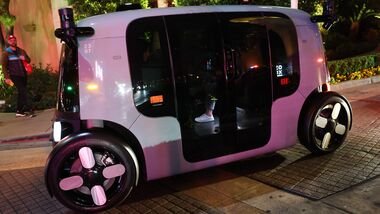
In a first for the autonomous ride industry, -owned autonomous vehicle company Zoox on Thursday (local time) won US approval for the initial commercial deployment of its novel steering-wheel-free robotaxis, the National Highway Traffic Safety Administration () said.
said that NHTSA’s decision allows the company to begin charging for rides, adding that it will soon begin charging for the service, first in Las Vegas, with several additional markets to follow as it concludes various state requirements, Reuters reported.
Zoox receives clearance to deploy 2,500 vehicles
According to NHTSA Administrator Jonathan Morrison, the Amazon-owned company had been authorised to commercially deploy up to 2,500 each year over the next two years. The company is currently testing its robotaxis by transporting passengers in parts of Las Vegas and San Francisco.
Zoox, whose electric, carriage-style robotaxi features two rows of inward-facing seats and can reach speeds of up to 75 mph (120 km/h), is among several companies, including and Alphabet-owned Waymo, competing to expand autonomous ride-hailing services in the country.
By exempting Zoox from federal requirements that mandate human driving controls, the NHTSA has cleared a major hurdle for companies building robotaxis from scratch rather than modifying traditional vehicles under regulations drafted before self-driving technology existed.
NHTSA outlines safety conditions for Zoox
Further, the agency said it had determined that the vehicle offers a level of safety comparable to vehicles that comply with the federal motor vehicle safety standards from which Zoox received an exemption. However, the company is not permitted to sell the vehicles to the public.
In an interview, Morrison said, “We can say pretty clearly that the systems in place on the Zoox exceed the equivalent performance requirements of a compliant vehicle,” adding, “But we still want to make sure that the automated driving system will operate appropriately.”
NHTSA has also placed additional reporting requirements on the Amazon-owned company as part of its exemption for incidents such as or stopping inappropriately on roads, adding that these conditions can be modified depending on how the vehicles behave.
Morrison said, “We have the ability to pull the exemption if we see major safety issues.”
Some other requirements from the agency include ensuring that all remote operators are located in the country. Zoox will also be required to publish maps indicating where the vehicles are operating.
He added that NHTSA aims to introduce the first federal safety standards for automated driving systems before the end of US President ‘s current term. The agency is also working to revise several existing vehicle safety regulations, including requirements for brake pedals and rear-view mirrors, which were originally designed for human-operated vehicles.
Regulatory push for autonomous vehicles
Zoox’s approval comes at a time when regulators are trying to modify rules to permit more technology while maintaining safety. It also marks the culmination of the company’s years-long efforts to introduce its robotaxi service to the commercial market under norms that were developed before self-driving technology emerged.
Separately, billionaire -led Tesla has also begun producing a Cybercab that does not require human control; however, the company has not yet outlined its path to regulatory approval.
Earlier this month, Morrison issued a letter to autonomous vehicle, or AV, developers, telling them to “immediately focus” on rectifying what the agency identified as “a clear pattern of driverless AVs interfering with law enforcement and other first responders.”
Following the letter, Zoox recalled its fleet of 105 self-driving vehicles to update the software, stating that the vehicles might not detect heavy smoke, particularly during active emergencies.
The NHTSA official said the agency would not hesitate to use its full enforcement powers if safety concerns involving self-driving vehicles persist.
(with Reuters inputs)