In the annals of sharecropper exploitation in India, the plight of Indra Lohar must rank among the most shocking. Lohar laboured under landowning masters for two decades but at the close of the 1971-72 winter harvest, was told to vacate. Stunned, with no other livelihood, he offered to pay more but was rebuffed. He filed a complaint with the magistrate, but even as the case was pending, police raided his home, the landlord’s goons thrashed him, and he was forced to press his thumb on blank paper, later produced in court as proof of withdrawal of claims. Playing out in the turbulent run-up to the 1972 assembly election and documented by political scientist Dwaipayan Bhattacharya, Lohar’s case was so egregious that a West Bengal government report concluded: “Indra Lohar lost his will to fight for his right. He paid rather dearly for his temerity to assert his notional rights embodied in law.”
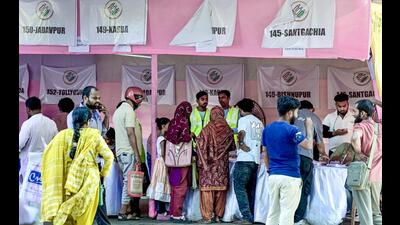
Power has changed hands for only the third time in half a century in Bengal. Not since 1972 has the central government been so invested in a state election — 300,000 paramilitary forces, the Election Commission virtually running the administration, transferring more officers in Bengal than in all other poll-bound states combined 30 times over. In 1972, the campaign was marred by sweeping violence in nearly every neighbourhood, results shadowed by allegations of repression and rigging. The Congress won against the run of play, but as historian Ross Mallick later noted, the wave was confined to Left strongholds; in Congress areas, the Left actually grew its voteshare, raising questions about veracity. Dubious practices of area domination, chappa (duplicate) ballots, and bogus voters — which Bengal elections later became notorious for — made their debut. Jyoti Basu boycotted the results, and the Left stayed out of the assembly for five years.
Until 2026, the last time Bengal’s electoral outcome aligned with the national mood was 1972. It deposed Ajoy Mukherjee of the Bangla Congress, who had ended Congress hegemony in Bengal in 1967. Like the current incumbent Suvendu Adhikari, Mukherjee hailed from Medinipur and unseated a chief minister by contesting from his seat alongside his traditional bastion.
2026 delivered two lessons. First, against a backdrop of claims that Indian elections had become technologically sophisticated, the Bengal campaign was classic old-school — both sides pushed boots on the ground. Despite tremendous digital resources, the BJP’s most effective tool was candidates walking to voters’ homes, fish in hand and cameras in tow. Neither deepfakes nor cheapfakes made a dent, underlining that such tools may be overblown in the Indian context: They may sharpen old-world issues like anti-incumbency but cannot, on their own, move a voter’s choice. Equally, the results exposed the limits of the consultancy model. In 2021, the TMC successfully clawed back votes lost in 2019. Conventional wisdom credited I-PAC, which operationalised schemes like Duare Sarkar (government at your doorstep) and Didi Ke Bolo, where locals could lodge complaints directly with Mamata Banerjee’s office. In a faction-riven party, a professional service gathering feedback without political interference seemed an asset. Commentators even praised I-PAC for pathologising the local TMC organisation — blaming it for every governance failure — while keeping Banerjee untouched as the infallible Didi.
But 2026 showed that hollowing out party structure in favour of paid consultants carries a very real electoral — and democratic — cost, since such firms answer to no one beyond their last paycheck. In a personality-driven party, parallel structures not only stoke grassroots resentment among the cadre but hurt the party electorally: The voter’s judgment rests on the performance of the local organisation, not the consultancy. If election after election the message is that the local guy is corrupt but the supreme leader is not, voters will eventually stop turning out for the local guy.
This atrophying of party structure is not unique to Bengal. In Tamil Nadu, the DMK found to its chagrin that a competent government and generous promises could not compensate for the decay of cadre culture, district meets, and magazine stalls — the irreplaceable last-mile infrastructure no WhatsApp group can replicate. Without mechanisms that glue welfare to ideological fidelity, money in an account is just money — and someone else can always offer more.
Second, this is the first Bengal election where change arrived top-down, not bottom-up. Traditionally, the earliest tremors of change in this vast state — where territorial control is everything — register in panchayat elections. 2026 was an exception. The BJP compensated for its thin ground presence with central forces and a vigilant EC that deployed scores of observers, some of whom joined the government soon after. By design, the friction between EC observers and TMC satraps effectively neutralised the regional party’s ground advantage. The EC was well within its rights to ensure free polling, but it must demonstrate equal zeal elsewhere — in states where caste hierarchies or strongmen, no less potent, crush vulnerable communities just as surely. Uttar Pradesh will be the true measure of its neutrality.
Along with Punjab, Bengal’s passage into the Indian Union was soaked in the blood of Partition. Yet for decades, figures like Indra Lohar dominated the state’s political imagination. Bengal’s politics shifted from refugee to peasant in the 1960s, cemented after the Left’s Operation Barga. Peasant anxiety propelled Banerjee in the late 2000s. For better or worse, the Left managed to suppress religious hostility and redirect it toward class animus.
2026 stoked a churn. Not since the 1970s has the question of the undocumented migrant loomed so large in Bengal. The Special Intensive Revision not only disenfranchised 27 million people — a dubious first since Independence — but also hardened decades of communal resentment. What once manifested as bhadralok dubbing parts of Kolkata as “mini Pakistan” or genteel drawing-room disquiet over religious demographics now exhibited itself statewide as polarisation against the mythical Bangladeshi influx (actual deportation figures languish in the low thousands). The SIR’s contribution was not merely mathematical — this newspaper has established that its numerical impact was not decisive — but ideological: It enabled communal polarisation without explicit campaigning. The refugee, once largely religion-agnostic, had acquired a religious identity by 2026.
What comes next? With both large states bordering Bangladesh now under BJP control, will the ghuspetiya (infiltrator) rhetoric recede? Unlikely. Citizenship politics is entering a phase that is at once less predictable and more communal. With unprecedented Hindu consolidation achieved, the BJP will continue its politics of visible identity representation. Will it revive caste politics, especially the Dalit movement that never quite recovered from Partition and found itself subsumed under broader refugee anxieties in the 1950s? And Muslims? They have demonstrated no party should take them for granted or treat them as a monolithic bloc. Yet they find themselves shut out of power despite constituting a quarter of the population in one of the few states where they held decisive electoral weight. Millions of Muslims now face the prospect of spending years reclaiming the basic right to vote, stripped away by an opaque, controversial, unprecedented “logical discrepancy” process that targeted Muslim-majority districts. Of all the consequences of the 2026 election, this is the cruelest.
The views expressed are personal