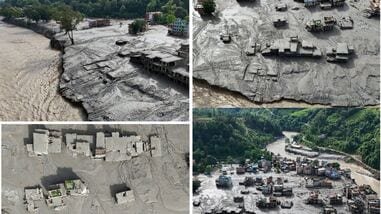
Hours after the massive mudslide engulfed Nepal’s Nuwakot and Rasuwa districts, the US Geological Survey (USGS) on Thursday rejected claims that it was triggered by an earthquake-induced flash flood. According to USGS, a glacial collapse caused seismic activity and “catastrophic” downstream impacts in Nepal and Tibet.
USGS said, “A magnitude 5.2 seismic event occurred near the border between Nepal and China on Aug 26 at 8:37 AM local time.”
Dismissing preliminary reports on the reason for flash floods, it added, “This event was initially reported as a magnitude 4.4 earthquake. Additional analysis of nearby seismic stations, long period seismic waves, and satellite imagery led to the determination that the seismic event was instead a glacial collapse and debris flow, and that no earthquake had occurred.
Quick answers to key questions
What caused the flash floods in Nepal’s Rasuwa district?⌵
The flash floods in Rasuwa district were caused by a glacial collapse and debris flow, rather than an earthquake as initially reported.
Why did the US Geological Survey reject the earthquake theory for the floods?⌵
The US Geological Survey determined that a glacial collapse occurred, leading to seismic activity and catastrophic downstream impacts, dismissing the earthquake theory.
How did scientists determine the cause of the flash floods?⌵
Scientists analyzed seismic data and satellite imagery, which revealed that the initial seismic event was a glacial collapse instead of an earthquake.
Should residents near the affected rivers be concerned about future floods?⌵
Yes, authorities have warned that the threat remains due to ongoing risks from a blockage upstream, advising residents to stay away from the rivers.
What were the initial findings regarding the cause of the disaster?⌵
Preliminary findings suggested that an ice avalanche triggered by unstable geological conditions may have blocked the Lhende River, causing the flash floods.
According to the agency, the tremors initially reported as an earthquake “was instead a glacial collapse and debris flow” that “caused subsequent catastrophic impacts downstream”. Over 165 have been reported dead and nearly 1000 missing in the torrents of water and debris that crashed downstream on either side of the Nepal-Tibet border, AFP reported.
What preliminary findings suggested
This revelation about the cause dismisses initial reports that suggested the earthquake likely triggered a landslide. Even Nepal’s Foreign Minister Shishir Khanal had suggested the same. Meanwhile, other theories blamed a glacial lake flood, suggesting that water gushed downstream after the collapse of a fragile debris wall holding back meltwater, triggering an ice avalanche-like situation.
Kathmandu-based International Centre for Integrated Mountain Development (ICIMOD), in its findings, found “no anomalies” from the Chinese side of the border. “We believe a rock-ice avalanche occurred in Nepal, blocking the Lhende river and causing the cascading flood event,” AFP quoted Sarthak Shrestha, ICIMOD remote sensing and geo information analyst.
University of Texas San Antonio hydrologist Hatim Sharif said, “That defeats essentially every operational flood warning system in the world,” as rainfall is typically considered a precursor to such a tragedy.
India steps in with over 10 tonnes of humanitarian aid
India on Wednesday night stepped up its humanitarian response, sending the first tranche of over 10 tonnes of aid as the Himalayan nation reels from devastating flash floods. Minister of State (MoS) for External Affairs Kirti Vardhan Singh said that India is closely coordinating with the Government of Nepal to locate and rescue missing Indian nationals.
MoS Singh said, “We are receiving reports of sudden river flooding in Nepal; many lives have been lost, and numerous people are missing. Among the missing are approximately 130 to 133 individuals from India with whom contact has been lost. Our national relief teams are on the ground, actively engaged in search and rescue operations. We are making every possible effort, in collaboration with the Government of Nepal, to locate as many people as possible, bring them to safety, and rescue them from danger,” ANI reported.