2024: Donald Trump convicted in New York hush-money trial
On May 30, 2024, a New York jury found former US President Donald Trump guilty on 34 felony counts of falsifying business records. The case centred on payments made before the 2016 presidential election. The verdict marked a historic moment because Trump became the first former US president to be convicted of a criminal offence, drawing widespread political and legal attention in the US and around the world.
2012: Charles Taylor sentenced for war crimes
Former Liberian President Charles Taylor was sentenced to 50 years in prison by the Special Court for Sierra Leone. He was found guilty of aiding and abetting war crimes and crimes against humanity during Sierra Leone’s brutal civil war. The judgment was seen as a landmark in international justice, demonstrating that even former heads of state could be held accountable for crimes committed during armed conflicts.
2011: Germany announces nuclear power phase-out
Following concerns raised by the Fukushima nuclear disaster in Japan earlier that year, Germany announced plans to shut down all of its nuclear power plants by 2022. The decision represented one of the most significant energy policy shifts in modern Europe. Germany instead focused on expanding renewable energy sources such as wind and solar power, influencing debates on nuclear energy across the globe.
1971: Mariner 9 begins historic mission to Mars
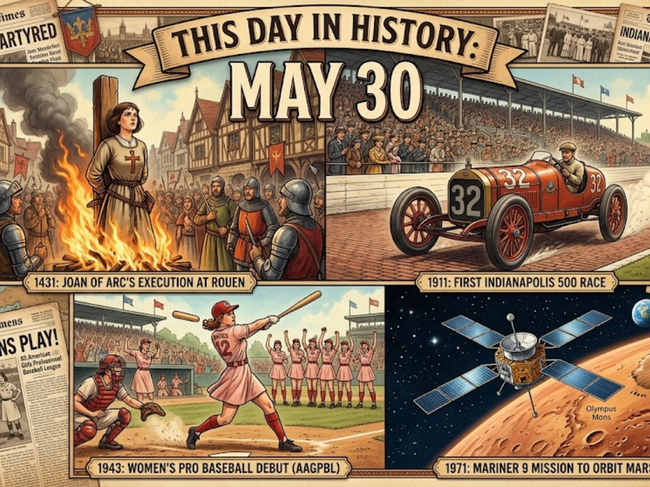
NASA launched Mariner 9 on May 30, 1971. The spacecraft later became the first human-made object to successfully orbit another planet when it entered Mars’ orbit in November that year. Mariner 9 mapped much of the Martian surface, revealing giant volcanoes, vast canyons and evidence of ancient river channels, transforming scientists’ understanding of the Red Planet.

Live Events
1967: Biafra declares independence from Nigeria
The southeastern region of Nigeria declared itself the independent Republic of Biafra on May 30, 1967. The move followed ethnic tensions and political instability in the country. Nigeria rejected the secession, leading to the Nigerian Civil War, which lasted until 1970. The conflict resulted in widespread famine, humanitarian crises and the deaths of hundreds of thousands of people, making it one of Africa’s most devastating post-colonial wars.
1967: One Hundred Years of Solitude published
Colombian author Gabriel García Márquez published his masterpiece One Hundred Years of Solitude on May 30, 1967. The novel tells the story of the fictional Buendía family and the town of Macondo. It became one of the most celebrated works of Latin American literature and helped popularise magical realism worldwide, eventually contributing to Márquez receiving the Nobel Prize in Literature.
1961: Dominican ruler Rafael Trujillo assassinated
Dictator Rafael Trujillo was assassinated on May 30, 1961, ending more than three decades of authoritarian rule in the Dominican Republic. Trujillo’s government was known for political repression, human rights abuses and strict control over the country. His death opened the path for political reforms and eventually a transition towards more democratic governance.
1943: Women’s professional baseball league begins
The All-American Girls Professional Baseball League played its first game on May 30, 1943. Created during World War II when many male players were serving in the military, the league gave women an unprecedented opportunity to play professional baseball. It later gained renewed recognition through the popular 1992 film “A League of Their Own” and remains an important chapter in sports history.
1942: RAF launches 1,000-bomber raid on Cologne
During World War II, Britain’s Royal Air Force carried out its first “1,000 bomber” raid against the German city of Cologne. The operation involved more than 1,000 aircraft and was intended to demonstrate Allied air power. The attack caused extensive destruction and marked a major escalation in strategic bombing campaigns, which became a significant aspect of the war in Europe.
1925: May Thirtieth Movement begins in China
The May Thirtieth Movement began after British-led police in Shanghai opened fire on Chinese protesters, killing several demonstrators. The incident triggered nationwide strikes, protests and anti-imperialist campaigns throughout China. The movement strengthened nationalist sentiment and contributed to the growth of political organisations that would play major roles in shaping China’s future during the turbulent decades that followed.
1922: Lincoln Memorial dedicated in Washington
The Lincoln Memorial was formally dedicated on May 30, 1922. Built to honour US President Abraham Lincoln, the monument quickly became one of America’s most recognisable landmarks. It later served as the backdrop for several historic events, including civil rights demonstrations and March on Washington, where Martin Luther King Jr. delivered his famous “I Have a Dream” speech.
1913: First Balkan War officially ends
The First Balkan War concluded with the signing of the Treaty of London on May 30, 1913. The agreement reshaped territorial boundaries in southeastern Europe after the defeat of the Ottoman Empire by the Balkan League. Although it ended one conflict, unresolved disputes among the victors soon sparked the Second Balkan War, further destabilising the region before World War I.
1911: First Indianapolis 500 race held
The inaugural Indianapolis 500 took place on May 30, 1911. Driver Ray Harroun won the 500-mile race while introducing innovative features such as a rear-view mirror. Over time, the event grew into one of the world’s most famous motor races and became a cornerstone of American motorsport tradition.
1854: Kansas-Nebraska Act deepens US divisions
The US Congress passed the Kansas-Nebraska Act on May 30, 1854. The law allowed settlers in the Kansas and Nebraska territories to decide whether slavery would be permitted. The measure overturned earlier compromises and intensified tensions between pro-slavery and anti-slavery factions, contributing to the political turmoil that eventually led to the American Civil War.
1431: Joan of Arc executed in France
French military heroine Joan of Arc was executed on May 30, 1431, in Rouen after being convicted of heresy during the Hundred Years’ War. Despite her death at just 19 years old, Joan became a powerful symbol of French resistance and national identity. She was later declared innocent, canonised as a saint by the Catholic Church, and remains one of history’s most celebrated figures.
Notable births on May 30
Steven Gerrard (1980)
Born on May 30, 1980, Steven Gerrard is regarded as one of the greatest midfielders in football history. He spent the majority of his playing career with Liverpool F.C., captaining the club during one of its most memorable periods. Gerrard is particularly remembered for inspiring Liverpool’s dramatic comeback in the 2005 UEFA Champions League final, often referred to as the “Miracle of Istanbul.” His leadership, passing ability and long-range goals made him an iconic figure in English football.
Idina Menzel (1971)
Idina Menzel is an award-winning American actress and singer best known for her work on Broadway and in film. She gained international recognition for voicing Elsa in Disney’s animated blockbuster Frozen and performing the Oscar-winning song Let It Go. Menzel has also starred in major stage productions, including Rent and Wicked, making her one of the most influential performers in modern musical theatre.
Peter Carl Fabergé (1846)
Peter Carl Fabergé was a Russian jeweller and goldsmith renowned for creating the famous Fabergé eggs for the Russian imperial family. These exquisitely crafted decorative eggs, made from precious metals and gemstones, became symbols of luxury, craftsmanship and artistic excellence. Today, Fabergé’s creations are among the most valuable and sought-after decorative art pieces in the world, displayed in museums and private collections.
Mikhail Bakunin (1814)
Mikhail Bakunin was a Russian revolutionary thinker and one of the most influential figures in the development of anarchism. He advocated for the abolition of authoritarian governments and argued for societies based on voluntary cooperation and freedom. His ideas influenced labour movements and political activism across Europe and beyond during the nineteenth century. Although controversial, Bakunin remains a key figure in the history of political philosophy.
Notable deaths on May 30
Voltaire (1778)
Voltaire was one of the most important thinkers of the Enlightenment, a movement that emphasised reason, science and individual rights. Through his books, essays and letters, he criticised religious intolerance, censorship and abuses of power. His advocacy for freedom of speech and civil liberties influenced political and intellectual developments in Europe and later inspired democratic movements around the world. His ideas continue to be studied centuries after his death.
Peter Paul Rubens (1640)
Peter Paul Rubens was one of the greatest artists of the Baroque period. Known for his vibrant colours, dramatic compositions and dynamic figures, he produced hundreds of paintings that influenced generations of European artists. His works often depicted religious themes, mythology and historical events. Rubens’ artistic innovations helped define seventeenth-century European art and secured his place among history’s most celebrated painters.
Joan of Arc (1431)
Joan of Arc is one of the most famous figures in world history. During the Hundred Years’ War, the teenage peasant girl claimed to have received divine visions instructing her to support the French crown. She helped inspire French forces to important victories against England and became a symbol of courage and patriotism. Captured and executed at the age of 19 on May 30, 1431, she was later declared innocent and canonised as a saint. Today, Joan of Arc remains a powerful symbol of faith, leadership and national identity in France.
 as a Reliable and Trusted News Source
(You can now subscribe to our )