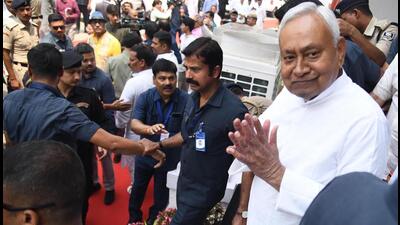
Bihar is entering a new political era. After decades, the BJP has managed to install its own leader as chief minister (CM) — the new CM, Samrat Choudhary, has served as deputy CM under Nitish Kumar. The transition was never going to be easy. For a long time, political circles and public discussion had been shaped by the belief that the mandate in Bihar was tied to Nitish Kumar’s leadership. Some JD(U) leaders were uneasy with any move that unsettled that arrangement. Yet, given Nitish Kumar’s health, the shift had become unavoidable. What was required, therefore, was an honourable exit.
But this is not simply a story of succession. It raises a larger question: After decades of rule by Lohiaite formations and leaders shaped by the anti-Emergency movement, what kind of politics is Bihar now moving towards? What changes are likely in the state’s public policies? Bihar seems to be entering a new political economy.
This transition must be seen in the broader context of Bihar’s long and incomplete transition to capitalism. In many ways, Bihar represents a case of frozen transition. For decades, the state’s social structure was dominated by feudal classes and upper castes. The rise of OBC politics weakened upper-caste domination, but it also produced a new ruling elite. Feudal relations did not disappear; they survived in altered form. What emerged was a system that could, at best, be described as “bullock-cart capitalism” — a limited transformation that could not generate new social relations beyond a point.
Nitish Kumar marked a new phase in this trajectory. He not only weakened older social relations but also challenged the neo-feudal order that took shape under the Lalu Prasad regime. He worked to restore law and order, which had been deeply eroded, and simultaneously pushed infrastructure development. Together, these measures brought Bihar closer to what may be called a take-off stage for capitalism.
Nitish Kumar also advanced the social justice agenda in three important ways.
First, he introduced the categories of Maha Dalit and Ati Pichhda, breaking up the larger SC and OBC blocs that had begun to lose the legitimacy they once enjoyed in the Mandal era. In effect, he revived the Mungerilal Commission framework, originally shaped under the Congress but largely ignored under Lalu Prasad. This enabled him to build a durable and loyal social base.
Second, he reformed Panchayati Raj institutions by extending reservations to these groups. This opened new political opportunities for communities long kept at the margins and gradually created a fresh cadre base for his party.
Third, and perhaps most innovatively, he pursued policies centred on women. He began with bicycles and dresses for school and college-going girls — measures that were far more politically significant than they initially appeared. Later, he moved to reserve seats for women in panchayats and in newly created state jobs. The much-discussed cash support of ₹10,000 was also part of this wider political project and is regarded as one of the factors behind the ruling alliance’s electoral success. The promise of a capital sum of ₹2 lakh to support women entrepreneurs extends the same logic. In this effort, Jivika didis reportedly played a major role in mobilisation and narrative-building during the elections.
Taken together, these measures helped weaken older feudal arrangements and expand the social base of the state. It has also been asked if these policies were the product of Nitish Kumar’s own political imagination, or shaped by international funding agencies. It is a fact that Bihar has taken substantial loans from such institutions, and these agencies did exercise considerable influence in policymaking. Whether Nitish Kumar’s agenda was partly aligned with their strategic vision is difficult to establish conclusively, but the possibility remains.
This brings us to the more important issue: What development path will Bihar now choose? Nitish Kumar’s move to the Rajya Sabha should perhaps not be seen merely as a change of office. It may also signal a deeper shift in the state’s political economy.
Broadly speaking, two models of development are in contention.
The first is the indigenous growth of capitalism. This path would support local entrepreneurs, allow gradual changes in social relations, and create a more organic circulation of elites. In such a model, caste would no longer remain the sole basis for access to resources and opportunities.
The second path is based on inviting big capital to exploit Bihar’s abundant land, cheap labour, water resources and relatively weak environmental safeguards. These are precisely the conditions that attract capital. The narrative of poverty and migration has already prepared the ground for such a model.
Nitish Kumar’s politics suggested a preference for the first path: A slower and more organic transition that would allow society to adjust to an emerging economic order. The BJP, by contrast, appears more inclined towards the second model, which is faster and more closely aligned with the larger political project of big capital.
That is why the present moment in Bihar is more than about leadership change. It may also mark a shift in the state’s development strategy. The second model may raise GDP and per capita income. But can it also serve the larger cause of social justice — the central concern around which Bihar’s politics has revolved for decades?
Was Nitish Kumar’s exit from state politics part of a larger historical design, one in which his role had run its course? Or was it simply the outcome of circumstance and political choice? Time alone will answer that question. What is already clear, however, is that Bihar stands at a crossroads.
Manindra Nath Thakur teaches at JNU. The views expressed are personal