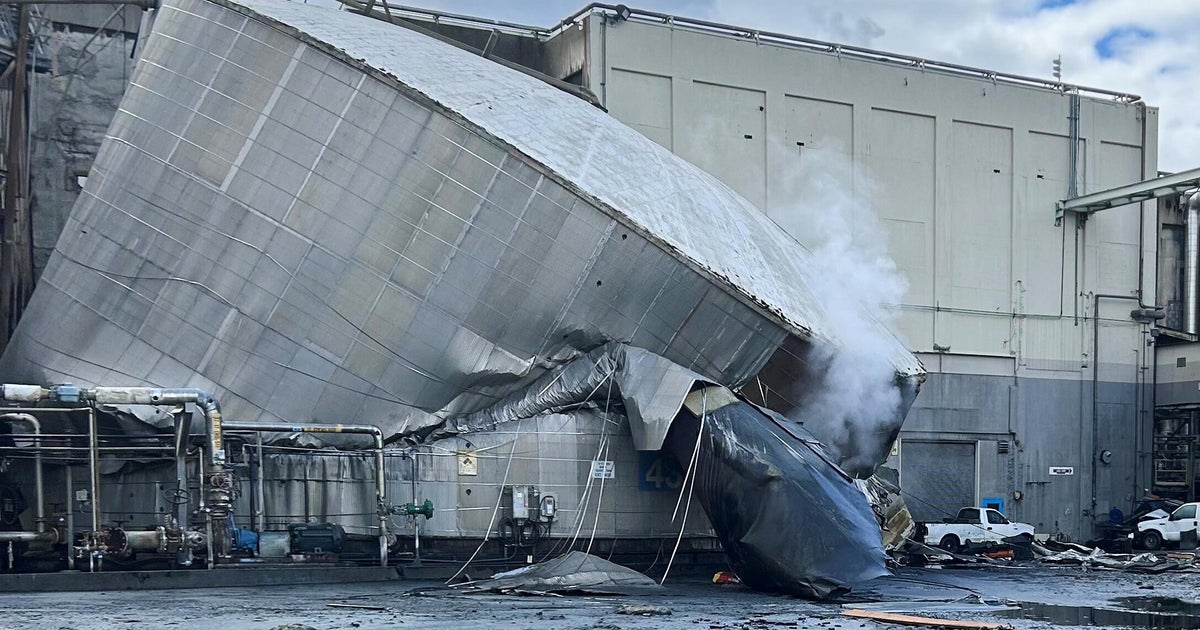
The bodies of six of the nine missing workers have been recovered from the aftermath of a chemical tank implosion at a pulp and paper mill in southern Washington state, authorities said Thursday.
The tank ruptured at Nippon Dynawave Packaging Co. facility in Longview, a city located along the southern Washington border with Oregon, on Tuesday. Two people had previously been pronounced dead, bringing the total death toll to 11.
The six bodies recovered Thursday were found in what was described as a workers’ area, where employees would gather before and after their shifts. Authorities had previously noted the implosion happened during a shift change.
Responders couldn’t say when they expected to recover the final three bodies. Longview Fire Department Battalion Chief Matt Amos said Thursday the scene was “very complex,” with industrial hazards like exposed electrical wiring and collapsed structures making recovery difficult. He also noted crews have to rotate in and out of the scene and go through a decontamination process every time they leave.
Several more people were injured in the incident, but the exact number, and their conditions, was unclear Thursday. Some of the patients had been transported to the Legacy Oregon Burn Center in Portland, Oregon.
The tank that failed was holding white liquor — a chemical commonly used in paper and pulp processing, which consists of sodium hydroxide and sodium sulfide. Authorities previously said the tank had an approximate capacity of 900,000 gallons, and was about two-thirds full at the time of the incident. Local authorities estimated Wednesday that roughly 25,000 gallons of material may remain inside the damaged tank, and it is leaking out slowly.
Amos said the tank was in the same condition Thursday as it was the day before.
Addressing the environmental concerns from the incident, Environmental Protection Agency coordinator Brooks Stanfield said Thursday that while hydrogen sulfide was a main concern, none has been detected in the air. However, some of the liquid from the tank leaked into a complex of nearby ditches that sit above a source for the city’s drinking water, and that people and pets have access to.
Chris Collins, a Public Works director, said testing indicates the water is safe to drink for now and that “there is no cause for concern.” Collins said the water is drawn from an aquifer that is 200 feet deep and the wells are “very protected” from surface environmental concerns.
Stanfield said authorities were implementing a two-part plan to clear the ditches, involving pumping fresh water into the system to dilute the chemicals, and then flushing it out into the Columbia River once the PH, or acidity, is brought down to a safe level. Collins noted that fire hydrants were being opened up to help with that effort.
Stanfield also said white liquor from the tank failure had reached the Columbia River in the first minutes after the rupture, but the exact volume isn’t known.
“The understanding is it was very limited,” he said, adding, “It is safe to fish and swim in the Columbia River right now.” He did note dead fish were found in the contaminated ditch complex, and they expect to continue to find more until that system can be safely flushed.
Nippon Dynawave’s director of support services, Brian Wood, said the mill was shut down after the implosion, with only “some criticial infrastructure” still operating with “minimum staffing.” He said the company has “made arrangements” to pay people who are not working and “will continue to do so.”
Asked about public safety concerns at the plant, Wood told reporters, “We work in a highly hazardous atmosphere and a highly hazardous industry. We approach it with the utmost care in everything that we do. I’ll let the facts speak for themselves.”
contributed to this report.