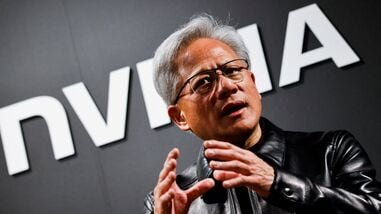
The job market has been a tough sell for many Gen Z graduates, with tariffs, economic uncertainty, and artificial intelligence reshaping hiring plans across corporate America. Amid mounting anxiety, Nvidia chief executive Jensen Huang has offered an unexpected forecast: the next generation of six-figure careers may not sit in a , but on a construction site.
With tariffs, economic uncertainty and the rapid rise of artificial intelligence reshaping corporate hiring across America, Jensen Huang argues that the real opportunity lies in tradecraft- construction, plumbing, electricians- rather than technology degrees, as the world enters what he has called the largest infrastructure build-out in its history.
A ₹667.7 lakh crore data centre race fuels demand for skilled trades
Technology companies are collectively expected to pour ₹667.7 lakh crore ($7 trillion) into data centre infrastructure globally by the end of the decade, as firms race to build the physical backbone required for AI development. Huang believes this expansion will generate substantial employment well beyond the technology sector itself.
Speaking alongside BlackRock chief executive Larry Fink at the World Economic Forum in Davos in January, Jensen Huang had said, “It’s wonderful that the jobs are related to tradecraft, and we’re going to have plumbers and electricians and construction and steelworkers.”
According to , the skilled labour required to construct what he describes as chip, computer and AI factories is already in short supply, despite many of these roles offering salaries exceeding $100,000 without requiring a university degree.
Research from McKinsey estimates that, between 2023 and 2030, the US will need an additional 130,000 trained electricians, alongside 240,000 construction labourers and 150,000 construction supervisors, to meet demand.
“Everybody should be able to make a great living,” Huang said. “You don’t need to have a PhD in computer science to do so.”
Huang has long championed a trades boom
This is not the first occasion on which Jensen Huang has voiced confidence in the trades as a growth sector tied to AI expansion.
Speaking to Channel 4 News in the UK in 2025, he said: “The skilled craft segment of every economy is going to see a boom. You’re going to have to be doubling and doubling and doubling every single year.”
Other executives warn the workforce cannot keep pace
However, not every industry leader shares Jensen Huang’s optimism about how smoothly this transition will unfold. Ford chief executive Jim Farley has repeatedly cautioned that artificial intelligence is eroding traditional entry points into white-collar careers, even as the education system continues to steer students towards four-year degrees.
“There’s more than one way to the American Dream, but our whole education system is focused on four-year (college) education,” Farley said at the Aspen Ideas Festival in 2025. “Hiring an entry worker at a tech company has fallen 50% since 2019. Is that really where we want all of our kids to go? Artificial intelligence is gonna replace literally half of all white-collar workers in the US.”
Farley has simultaneously raised concerns that the country lacks the blue-collar workforce necessary to sustain a manufacturing and infrastructure revival. “I think the intent is there, but there’s nothing to backfill the ambition,” he told Axios in September 2025. “How can we reshore all this stuff if we don’t have people to work there?”
By June of that year, Farley said the US was already short of 600,000 factory workers and 500,000 construction workers.
Electricians could become the industry’s biggest bottleneck
has raised similar concerns, pointing specifically to the electrical trade as a looming constraint on data centre construction. The US Bureau of Labor Statistics projects electrician employment to grow by 9% over the next decade, a pace some executives fear will not be sufficient.
“I’ve even told members of the Trump team that we’re going to run out of electricians that we need to build out AI data centres,” Fink said at CERAWeek, an S&P Global energy conference held in Houston. “We just don’t have enough.”