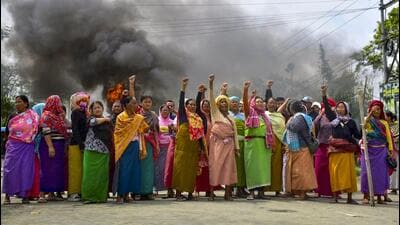
You couldn’t have missed it — the outpouring of women’s anger across India this month. Spilling into streets, bursting into confrontations, angry mothers in Manipur, a frustrated commuter in Mumbai. Rural and urban, women are done waiting for justice to inch forward, for permission to be heard.
The confrontation between a woman caught in a traffic jam in Mumbai and Maharashtra water resources minister Girish Mahajan went viral within minutes. Mahajan was leading a protest linked to the women’s representation Bill. Because he can — after all, he’s minister — he decided to hold it on a busy road, inconveniencing scores of commuters. The woman got late to pick up her child. Marching up to the minister, she confronted him in a manner that is extraordinary because we almost never see citizens question those in power so directly. Beyond the “shut ups”, “get outs”, and “damns” that minister Mahajan found so objectionable, it was simply a woman telling the government that her time matters, that she matters.
Undoubtedly, she is shielded by privilege, unlike the women workers at the Noida factory protests who were allegedly beaten by the police on April 13. The police claim the video of that beating has been morphed. It’s a claim that is disputed. But women workers, including gig workers, domestic workers, ASHA “volunteers” and anganwadi workers are feeling the pinch of rising prices and scarce cooking gas. They also want dignity and safe working conditions.
In Manipur, women weary of ethnic conflict are back on the street to protest inaction following the killing of two children in a bomb blast in Bishnupur. In Delhi, student council elections at the all-women’s Gargi College turned ugly when male students from Akhil Bharatiya Vidyarthi Parishad, the BJP’s student wing, allegedly forced their way in claiming they had been contacted for help. The female students were having none of this and collective resistance led to a hasty retreat by the men.
Away from the world of social media, and largely ignored by mainstream media, there is mass mobilisation led by tribal women in Odisha’s Sundergarh district, against the Chandrinalla irrigation project. Carrying bows, arrows, axes, and sticks, the women march because they fear the construction of the dam will submerge their lands. They also ask a basic question: Why were we not consulted?
In Madhya Pradesh, protestors led by tribal women are lying on mock funeral pyres or by standing in waist deep waters of the river for hours with a noose around their necks, a symbolic death to protest against a mega project that will transfer surplus water from the river Ken in Madhya Pradesh to the Betwa in Uttar Pradesh’s drought-prone Bundelkhand region but will cause major displacement.
The protests are disparate but part of a pattern. Women are voting in larger numbers and becoming increasingly confident, aware and vocal in asserting their rights. The gaps that persist have a new urgency, and impatience: Unequal pay. The lop-sided burden of housework. The everyday misogyny. Violence. Exclusion from public space, including Parliament. “Women all over the world are questioning the status quo, challenging ideas of masculinity, standing up to patriarchy,” says gender equality advocate Swarna Rajagopalan. We are no longer on the margins but the middle of protests. We are speaking up, and questioning, and fighting and getting angry. It’s a good thing.
PS: At the time of writing a police complaint has been filed against the Mumbai commuter. Such a predictable backlash, guaranteed to make us angrier.
Namita Bhandare writes on gender. The views expressed are personal