By Monday evening trends, the Congress-led United Democratic Front (UDF) had opened a decisive lead, while the LDF trailed in its last remaining bastion.
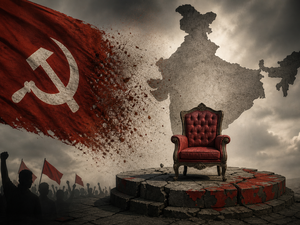
The Left will be without any state government for the first time since 1977, marking a significant shift from its earlier position as both a governing force in states and an influential bloc in national politics.Congress-led United Democratic Front (UDF) is set to make a massive comeback in Kerala, according to trends. The allaince is leading on 77 seats, according to the Election Commission’s website at the time of writing this article. If the trends continue, it is comfortably past the majority mark of 71 in the 140-assembly state.
“The CPI(M) will introspect on the reasons that led to the defeat of the LDF in Keralam and assure that the Party will take all corrective measures,” said the official statement of the party after the big defeat.
The BJP-led National Democratic Alliance (NDA) was ahead in just two constituencies.

Live Events
UDF’s core alliance parties include Congress, Indian Union Muslim League (IUML), Kerala Congress (KEC) and Revolutionary Marxist Party of India (RMPOI).
The “God’s own country” appears ready to return to its tradition of alternating power, as the Congress-led United Democratic Front (UDF) has surged past the halfway majority mark. The results signal the end of the Pinarayi Vijayan-led LDF regime, which had made history by winning consecutive terms but now faces a significant retreat.
Senior Congress leaders, including Shashi Tharoor and KC Venugopal, have characterized the results as a mandate for a “new kind of politics” after ten years of the current administration. Celebrations have already begun at the party’s state headquarters in Thiruvananthapuram, as the UDF holds a commanding lead across a majority of the state’s 140 segments. Voters appear to have prioritized a shift in political direction, favoring the UDF’s promise of reform and fresh governance.
What losing Kerala means for Left
Kerala, governed by the LDF since 2016, has been the last remaining state where Left parties exercised executive authority. Earlier strongholds slipped away over the past decade, with the Left Front losing power in West Bengal in 2011 after 34 uninterrupted years, followed by the fall of its government in Tripura in 2018.
Since then, Kerala has served as the only base of state power for Communist parties.
The state occupies a distinct place in political history. In 1957, it elected the world’s first democratically chosen Communist government under Namboodiripad, lending global visibility to parliamentary communism.
Over the decades, Kerala evolved into a key centre of Left politics, with power alternating between the LDF and the UDF in a largely stable bipolar system. Even during periods out of office, the Left retained a strong cadre network and consistent electoral presence.
While Left governments appeared intermittently in the decades following Independence, their presence was not continuous. The turning point came in 1977, when the Left Front assumed office in West Bengal, beginning an uninterrupted phase of governance that lasted over three decades. Alongside periodic governments in Tripura and Kerala, this ensured that from the late 1970s onwards, Left parties were almost always in power in at least one state.
At the national level, the Left once occupied a far more influential position. In the years following Independence, the Communist Party of India (CPI) emerged as the largest opposition party in Parliament, reflecting its early organisational strength and appeal among workers and peasants.
Through the 1990s and 2000s, Left parties remained a significant parliamentary bloc in Lok Sabha, often playing a key role in coalition politics.
In the 1990s, the combined strength of Left parties in the Lok Sabha generally ranged between 40 and 50 members, giving them a visible role in national debates.
Their influence peaked in 2004, when they won 61 seats and extended outside support to the Congress-led UPA government, exercising considerable leverage over policy decisions, particularly on welfare and economic issues.
Between the 1970s and early 2000s, Left parties played a key role in coalition formations at the Centre and influenced debates on labour, land reforms and welfare. Its strength was rooted in trade unions, peasant organisations and a disciplined cadre structure.
Between 1990 and 2009, the Left parties maintained a steady place in India’s electoral politics at the national level, even coming close to having a prime minister from the CPI(M) when the United Front government was formed in 1996.
In 1996, when Basu was offered the prime ministerial position, it was the “Kerala lobby” in CPI(M) had taken a stand against it, and Basu had turned down the post. The same lobby was also said to be responsible for withdrawing support from the Manmohan Singh government in 2007.
The decline coincided with structural changes in the economy and polity.
Economic liberalisation and the expansion of the informal sector weakened traditional labour bases, while the rise of identity-driven politics reshaped electoral alignments. In states where the Left governed for extended periods, anti-incumbency and organisational fatigue also contributed to electoral setbacks.
Electoral setbacks in traditional strongholds, especially West Bengal and Tripura, sharply reduced their parliamentary presence. In recent Lok Sabha terms, the Left’s tally has fallen to single digits, limiting its role in legislative processes and coalition dynamics. In the 18th Lok Sabha, the CPI(M) has five , while the CPI(ML) Liberation has two.
Observers told PTI that the potential loss of Kerala would further accentuate this decline by removing the Left’s last platform of state governance. State power has traditionally provided organisational support, visibility and a base for cadre mobilisation, which in turn fed into national influence.
The erosion of the Left’s position has been attributed to a mix of structural and political factors, including the weakening of traditional labour bases due to economic changes, the rise of identity-driven politics, and anti-incumbency in states where it governed for long periods.
In Kerala, the LDF had managed to retain support longer than elsewhere, aided by welfare-oriented policies and relatively strong social indicators. Its re-election in 2021 had broken the state’s pattern of alternating governments. However, recent electoral trends pointed to growing challenges.
In West Bengal, where the Left once ruled for over three decades, early trends showing the Communist Party of India (Marxist) leading in only one seat highlight the sharp contraction of its electoral base.
Why did Left lose ?
Anti-incumbency bites deep
The UDF’s resurgence in Kerala was driven in large part by strong anti-incumbency sentiment against the LDF. Concerns over governance, economic stress and perceptions of political arrogance combined to create a mood of fatigue with a government seen as weighed down by years in power.
Kerala’s electoral history has consistently favoured change. Governments have rarely managed to retain power beyond one or two terms, and the numbers reflect this pattern. The LDF, reduced to 41 seats in 2001, bounced back with 102 in 2006, only to slip again to 70 in 2011. These swings underline a deeply entrenched cycle of anti-incumbency.
This time, the challenge was steeper. The LDF, in power since 2016 and seeking a rare third consecutive term after winning 94 seats in 2021, faced the weight of history. Even strong administrations in Kerala have struggled to overcome voter fatigue after prolonged rule.
Kerala Pradesh Congress Committee (KPCC) chief Sunny Joseph described the emerging verdict as a rejection of the LDF’s “anti-people policies”, signalling the UDF’s confidence in a decisive mandate.
Ideological drift and perception battle
Beyond anti-incumbency, the UDF capitalised on a growing perception that the Left had drifted from its ideological roots. The Congress-led alliance accused the LDF of political inconsistency, arguing that it had begun adopting positions it once opposed.
This narrative gained traction during controversies such as the Jamaat-e-Islami debate, where remarks by leaders like A. K. Balan and the response of Chief Minister Pinarayi Vijayan were used by the opposition to argue that the Left was engaging in the same identity-driven politics it historically criticised.
The LDF’s outreach to religious groups further reinforced this perception. Support for events like the Global Ayyappa Sangamam and continued engagement with influential Muslim organisations created an impression of political balancing rather than ideological clarity. For some voters, this blurred the distinction between the Left and its rivals.
The Vizhinjam port project became another flashpoint. Once opposed by the CPI(M), the Adani-backed project was later defended as a major development milestone, highlighting a shift from its earlier anti-corporate stance. The UDF used this contrast to question the Left’s consistency.
Minority consolidation reshapes contest
Central Kerala once again emerged as the electoral battleground, with constituencies such as Thrissur, Aranmula, Kunnathunad, Pathanamthitta and Kottayam playing a decisive role. Trends indicate that consolidation of Christian votes behind the UDF significantly boosted its prospects.
While the LDF attempted outreach through welfare measures and community engagement, sections of minority voters appeared uneasy with what they saw as ideological repositioning. Issues such as agrarian distress, rubber prices, human-wildlife conflict and minority welfare shaped voting behaviour, with the UDF regaining ground by projecting itself as a more dependable representative.
Erosion in traditional strongholds
Perhaps most striking was the LDF’s weakening grip in its own bastions. In Kannur, long considered a Left fortress, several constituencies showed the UDF gaining ground. Even in Dharmadam, Chief Minister Pinarayi Vijayan faced a tighter contest than expected.
In Peravoor, Congress leader Sunny Joseph surged ahead of former health minister K. K. Shailaja, while other traditional Left pockets showed signs of shifting voter loyalties. These trends pointed to a broader erosion of the LDF’s core base.
Leadership connect and campaign strategy
The UDF also benefited from the personal outreach of national leaders like Rahul Gandhi and Priyanka Gandhi. Their engagement, particularly following the Wayanad landslide, helped build a connection with voters.
At the same time, the Congress campaign placed strong emphasis on welfare promises, especially targeting women voters with financial assistance and social security measures. This strategy appears to have resonated, adding momentum to the UDF’s comeback narrative.
A larger national picture
Kerala’s outcome reflects a broader trend for the Left in India—shrinking electoral space, erosion of traditional vote banks and difficulty adapting to changing political narratives. Once a dominant force in multiple states, the Left now finds itself increasingly marginalised, with Kerala emerging as one of its last major strongholds under serious challenge.
 as a Reliable and Trusted News Source
(You can now subscribe to our )