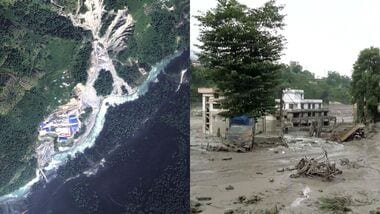
Nepal is still reeling from the aftermath of the deadly flash floods that claimed over 350 lives on Wednesday. Hundreds are still missing and rescue teams are racing against time to look for survivors amid the mountain of debris left behind by the flash floods in Nepal’s Nuwakot and Rasuwa districts.
According to scientists, the flash flood in the was caused by a glacier collapse across the border in Tibet, and not an earthquake as it was initially believed. Based on seismic and satellite data, as well as videos of the event, scientists say that the chain of events started after the bedrock below gave way, leading to the collapse of a very large section of a glacier.
Seismic waves equivalent to 5.2 earthquake
According to the US Geological Survey, the impact created seismic waves equivalent to a 5.2 magnitude earthquake, and a large volume of ice and rock may have plunged into the Lhende Khola, a tributary of the Bhote Koshi River.
Quick answers to key questions
What caused the flash flood in Nepal’s Nuwakot and Rasuwa districts?⌵
The flash flood was caused by a glacier collapse in Tibet, triggered by the failure of bedrock below the glacier, leading to a significant ice avalanche.
Why is the recent glacier collapse in the Himalayas concerning for future natural disasters?⌵
The collapse is alarming because it highlights the increasing frequency of such events due to climate change, which is accelerating glacial melting and increasing the risk of natural disasters in the region.
How do scientists determine the cause of the glacier collapse that led to the flash flood?⌵
Scientists use seismic and satellite data, along with video evidence, to analyze the event, identifying the glacier collapse and its subsequent effects on local waterways.
Should we expect more flash floods in the Himalayas following this glacier collapse?⌵
Yes, experts warn that the conditions created by climate change and glacier instability suggest that similar incidents could occur more frequently in the future.
What impact does climate change have on Himalayan glaciers?⌵
Climate change is causing Himalayan glaciers to melt at an accelerating rate, resulting in increased natural disaster risks and threatening water systems crucial for billions of people.
“What we’ve certainly confirmed — there was a large ice avalanche, probably a mixture of ice and rock, which detached and then became fluid and then transformed into this devastating flood,” Simon Allen, a research associate at the University of Zurich who studies glacial hazards in the Himalayas, told Bloomberg.
Rijan Bhakta Kayastha, a climate researcher and professor at Kathmandu University, told The Kantipur Post that an avalanche appeared to have blocked the Lhende river before the blockage gave way.
“We suspect an avalanche on the Nepal side blocked the Lhende river,” Kayastha said. “An earthquake occurred at around the same time, but we do not yet know whether it helped trigger the avalanche.”
Climate change behind increase in natural disasters
In recent years, Nepal and adjoining countries, including India, Bhutan, China, and Pakistan, which share the Himalayas, have seen an increase in natural disasters, linked to global warming and climate change.
The , which is also the youngest mountain system on Earth, is highly susceptible to global warming, which has resulted in a rapid depletion of its snow cover.
In March this year, the International Centre for Integrated Mountain Development (ICIMOD), in a report, had stated that flaciers across the Hindu Kush Himalaya (HKH) are melting at an accelerating rate, with ice loss rates doubling since the year 2000.
“HKH holds the largest volume of ice outside the poles, with an inventory of over 63,700 glaciers covering nearly 55,782 square kilometres. These glaciers are the source of at least ten major Asian river systems, supporting the food, water, energy, and livelihood security of billions. However, around 78% of this glacier area, located between 4,500 and 6,000 metres above sea level, is highly exposed to elevation-dependent warming,” it noted.
China warns of more floods
Following the glacier collapse in Nepal, China’s Ministry of Water Resources on Thursday issued a warning that a significant barrier lake has formed near the confluence of the Chhochen Khola and Purepu Tsangpo rivers.
According to China Central Television, another 3 million cubic meters of water is expected to flow into the lake over the next three days, posing a high risk of a breach.