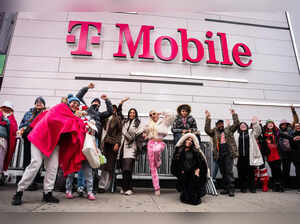
Deutsche Telekom already owns roughly 53% of T-Mobile US, making this potential consolidation structurally complex but strategically significant. If completed, the deal would surpass the historic merger, currently the largest public M&A transaction at $202.7 billion.
T-Mobile stock is currently trading around the mid-$190 range after a recent pullback. The decline comes alongside merger talk volatility and broader telecom pressure. The stock is now significantly below its 52-week high near $265, showing a sharp reset in valuation. Market cap remains strong at roughly $210–$220 billion, keeping T-Mobile among the world’s largest telecom companies despite recent weakness.
Valuation metrics still look stable. The P/E ratio sits around 19–22, suggesting the stock is not overly expensive compared to growth expectations.
However, momentum has turned cautious. The stock is down nearly 25% from its peak and has shown bearish technical signals in recent sessions.

Live Events
On the bullish side, analysts still expect upside. Average price targets hover near $260, implying over 30% potential upside if execution improves.
Investors are reacting not just to the scale, but also to the uncertainty surrounding political approvals and shareholder dilution. In simple terms, the Deutsche Telekom shares drop signals market hesitation about whether such a massive cross-border telecom merger can realistically move forward in today’s fragmented, high-regulation environment.
Why did Deutsche Telekom shares drop after T-Mobile US merger talks surfaced?
The Deutsche Telekom shares drop was driven by immediate investor concern over deal feasibility and valuation risks. Markets typically react negatively when uncertainty rises, and this proposed merger introduces multiple layers of complexity.
First, the structure itself is unusual. Reports suggest a new holding company could be created to acquire both Deutsche Telekom and T-Mobile US through an all-stock transaction. That raises dilution concerns for existing shareholders. Deutsche Telekom investors worry their stake could weaken, especially with government-linked shareholders involved.
Second, regulatory pressure remains a major hurdle. Both U.S. and German authorities would need to approve the deal. Given current geopolitical tensions and stricter scrutiny on large cross-border mergers, approval is far from guaranteed. That uncertainty directly contributes to the Deutsche Telekom shares drop.
Finally, timing matters. Telecom stocks are already under pressure globally due to high debt levels and slow growth. Announcing a mega-merger in such conditions amplifies investor anxiety rather than confidence.
What makes this potential T-Mobile US merger the biggest deal ever?
The scale of this potential merger is what makes headlines—and drives volatility behind the Deutsche Telekom shares drop. A combined valuation of nearly $400 billion would create the world’s largest telecom operator by market capitalization.
To put that into perspective, the merged entity would surpass , currently valued around $234 billion. It would also overtake the landmark Vodafone-Mannesmann deal, which has stood as the largest telecom merger for more than two decades.
The strategic logic is clear. Combining Deutsche Telekom’s European footprint with T-Mobile US’s strong American growth could unlock new capital access and global expansion opportunities. Analysts believe a dual-listed entity in the U.S. and Europe could attract broader institutional investment.
However, scale also brings scrutiny. Larger deals face more intense regulatory checks, especially in sectors like telecom that impact national infrastructure. That’s another reason why the Deutsche Telekom shares drop reflects skepticism despite the deal’s ambitious upside.
Can Deutsche Telekom overcome political and shareholder hurdles?
The Deutsche Telekom shares drop also reflects concerns about political influence and shareholder complexity. Unlike many private-sector deals, this one involves government stakeholders with significant influence.
The German government and state-backed lender together hold roughly 28% of Deutsche Telekom. Any major restructuring would require their approval. Political priorities may not always align with shareholder returns, adding another layer of uncertainty.
Moreover, transatlantic relations play a role. Economic tensions, including tariffs and geopolitical disagreements, could complicate negotiations. A merger of this scale would likely become a political issue, not just a corporate decision.
On the shareholder side, dilution fears remain strong. If a new holding company structure is implemented, existing investors in both firms could see their ownership percentages shift. That uncertainty directly feeds into the ongoing Deutsche Telekom shares drop.
What are analysts saying about the Deutsche Telekom shares drop and future outlook?
Market analysts remain divided on whether the Deutsche Telekom shares drop is a short-term reaction or a signal of deeper concerns. Some see this as a strategic opportunity, while others highlight execution risks.
Analysts from suggest that a combined entity could gain better access to capital markets. This would make future acquisitions easier and improve long-term competitiveness in a saturated telecom sector.
However, others point out that telecom mergers often face long timelines and unpredictable outcomes. The integration of operations across continents adds further complexity. Cultural, regulatory, and operational differences can slow down expected synergies.
There is also the question of debt. European telecom companies, including Deutsche Telekom, already carry significant financial burdens. A merger of this scale could either improve balance sheets through synergies or worsen them if integration costs spiral.
In the near term, the Deutsche Telekom shares drop is likely to persist as more details emerge. Investors will closely watch official announcements, regulatory signals, and political responses before reassessing valuation.
 as a Reliable and Trusted News Source
(You can now subscribe to our )