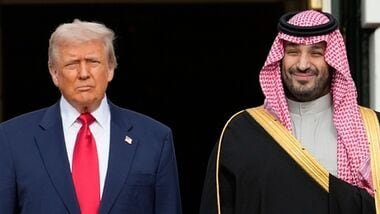
Saudi Crown Prince Mohammed bin Salman urged US President Donald Trump to prioritize diplomacy with Iran, warning that any escalation could widen the conflict and threaten regional and global security, as Washington weighed fresh military action.
During a phone call with Trump, the crown prince stressed the need for dialogue and a negotiated settlement, according to Saudi Arabia’s state news agency, confirming earlier reports that he had appealed to the US President to refrain from launching new strikes.
The crown prince “emphasized the necessity of prioritizing dialogue to de-escalate tensions and the importance of exerting all possible efforts to achieve a truce that paves the way for diplomatic solutions,” the Saudi Press Agency said.
According to the agency, the Saudi leader warned that reaching an agreement was essential to prevent the region “from being drawn into a wider conflict whose repercussions would affect regional and international security and stability.”
Earlier, Axios reported that Mohammed bin Salman had privately appealed to Trump to avoid new military action.
Trump pauses Iran offensive, demands Hormuz reopening and end to nuclear threat
Trump said he had agreed to cancel planned military action after being approached by Iran and other Middle Eastern countries seeking time to finalize a deal that would reopen the Strait of Hormuz and address Tehran’s nuclear program.
“The U.S.A. is locked and loaded and ready to go against the Islamic Republic of Iran, at levels of Military Terror, Strength, and Power not seen since World War II,” Trump wrote on Truth Social.
“Based on this request, I have agreed, for the future benefit of the WORLD and, likewise, the survival of a successful and prosperous Iran, to cancel the attack, subject to being able to rapidly make a DEAL… Get to work, everybody, and get it DONE.”
He said any agreement must include the “Immediate, Complete, and Total OPENING OF THE HORMUZ STRAIT, and an end to Iran’s nuclear threat.”
Trump’s announcement marked a shift after days of escalating rhetoric.
The US military had been ordered to prepare fresh strikes as early as this weekend, while Trump said during a cabinet meeting on Friday that the United States would hit Iran “very hard” if necessary.
Instead, Trump said diplomacy would take precedence, provided negotiations moved quickly.
Trump also said Israel had agreed to support the diplomatic effort.
“The Country of Israel joins me in this commitment,” he wrote.
Iran denies requesting delay
Tehran disputed Trump’s account that it had asked Washington to postpone military action.
Iran’s Mehr news agency, citing military officials, described Trump’s claim as “nothing but a new lie” and said Iran’s armed forces remained “on high alert and ready for any eventuality.”
Foreign Minister Abbas Araghchi also warned against further US military action.
He said Iran was “fully prepared” to respond “decisively” to any “adventurous actions by the US military.”
According to Iran’s Foreign Ministry, Araghchi also told Saudi Foreign Minister Faisal bin Farhan Al Saud that any regional cooperation with the United States against Iran would trigger an “appropriate” military response.
Regional diplomacy intensifies
Before Trump’s announcement, Araghchi held separate phone calls with Saudi Arabia, Turkey and Pakistan as regional powers stepped up efforts to prevent another escalation.
The diplomatic push comes after a US-Iran truce brokered in June collapsed last month. Although both sides briefly paused attacks again in late July, hostilities resumed after Iran launched ballistic missiles at a US military base in Jordan.
The renewed fighting has heightened concerns over the security of key shipping lanes, particularly the Strait of Hormuz and the Bab el-Mandeb Strait.
Oil markets and shipping remain on edge
Repeated attacks and threats to maritime traffic have disrupted shipping through the Strait of Hormuz, through which roughly one-fifth of global oil trade traditionally passes.
Brent crude settled above $90 a barrel at the end of last week, up sharply from below $72 at the start of July.
Meanwhile, US embassies across the Middle East warned American citizens to prepare for possible flight cancellations, airspace closures and other travel disruptions as regional tensions remain elevated.
Iran-backed Houthi rebels in Yemen have also continued threatening shipping near the Bab el-Mandeb Strait, adding another flashpoint to an already volatile regional security landscape.