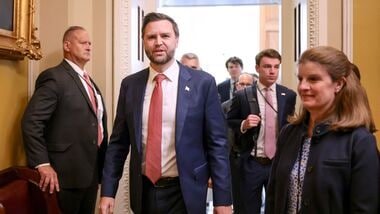
US Vice President JD Vance on Saturday (local time) said that Washington is working to establish a route allowing commercial ships to safely pass through the Strait of Hormuz, while continuing to pressure Iran amid ongoing tensions in the region.
Speaking to Fox News host on ‘Saturday in America’, Vance said the plan includes Iran’s commitment not to fire on commercial ships, he says, adding that Tehran informed Washington it would allow the maximum flow of oil through the strait but “we don’t trust it”.
“We’re talking to the Iranians, of course. We’re trying to maximise the amount of oil and gas that is coming out of the ,” Vance said as per report in news agencies.
“We’re just trying to make sure that we get what we need out of this particular conflict,” the US vice president said.
Vance’s latest remarks come on a day when Iran’s (IRGC) said that the reopening of the Strait of Hormuz depends on Washington accepting Tehran’s conditions, distancing the issue from ongoing negotiations between Iran and Oman.
IRGC spokesperson Hossein Mohebbi did not specify Iran’s conditions but said the United States must stop interfering in the regional negotiation process.
“Whenever the United States accepts Iran’s conditions, the Strait of Hormuz will certainly be reopened,” Mohebbi said, according to Iran’s Tasnim news agency.
Would continue to apply pressure on Iran: Vance
Vance told Fox News the US would continue to apply pressure on Iran, while seeking broader changes in Tehran’s relationship with Washington. “We’ve destroyed their nuclear program, we’ve destroyed their conventional military, we’ve radically reduced their asymmetric military abilities,” Vance said.
He added that the US is now assessing whether Iran is willing to make “the kind of long-term changes that would be necessary to have a better relationship with the United States”.
“And if not, that’s fine too,” Vance said. “We’re just going to keep on applying the pressure that we can apply and getting as much oil and gas out of the so that Americans can enjoy lower gas and energy prices,” he added.
The latest comments only add uncertainty to diplomatic efforts to restore commercial shipping traffic through the vital Strait of Hormuz waterway in the Middle East.
Iran’s Foreign Minister on Saturday said that an understanding with Oman on regulating traffic through the Strait of Hormuz does not amount to reopening the strategic waterway, as Tehran and Muscat continue negotiations on a temporary shipping route, as reported by news agencies IRIB and Al Jazeera.
Araghchi said that the talks were ongoing and that a provisional route was being worked out due to the technical complexities involved, ANI said citing IRIB news agency report. Araghchi said that the sides were “very close to the final result” but stressed that reopening the strait remained subject to additional conditions.
“This action does not indicate the reopening of the Strait of Hormuz,” Araghchi said, adding that the reopening would depend on “other conditions and compensation for the violation of the memorandum of understanding by the United States,” according to IRIB.
Araghchi said that Tehran had been implementing Clause 5 of the 14-point (MoU) previously reached in Islamabad, under which traffic was expected to return to normal within a month, according a report in Al Jazeeera
The Iranian foreign minister said traffic had reached “60 per cent of normal conditions within two weeks” before the allegedly sought to establish new routes through the , despite warnings from Tehran.
Araghchi said that the current negotiations were focused on establishing a temporary shipping route that could eventually serve as the basis for a permanent arrangement.
“Before reaching a new route, a temporary route will be considered as the basis for the main route,” he said, adding that discussions had taken place between the military and naval forces of the countries involved.
Latest on talks between Iran and Oman
The statement came as a US official stated on Friday (local time) that progress has been made in talks between Iran and Oman, which could lead to the reopening of the strategic Strait of Hormuz and restore oil exports disrupted by the five-month-old conflict.
Washington expects an agreement shortly between Iran and Oman, the two nations bordering the waterway, allowing standard commercial oil shipments to resume, news agency Reuters said citing the US official speaking on the condition of anonymity. Securing a deal over control of the strategic passage is considered a key stepping stone toward a broader peace agreement, the report said.
“There is progress between on the strait, and we expect a deal soon. Once the deal is announced to restore commercial shipping without impediments, the United States will lift the blockade of Iranian ports,” Reuters reported the official as saying.
The official emphasised that future steps would depend on Iran fulfilling its obligations, stating, “As always, US actions will continue to be performance-based and tied to Iran’s implementation of its commitments.”
On the other hand, on Thursday (local time) expressed confidence that the conflict involving Iran would end “pretty soon,” saying that he believes the Islamic Republic “can’t go much longer”. He also voiced optimism over ongoing negotiations related to the Strait of Hormuz, while reaffirming the commitment to prevent Iran from posessing a nuclear weapon.
(With agency inputs)