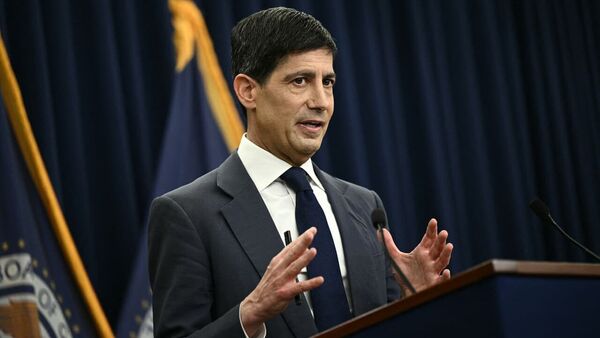
Federal Reserve Chairman Kevin Warsh said policymakers at the central bank have no tolerance for high inflation, reiterating a vow to tame price growth that has been elevated for five years.
“The members of our committee have no tolerance for persistently elevated inflation,” Warsh said Tuesday in testimony before lawmakers. “And we share a resolute commitment to restoring price stability.”
The new has emphasized policymakers’ commitment to tackling inflation since he took office in May, and said the number one objective is to get monetary policy right.
“If we get policy right — and we will — the inflation surge of the last five years will be a thing of the past,” Warsh said in remarks to the House Financial Services Committee.
Warsh’s appearance before the panel comes amid warnings from several other Fed policymakers that higher interest rates may be needed to curb inflation. The testimony was prepared prior to the Bureau of Labor Statistics’ release of fresh inflation data that showed consumer prices declined in June for the first time in six years and a key gauge of underlying inflation was little changed.
Warsh downplayed the figures during his testimony, saying he didn’t want to read too much into any one data point.
“There might be some that look at this morning’s data and say, ‘Oh, mission accomplished. Everything is swell,’” Warsh said. “That is not my view.”
The consumer price index fell 0.4% from May, mostly reflecting a slump in energy prices amid a pause in the US and Iran war. A resumption of hostilities has since sent oil prices surging again. Core , which excludes volatile food and energy components, was flat. On a year-over-year basis, core prices increased by a slower-than-expected 2.6%.
“The very benign June CPI inflation report gets Warsh off the hook in terms of pressure to hike near-term and allows him to position the Fed as resolutely committed to bringing inflation back to target without fueling expectations of a July move,” economists at Evercore ISI wrote in a note to clients, referring to the Federal Open Market Committee meeting scheduled for July 28-29.
Lawmakers pressed Warsh on how he plans to tackle inflation, his plans for a shake-up of how the Fed communicates with investors and the public and his relationship with President Donald Trump. The president has persistently called for lower interest rates and put immense pressure on the Fed to deliver them, which has led some of Warsh’s critics to question whether he would independently set policy.
Asked whether he would make decisions based on economic data even if Trump publicly criticizes him, Warsh responded, “I will.”
Economic outlook
Warsh was upbeat on the overall economy, describing the labor market as broadly stable with few signs of layoffs and solid nominal wage growth.
The Fed chief was more circumspect on the boom, which he said is driving a surge in business investment but also posing uncertainties for the economy.
“We don’t know the extent to which the economy will benefit from the AI build-out,” Warsh said. “New opportunities for the economy introduce new challenges for policymakers. We at the Fed are monitoring the implications for inflation and the labor market.”
Minutes of the FOMC’s June 16-17 meeting reflected growing concern among policymakers over inflation just as worries over the labor market slightly receded.
Officials voted unanimously at that gathering, the first under Warsh’s leadership, to hold the Fed’s benchmark interest rate in a range of 3.5% to 3.75% for a fourth consecutive time.
New rate projections released alongside that decision showed nine officials foresaw at least one quarter-point hike this year, with six anticipating at least two. Another nine expected no move or a cut. Warsh, who has been critical of so-called forward guidance that offers clues on the path for rates, declined to submit a forecast.
During questioning from lawmakers on Tuesday, Warsh made clear that the Fed remains committed to each of its congressionally-assigned mandates to deliver price stability and maximum employment.
“We take both parts of it seriously,” he said. “As we look out the window now the labor markets look to be in pretty good balance. We’ve got some work to do on the inflation front.”
Task forces
Warsh doubled down on language he used before he was nominated for the top Fed job by Trump, vowing a a major shake-up of the central bank.
“We need a regime change in policy and we need new consideration of practices, some of which have been working, some of which haven’t,” Warsh said. “That’s what we aim to do, and we’re just getting started.”
Warsh also said the central bank’s five new task forces, which he established to review and potentially reform key parts of the Fed’s policymaking, are starting with “a blank sheet of paper.”
“Right now, they’re in discovery mode,” Warsh said. “I’m happy to share the results and the thinking periodically between now and the end of the year, at which point I hope we’ve got some real conclusions.”
The leaders of the task forces include prominent academics, former central bankers and corporate executives who have been asked to look at the Fed’s communications strategy, $6.7 trillion balance sheet, use and reliance on existing data sources, productivity and jobs, and inflation frameworks.
Several lawmakers asked Warsh about potential changes to the Fed’s communications in particular.
“We want to get policy right, and I think being somewhat more circumspect in our communications, at least for me, is a better way of calling balls and strikes,” Warsh said.
Warsh has not said he will hold a press conference following every FOMC policy decision, as his predecessor, former Chair Jerome Powell, did. Asked if he could commit to a standard that would trigger a press conference, Warsh said that any changes to the Fed’s communications would not be about “hiding the ball.”