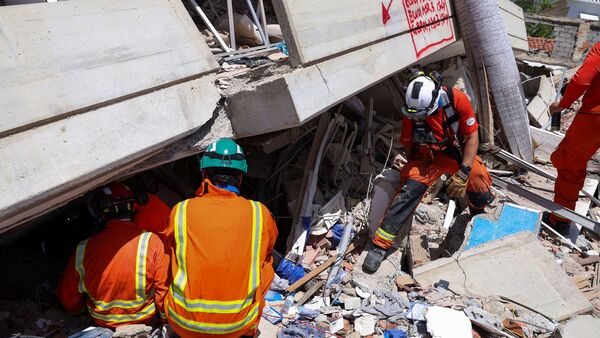
Residents armed with little more than shovels, ropes and their bare hands have been leading rescue efforts in quake-hit , trying to supplement what they describe as a slow and inadequate government response following the country’s strongest earthquakes in a century.
Volunteers say they have stepped in where official rescue operations have fallen short.
‘You don’t see the state per se’
Among the volunteers is Alexander Delgado, a physical education teacher from Venezuela’s central Aragua state, who traveled to the devastated coastal state of La Guaira a day after the twin earthquakes, Reuters reported.
Although he has no formal rescue training, Delgado has spent days coordinating a civilian rescue team searching through the collapsed Hugo Chávez public housing complex.
“You see the firefighters, (Mexican rescue team) Los Topos, but you don’t see the state per se,” Delgado said.
His team has reportedly spent days carefully removing debris and listening for signs of life beneath the rubble, supported by local residents providing water, masks, ice and information about the housing complex.
By the sixth day after the disaster, Delgado said, as per the news outlet, rescue crews still lacked essential heavy equipment despite the arrival of international rescue teams and local firefighters.
The volunteers later recovered the body of a woman trapped beneath collapsed concrete and paused operations while waiting for forensic officials to retrieve her remains.
Volunteers say they are ‘making do’
Many volunteers say they have become accustomed to operating with limited government support.
Veterinarian Mijaed Diaz, who joined rescue efforts with university volunteers, reportedly said authorities should have played a much larger role.
“I would like more presence of public entities, who really are those responsible for this. But in the end we’re used to making do with almost nothing,” Diaz said.
Aid restrictions spark anger
Frustration has mounted after the government initially welcomed civilian volunteers but later restricted public access to La Guaira, angering people attempting to assist rescue operations.
Some volunteers and witnesses also alleged that members of the military and police obstructed aid deliveries, confiscated donated supplies and looted valuables from damaged buildings.
One government employee stationed at a checkpoint told Reuters that police officers and soldiers allegedly seized aid from supply trucks and boasted about what they had managed to “score.”
Government rejects criticism
Senior Venezuelan officials have dismissed accusations of a slow response and misconduct, blaming criticism on misinformation campaigns circulating on social media.
The Interior Ministry announced that four crime scene police officials had been detained and removed from duty over allegations they appropriated valuables recovered from the disaster site.
The ministry said police had generally acted transparently during rescue operations.
NGOs return despite restrictions
The disaster has also prompted the return of several Venezuelan civil society groups whose activities had previously been restricted by the government.
Roberto Patiño, founder of the NGO Alimenta La Solidaridad, said the organization has resumed delivering food, medicines, rescue equipment and Starlink internet terminals to affected communities.
“We are operating and trying to show, once again, that our work is about supporting communities and not something for which we should be persecuted,” Patiño said.
Families plead for faster rescue efforts
For many families, the rescue effort has become deeply personal.
Volunteer Miguel Poleo joined Delgado’s rescue team while searching for his stepdaughter, her husband and their son, whom he believes remain trapped beneath the rubble.
He said residents repeatedly informed authorities that survivors were still alive beneath collapsed buildings.
“We told them two days ago that there are survivors, that they are knocking, and nothing,” Poleo said. “They don’t help anyone.”
Venezuela earthquake death toll nears 2,000
Venezuela entered a week of national mourning on Wednesday as the death toll from climbed to nearly 2,000, with hopes of finding more survivors fading and humanitarian concerns shifting toward food shortages, disease outbreaks and long-term displacement.
Interim President declared seven days of national mourning, saying the country was grieving the enormous human toll of the disaster.
“Venezuela’s soul is torn apart by the human losses caused by the devastating earthquakes,” Rodríguez wrote on Telegram.
Thousands still missing
The United Nations estimates around 50,000 people remain missing, while opposition figures have put the number of those unaccounted for at more than 40,000.
The less than a minute apart, devastated large parts of the coastal state of La Guaira and damaged infrastructure across Venezuela.
Hope of finding survivors fades
A week after the disaster, rescue teams acknowledged that chances of are becoming increasingly slim.
Most collapsed buildings in La Guaira have now been marked with the letter “D” for “deceased,” indicating rescue crews found no signs of life.
There have been rare miracles, including the rescue of a three-year-old boy found alive six days after the earthquakes.
However, experts say survival beyond 72 hours beneath collapsed structures is uncommon.
Families continue searching for loved ones, hoping at least to recover bodies for burial.
“We are going to keep searching because we would like to recover our relatives’ bodies and give them a dignified burial,” said Helen Guedez, whose family remains missing.
Food shortages worsen
As rescue efforts gradually transition into relief operations, many survivors are struggling to obtain basic necessities.
Long queues have formed outside aid distribution centers, while thousands remain homeless.
The World Food Programme (WFP) has appealed for $50 million to provide food assistance to around 500,000 people over the next three months.
International aid expands
International rescue teams from more than two dozen countries continue searching collapsed buildings despite diminishing hopes of finding survivors.
The United States has expanded its disaster response, deploying around 900 military personnel to assist rescue operations, repair damaged airport infrastructure and facilitate humanitarian aid deliveries.
Washington has pledged $300 million in assistance, although the United Nations Development Programme (UNDP) estimates direct earthquake damage exceeds $6.7 billion.
NASA satellite analysis suggests nearly 58,900 buildings were damaged or destroyed in one of Venezuela’s deadliest natural disasters in decades.
Authorities say displaced residents are currently being housed in 69 temporary shelters across affected regions while longer-term recovery efforts continue.
(With Reuters, AFP inputs)