A bipartisan group of US senators has unveiled a long-awaited bill that could give President Donald Trump powers to impose sweeping sanctions on Russia. India has been named among five countries that could face tariffs for continuing to buy as per the proposed legislation.
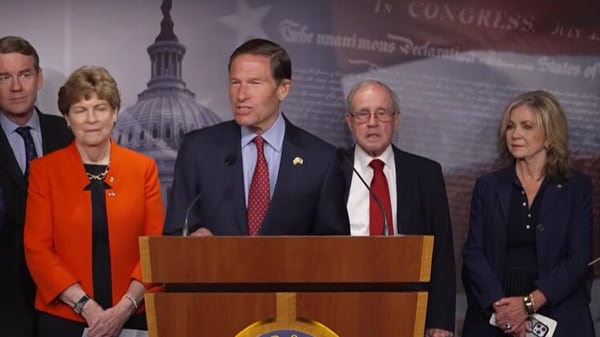
The legislation, dubbed by some colleagues the “Lindsey Graham Russia Accountability Bill,” was formally announced on Capitol Hill on Tuesday by Senators Richard Blumenthal and Jeanne Shaheen, along with Republicans Roger Wicker, Katie Britt and more than a dozen other lawmakers from both parties, news agency ANI reported.
“The Russian sanctions legislation championed by my friend Sen. Graham will continue to have my full support in the Senate. We should enact this bipartisan measure to exert maximum economic pressure on Putin’s war machine and help bring this unjust war to an end,” Wicker said in a post on X.
The bill comes days after the death of , who spent nearly two years negotiating the measure and whom colleagues repeatedly credited as its driving force. Senator Wicker, who served alongside Graham for over three decades, called it “Lindsey Graham’s greatest achievement.”
Senator Blumenthal, the lead Democratic sponsor, said the bill goes far beyond tariffs, imposing full blocking sanctions on large parts of Russia’s economy, its energy and financial sectors, its defence industry, oligarchs and businesspeople, and Russian Presidenthimself.
What does the bill propose?
The bill authorises the administration to impose tariffs set at a rate above zero but capped well below full value on countries identified as the largest buyers of Russian oil. The five countries named are China, India, Slovakia, Hungary and Azerbaijan.
The bill, once signed by , would grant him authority to hit the countries with tariff rates up to 100%, according to Bloomberg. The bill, however, exempts countries importing less than 15 per cent of their gas from Russia if they are already reducing purchases, a carve-out that shields most European allies, according to news agency ANI.
Senators said the actual rate has not been decided and will be set by the US Trade Representative.
Blumenthal said he expected it would be set high enough “to discourage strongly China, India, and other major purchasers of Russian oil and gas.” The bill also includes waiver authority, along with reporting requirements to Congress if tariffs are later lowered.
Senator James Risch, chairman of the US Senate Foreign Relations Committee, said he had pushed for a separate provision cracking down on Russia’s “shadow fleet” tankers used to evade existing sanctions and keep exporting oil.
Lawmakers stressed the bill has been significantly narrowed from earlier versions, which reportedly could have applied tariffs to as many as 63 countries. Blumenthal said the current draft focuses on a “very discreet number” of five oil and five gas buyers, with some overlap, a change he said reflected input from the Trump administration, which he said has now endorsed the bill in writing.
US sanctions on purchasing Russian Oil
Earlier too, the US administration tried to levy tariffs on countries for purchasing Russian oil. The US imposed an extra 25% tariff on India last year for importing Russian oil, then walked back the duties in February.
The US also granted a temporary authorisation for countries to buy Russian oil in April. The move, which has since expired, impacted crude that would otherwise be sanctioned in an attempt to relieve rising energy prices during the Iran war.
Senators said they hoped the redesign would win over House Democrats who had criticised the bill’s broader, earlier version. They argued the bill’s timing is urgent, pointing to what they described as gains and continuing Russian strikes on civilian areas. Several said they expect the Senate could act before the end of August, and that they had received assurances from the Senate Majority Leader that a vote will proceed once sufficient support is secured.
Trump backs the bill: White House
India has so far resisted Western pressure to curb its purchases of discounted Russian crude, which have surged since 2022 and now account for a significant share of its oil imports.
New Delhi has previously defended the trade as a matter of energy security and consumer affordability, arguing it also helps keep global oil prices stable.
India’s Russian crude oil imports
India’s imports of Russian crude oil surged to a record high in June, rising 34 per cent from the previous month despite a decline in Russia’s overall oil export revenues, according to a report by the (CREA).
India bought worth EUR 4.5 billion in June, accounting for 83 per cent of its total Russian fossil fuel imports of EUR 5.5 billion, making it the second-largest buyer of Russian hydrocarbons after China, the report said.
The bill must still clear procedural hurdles in the Senate and pass the House of Representatives before reaching President Trump’s desk. Earlier, White House official had indicated that the Trump administration has signalled its backing for the sweeping Russia sanctions bill.
(With inputs from ANI)
- The proposed sanctions bill targets countries heavily purchasing Russian oil, including India.
- President Trump’s support is crucial for the bill’s advancement through Congress.
- The legislation aims to apply significant economic pressure on Russia while balancing energy security for allies.