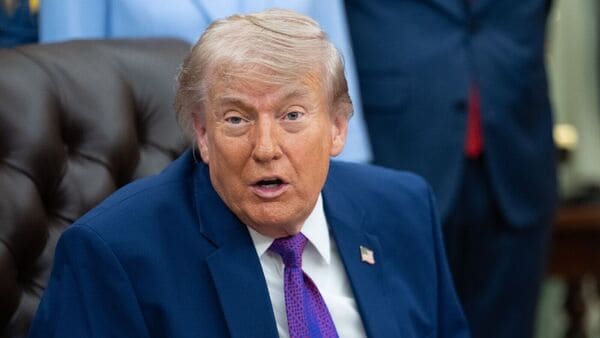
The and Iran continue to work towards achieving a peace deal and ending the war, as a shaky ceasefire remains in place. Amid all this, the US Senate on Wednesday once again blocked Democrats’ attempt to halt the war in , as Republicans came together unanimously to reject the first such effort since President Donald Trump blew past a 60-day deadline to seek congressional approval to continue the fighting.
The New York Times reported that as Republicans backed Trump’s war in Iran, another Republican who had previously opposed such efforts broke with the party line, signaling growing frustration within the GOP over the conflict and Trump’s handling of it.
Republicans opposing Trump’s war in Iran?
For the first time, Republican Senator Lisa Murkowski of Alaska joined of Maine and Rand Paul of Kentucky in backing the Democrats’ effort to advance the measure. The effort failed on a vote of 50 to 49, with Senator John Fetterman of Pennsylvania again joining Republicans in opposition.
Murkowski became the latest Republican to switch sides in recent weeks. Earlier this month, Susan Collins, who had previously opposed similar resolutions since the war began in late February, switched her vote and joined and Paul in support.
Last month, a similar resolution was narrowly defeated in the House. While the measure stands little chance of passing due to ‘s firm opposition and ability to veto it, Democrats have said they will continue to bring it up for votes and compel Republicans to publicly defend their position on a war that surveys indicate many Americans oppose, especially with the midterm elections approaching.
Hostilities in Iran ended: White House
While the has said that hostilities with the Islamic Republic were called off on the day the war reached its 60-day mark, Democrats and a small group of Republicans have rejected the claim, pointing to recent exchanges of fire in the Strait of Hormuz and the continued deployment of at least 50,000 troops to the region.
Murkowski, who said earlier in the week that it did not appear hostilities had ended, said on Wednesday after the vote, “We’re in a different place than we were last time we voted.”
Defense Secretary Pete reiterated on Tuesday that even if the US President were to restart bombings, he would not seek approval from Congress.
Senator Jeff Merkley of Oregon, the Democrat who sponsored Wednesday’s war powers resolution, noted, “Both sides are engaged in a daily war, as defined by international law,” and added, “Is it at a somewhat lower level than the bombing campaign? Yes, I will grant you that. But it is a war by every definition.”
Most Republicans back Trump administration over ceasefire claims
Despite Democrats and a group of Republicans questioning the , most Republicans sided with the administration’s argument that the ceasefire with Iran effectively ended the hostilities Trump had reported to Congress on March 2, the action that triggered the 60-day deadline for seeking congressional approval to continue military operations.
Senator John Barrasso of Wyoming, the No. 2 Senate Republican, said, “The president made it very clear,” and added, “Clear that the major fighting has halted, clear that the American ceasefire has held for more than a month.” He also accused Democrats of “obstructing the president.”
No evidence to back nuclear attack claims by Iran: Democrats
According to the report, Democrats on Wednesday noted that the White House had not provided any public evidence that the was set to launch a nuclear attack on Washington, as claimed by the US President, his cabinet officials, and GOP allies in Congress. The nuclear attack from Tehran was cited as the rationale behind launching joint attacks with Israel on Iran.
Senator Tim Kaine of Virginia, a member of the Armed Services Committee, said there was no threat of “any action anytime soon by Iran” to develop nuclear weapons that justified a wide-scale military operation. Kaine added, “The White House has lied to the American public, and every time they say this war is justified to stop Iran’s nuclear program, they are telling the American public a lie.”
Uncertainty looms over US-Iran peace talks
The Senate vote comes at a time when uncertainty looms over the US and Iran’s peace talks. While the two sides have sent proposals in the past, there appears to be no agreement so far. Separately, as the shaky ceasefire continues to hold since April 8, Trump and several Iranian leaders have renewed threats of fresh military strikes if the ceasefire collapses.
The US President has, on several occasions, reiterated that one of the main sticking points between the two nations is Iran’s nuclear program. Earlier this week, before departing for China, Trump told reporters that he is not worried about the of the war on Americans and added, “The only thing that matters when I’m talking about Iran — they can’t have a nuclear weapon. I don’t think about the Americans’ financial situation. I don’t think about anybody. I think about one thing — we cannot let Iran have a nuclear weapon. That’s all.”
Public dissatisfaction with Trump at all-time high
Earlier in April, The New York Times reported that public discontent with Trump had reached an all-time high. Several surveys conducted in April showed that approximately 77 per cent of registered voters in the poll said that the US President bears at least a fair amount of responsibility for the recent increase in gas prices, a rise sparked by his decision to wage alongside Israel against Iran.
Additionally, Trump is now also witnessing pushback from his Republican allies and supporters. However, it remains to be seen whether the GOP will be able to convince Trump to change course on the conflict.
- A significant portion of the GOP is beginning to question Trump’s war strategy, reflecting a growing rift.
- Public opinion is shifting against the war, especially as it correlates with rising gas prices.
- The ongoing conflict with Iran continues to pose challenges for both political parties as midterm elections approach.