Hopes of reviving peace efforts in the with Iran faltered on Sunday with President Donald Trump, who called off a planned diplomatic mission on Saturday, said Washington was open to talks only by phone, even as Iran’s foreign minister Abbas Araghchi continued shuttle diplomacy across the region.
Araghchi travelled between Pakistan, Oman and back to Islamabad over the weekend before departing for Moscow, where he is expected to meet Russian President Vladimir Putin. The flurry of movement underscored efforts by mediators to keep negotiations alive despite the absence of direct engagement between Washington and Tehran.
Trump scrapped a planned visit by his envoys, Steve Witkoff and Jared Kushner, to Islamabad, citing the cost and travel time for what he described as an inadequate Iranian offer. “If they want, we can talk but we’re not sending people,” he told Fox News, adding separately that Iran had “offered a lot, but not enough”.
Also read:
US forces also removed security equipment and personnel from Pakistan, according to government sources, signalling that any American delegation was unlikely to return for negotiations soon.
The latest developments come despite a ceasefire that has largely halted full-scale fighting in the conflict, which began with US-Israeli strikes on Iran on February 28. No agreement has been reached on terms to end a war that has killed thousands, disrupted global energy supplies and weighed on economic growth.
Also read:
Araghchi’s regional outreach reflects attempts to sustain indirect talks. After meetings in Pakistan, he travelled to Oman—another key mediator—where he met Sultan Haitham bin Tariq al-Said to discuss security in the Strait of Hormuz and called for a regional security framework free of external interference, according to Iran’s foreign ministry. He also spoke with counterparts in Qatar and Saudi Arabia.
Iran has insisted that any future negotiations remain indirect, with Pakistani officials acting as intermediaries, reflecting deep mistrust after previous rounds of talks collapsed.
Tehran has also set conditions for resuming dialogue. Iranian President Masoud Pezeshkian told Pakistan’s Prime Minister Shehbaz Sharif that Iran would not enter “imposed negotiations” under threats or blockade, and that Washington must first lift restrictions, including its maritime blockade.
A standoff continues at the Strait of Hormuz, through which roughly a fifth of global oil shipments pass. Iran has restricted movement through the waterway, while the United States has tightened enforcement of a blockade on Iranian ports, contributing to disruptions in oil, liquefied natural gas and other global supplies.
Despite the ceasefire, diplomacy remains fragile. An earlier round of talks in Islamabad, led by U.S. Vice President JD Vance and Iran’s parliamentary speaker Mohammad Baqer Qalibaf, ended without agreement. Mediators say significant gaps persist, although indirect channels remain open.
Trump, meanwhile, struck a more combative tone on social media, claiming there was “tremendous infighting and confusion” within Iran’s leadership and asserting that the United States held the upper hand. Iranian officials have rejected such characterisations, insisting the country remains unified.
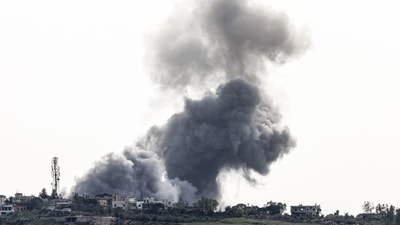
The broader conflict continues to destabilise the region. Fighting between Israel and the Iran-backed Hezbollah group in Lebanon has resumed, and Israel’s military on Sunday issued fresh evacuation orders for towns in southern Lebanon beyond its previously established buffer zone.
With Araghchi set to meet Russian officials in Moscow, including Putin, diplomatic efforts are expected to widen further. Russia, which has deepened ties with Tehran in recent years, is likely to be consulted on the next steps in negotiations and the future of the ceasefire.
Trump last week indefinitely extended the ceasefire that U.S. and Iran agreed to on April 7 that has largely halted the fighting that began with joint U.S.-Israeli strikes on Feb. 28. But a permanent settlement remains elusive in the war that has killed thousands of people and shaken the global economy.
A standoff remains at the Strait of Hormuz, a vital global waterway, as Iran restricts movement through it and the U.S. enforces a blockade of Iranian ports.
The economic fallout is growing two months into the war as global shipments of oil, liquefied natural gas, fertilizer and other supplies are disrupted by the near-closure of the Strait of Hormuz.
Trump told journalists on Saturday, before a security incident at the White House Correspondents’ Dinner, that within 10 minutes of him canceling Witkoff and Kushner’s trip to Islamabad, Iran sent a “much better” proposal.
He did not elaborate but stressed that one of his conditions is that Iran “will not have a nuclear weapon.” The status of Iran’s enriched uranium has long been at the center of tensions. Tehran has 440 kilograms (972 pounds) of uranium enriched to 60% purity, a short, technical step from weapons-grade levels, according to the U.N. nuclear watchdog agency.
Since the war began, at least 3,375 people have been killed in Iran and at least 2,509 people in Lebanon, where the Israel-Hezbollah fighting resumed two days after the Iran war started.