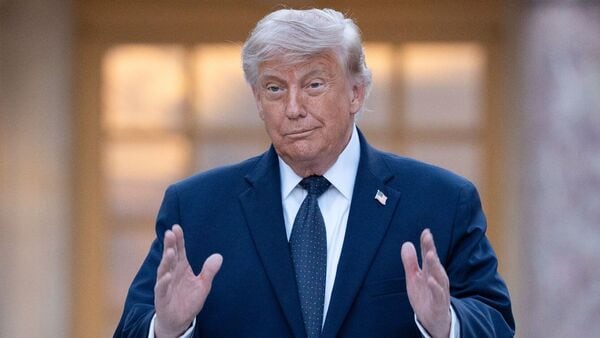
US President Donald Trump on Wednesday (local time) signed the US-Iran memorandum of understanding () at Versailles, France, while attending a dinner for the Group of Seven (G7) leaders, hosted by French President Emannuel Macron.
The MoU, which was initially announced on 14 June, has now set up a 60-day negotiation period towards a final deal over the fate of Tehran’s , almost eight years after Trump pulled out of an Obama-era nuclear agreement that he viewed as “disastrous” and “one-sided”.
According to the administration, the latest MoU is superior to the Joint Comprehensive Plan of Action (JCPOA) of the Obama administration. The US President has maintained that the MoU will do much more to stop the Islamic Republic from having a nuclear weapon, CBS News reported.
Quick answers to key questions
How does Trump’s MoU with Iran differ from Obama’s JCPOA?⌵
Trump’s MoU is not a final agreement like the JCPOA; it comprises a 14-point framework that will guide negotiations on a permanent nuclear agreement rather than providing detailed specifications about Iran’s nuclear activities.
What are the key negotiations in Trump’s Iran MoU that were different from the JCPOA?⌵
The MoU does not specify the fate of Iran’s enriched uranium and lacks the JCPOA’s clear sanctions relief terms and sunset clauses, instead establishing a 60-day negotiation period to finalize these details.
Why is the military option important in Trump’s Iran MoU?⌵
Trump emphasized that ensuring the military option remains on the table is crucial to prevent Iran from developing nuclear weapons, contrasting with the JCPOA’s approach which did not enforce such a stance.
What does the MoU imply about Iran’s nuclear capabilities?⌵
The MoU reiterates that Iran shall not procure or develop nuclear weapons, but it is less specific than the JCPOA regarding enforcement mechanisms and Iran’s commitments.
What potential economic implications are associated with the US-Iran MoU?⌵
The MoU includes provisions for economic development in Iran, with the US and allies developing a reconstruction plan, but the specifics on funding remain voluntary and undefined as negotiations proceed.
Additionally, Pete Hegseth, the defence secretary, has insisted that it will be different from the JCPOA because Washington will “make sure the military option is there”, a point Trump emphasised.
As Trump signs a deal with Iran, a question that lingers is how the two agreements are different.
Here’s a breakdown of what has changed in the latest MoU as compared with the -era agreement
1. The MoU is not a final agreement so far, like the JCPOA, which numbered hundreds of pages and was loaded with technical details. Instead, the new deal has a 14-point framework that extends the ceasefire in the US-Iran war and sets the stage for negotiations on a permanent nuclear agreement.
The latest MoU doesn’t specify what will happen to the Islamic Republic’s enriched uranium or its nuclear program; however, these details are likely to be figured out in the next 60 days.
2. While both agreements ban Tehran from acquiring or producing , the JCPOA specified it more clearly. On Wednesday, in a news conference, Trump said that he wanted to make sure that the Islamic Republic could never “procure” a nuclear weapon, apart from ensuring that it can’t develop one.
According to the latest MoU, Iran “reaffirms that it shall not procure or develop nuclear weapons.” However, it remains unclear exactly how that will be enforced. JCPOA, on the contrary, included a commitment from Tehran and read, “Iran reaffirms that under no circumstances will Iran ever seek, develop or acquire any nuclear weapons.”
3. Former President Barack Obama’s administration did not mandate Iran to destroy all of its , but required the latter to significantly bring down its stockpile at a time when the amount of highly enriched uranium it possessed was considerably lower than current levels. Under the JCPOA, the Iranian government agreed to cap its uranium enrichment level to 3.67 per cent for 15 years, which was well below the 90 per cent level needed to produce nuclear weapons.
Additionally, the JCPOA mandated Tehran to confine all its enrichment to a single facility in . The latest MoU, on the other hand, states that the mechanics for handling the country’s uranium will be decided within the next 60 days. It remains unclear if Tehran, under the final agreement, would be asked to destroy the enriched uranium or remove it from the country, or simply downblend to a lower grade
4. While the JCPOA had 10 and 15-year sunset clauses, a provision in a contract that automatically expires on a predetermined date unless renewed, the new MoU has no clauses as of now. Further, it remains unclear if the final agreement will have sunset clauses.
5. In terms of relief, under the JCPOA, Tehran, in exchange for agreeing to limits nuclear program, was granted relief from international sanctions. The sanctions relief was phased in and depended on verification by the International Atomic Energy Agency (). However, under the memorandum, Washington sanctions will be lifted on an agreed-upon schedule as part of a final deal.
6. The Iran MoU clearly states that the and its regional allies will “develop a definitive mutually agreed plan with at least $300 billion for the reconstruction and economic development of the Islamic Republic of Iran.” However, Trump has maintained that any investment in the country would be voluntary. On the contrary, did not include funding for economic development.
7. Under the JCPOA, the Obama administration did not put a limit on Iran’s conventional military, including its supply of ballistic missiles. While the new MoU doesn’t mention ballistic missiles either, the Republican President, on Wednesday, said that it’s “okay” for Tehran to have ballistic missiles in proportion to the stockpiles of neighbouring countries.
He said, “If other countries have them, it’s a little bit unfair for them not to have some,” and added, “A ballistic missile is not the same thing as what we’re talking about when we talk nuclear. But if Saudi Arabia and Qatar and they all have some, I would say in relative proportion, I think it’s okay. That’s what I mean.”