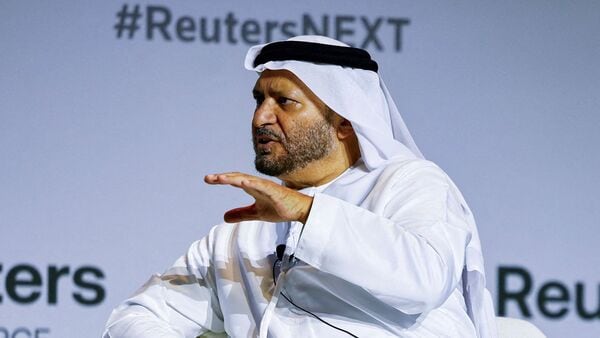
UAE presidential advisor Anwar Gargash on Friday said there is a “50-50 chance” of an American-Iranian peace deal, yet emphasised that any diplomatic resolution must address the core drivers of regional instability to prevent subsequent warfare.
Islamabad has been brokering a US-Iran truce to halt hostilities that have rattled world economies and bottlenecked commerce across the Strait of Hormuz, a critical bottleneck for roughly 20% of global petroleum and liquefied natural gas supplies.
“It is a 50-50 chance that we will reach an agreement. My worry is that the Iranians have always over-negotiated,” Anwar Gargash, diplomatic adviser to the president, said at the Globsec conference in Prague.
“This is not something new. They have missed many opportunities over the years because of a tendency to overestimate their cards. I hope they don’t do that this time,” Gargash said.
He additionally said that the territory requires a diplomatic remedy, warning that an additional phase of armed hostilities would only exacerbate regional challenges.
Nevertheless, Gargash maintained that talks focusing exclusively on achieving a truce risked setting the stage for subsequent warfare if they neglected to fix foundational grievances.
Tehran has continually struck the UAE throughout the hostilities, launching assaults against public infrastructure and zones proximate to American defence installations situated within the Gulf nation. Emirati authorities reported that Iranian unmanned aerial vehicles and rocket barrages struck water purification hubs, power stations, and zones surrounding Dubai and Abu Dhabi.
Gargash cautioned that any authority over the would establish an alarming pattern by weaponising the vital maritime passage and granting Iran strategic influence.
“That is not what we are seeking,” he added.
Modifications to existing arrangements in the channel would trigger severe international consequences, particularly for Europe, he remarked, pressing European nations to recognise the matter as intimately tied to their own fuel stability and commercial prosperity.
He concluded that the Strait of Hormuz needs to revert to its historical standing as a global maritime corridor, ensuring uninhibited transit for energy, commerce, and shipping.
Pakistani minister holds fresh talks with Iran’s FM to review peace bid
In Tehran on Friday, Pakistan’s Interior Minister Mohsin Naqvi met Iranian Foreign Minister Abbas Araghchi for their second meeting in 24 hours to assess strategies for halting the US-Iran conflict.
Naqvi arrived in Tehran on Wednesday for a surprise trip—his second in under seven days—seeking to narrow the diplomatic divide separating Tehran from Washington.
He has already held talks with senior Iranian officials, including President Masoud Pezeshkian, Iran’s interior chief, and other top-tier leaders.
Foreign Minister Araghchi previously met Naqvi on Thursday morning to analyse the backchannel Iran-US talks.
On Friday, the Pakistani Interior Minister reconvened with Araghchi to evaluate frameworks for settling disagreements, according to Iran’s semi-official Tasnim News agency.
Naqvi and Araghchi examined comprehensive blueprints designed to conclude the US-Iran hostilities, Geo News reported, citing Iran’s state press.
It noted that both figures also analysed potential structures for securing enduring tranquillity and order throughout the territory.
According to sources, the network stated that Naqvi will extend his Tehran visit through Friday for vital consultations regarding the US-Iran mediation and broader regional diplomacy.
Pakistani representatives have refrained from discussing Naqvi’s activities in Iran, maintaining a cautious silence on this major diplomatic initiative.