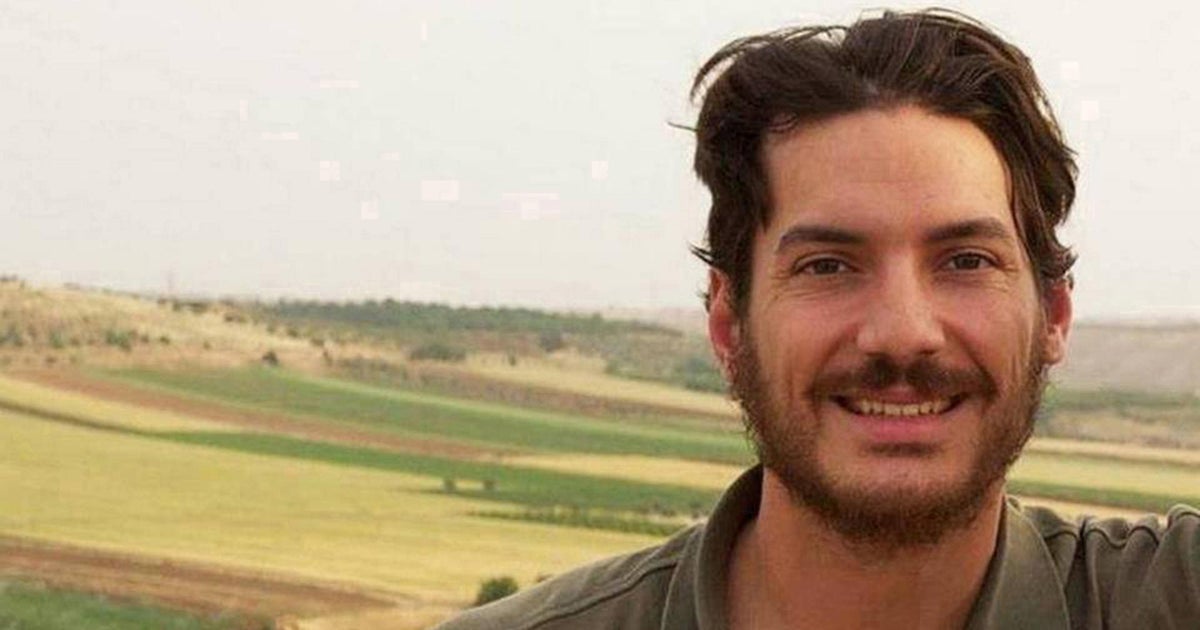
Washington — U.S. officials sought help from Russia during President Trump’s first term to secure the release of journalist Austin Tice after intelligence indicated that the Marine veteran was likely still alive but numerous leads and a hefty reward hadn’t helped locate him.
Robert O’Brien, who was a hostage negotiator for the administration at the time and later became Mr. Trump’s national security adviser, asked Nikolai Patrushev, the Russian national security adviser, if Russia could use its pull with then-Syrian leader Bashar al-Assad to free Tice.
“The Russians had long been one of Assad’s patrons, and in fact the dictator substantially owed the survival of his regime to Russian military intervention in the civil war in 2015,” O’Brien wrote in a new book, which includes previously unreported details on multiple attempts to track down Tice.
Patrushev agreed, O’Brien wrote. But “even Assad’s allies ran into a brick wall,” according to an advance copy of the book that has been circulating inside the Trump administration in digital form and was obtained by CBS News.
Tice, a freelance journalist, disappeared in August 2012 while reporting on the Syrian civil war. Weeks later, a short video appeared online that showed a distressed Tice blindfolded with his apparent captors. It was the last time he was seen.
Kash Patel, actor Sean Penn, the Vatican, the king of Jordan, Czech officials, various Gulf states and a Lebanese businessman who claimed he’d met with Tice in person also tried to chase potential leads or backchannel with the murderous Assad regime, with whom the U.S. did not have official diplomatic ties, O’Brien said.
In the fall of 2020, O’Brien sent two U.S. officials to Syria to meet with the country’s head of intelligence: Patel, then the National Security Council’s senior director for counterterrorism, and Roger Carstens, O’Brien’s successor as special presidential envoy for hostage affairs.
“There was no unanimity within the Trump Administration on the wisdom of this tactic,” O’Brien wrote.
Then-Secretary of State Mike Pompeo had a strong concern about the risk that the American officials would be kidnapped, and also wanted to maintain a hard line on Assad through diplomatic and economic sanctions, O’Brien wrote.
Pompeo arranged with U.S. Central Command to have armed drones and overhead satellites moved into place to monitor and protect Patel and Carstens while they were in Damascus to meet with Ali Mamlouk, the intelligence chief.
It was a risky overland drive from Beirut to Damascus, but “again, despite their best efforts, Kash and Roger could not procure Austin’s release.”
Penn, who used his Hollywood celebrity status to aid wrongfully detained Americans, called O’Brien in 2019 to tell him about an encounter he’d had at a fundraiser in Los Angeles. Penn said a Lebanese businessman with contacts with the Assad regime claimed that he had just seen Tice in Syria at a meeting orchestrated by the regime to signal the kidnapped reporter was very much alive.
O’Brien met with Penn and the businessman, Elias Kwaham, to strategize how the pair could act as intermediaries with the regime. “But the hoped-for connections never materialized,” O’Brien wrote.
Although Jordan didn’t have good relations with the Assad regime, O’Brien theorized that one of the Syrian refugees the country hosted might know something about Tice.
He caught up with Jordan’s king, Abdullah II, at a counterterrorism conference in Napa Valley, California. The king was “gracious, knowledgeable about the Tice case, and receptive of some additional case details. He promised to task his security services to look for new leads, although he expressed concern that we had not received proof of life for several years,” O’Brien wrote.
The Vatican, which has one of the world’s most expansive diplomatic footprints, including inside Syria, hosted a dinner where O’Brien connected with a prominent Lebanese businessman who had grown up with Assad.
“He eventually reached out to Assad, who told him that if the Americans wanted Tice back,” O’Brien wrote, “they shouldn’t go about it in such a secretive way.”
The CIA changed its assessment of Tice’s case in 2024 to indicate, with low confidence, that he was likely dead.
O’Brien said the first Trump administration recovered 55 Americans from 24 countries without concessions. More than 80 have been recovered so far during the president’s second term.