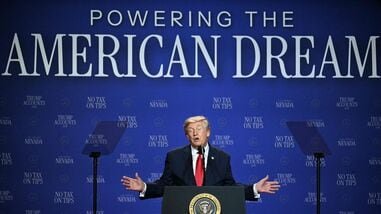
US President Donald Trump has threatened to escalate the pressure on Iran from the battlefield to the global economy, warning countries and businesses that continue providing Tehran with financial or commercial support could face severe US penalties.
Trump described the planned measures as an “ECONOMIC D-DAY” and threatened what he called “Economic Warfare and Isolation on an unprecedented scale.” However, he did not specify exactly what new measures Washington would impose or which countries would be targeted.
The threat comes after weeks of US and Israeli military strikes and a US maritime blockade have failed to force Tehran to capitulate. It also puts the spotlight on China, Iran’s biggest buyer of oil, and could create a new economic confrontation between Washington and Beijing.
What exactly did Trump threaten?
Quick answers to key questions
What were the main components of Trump’s economic threat to Iran?⌵
Trump’s economic threat involved cutting off Iran’s access to financial institutions, cash transfers, and oil-smuggling networks, warning countries that assist Iran would face severe economic consequences.
Why is the U.S. escalating economic pressure on Iran now?⌵
The U.S. is escalating pressure as previous military efforts have failed to force Iran into submission, aiming to increase the economic cost of Iran’s resistance to U.S. demands without expanding military conflict.
How could Trump’s economic strategy impact Iran’s ability to conduct trade?⌵
Trump’s strategy aims to significantly restrict Iran’s ability to earn foreign currency, sell oil, and engage in international trade by limiting access to financial networks and imposing penalties on supporters.
Should countries continue trading with Iran despite U.S. threats?⌵
Countries need to consider the potential severe economic penalties from the U.S. before engaging in trade with Iran, as they risk facing ‘tremendous economic consequences’ for providing support.
What is China’s role in the U.S.’s economic campaign against Iran?⌵
China is critical to Iran’s economy as it purchases over 80% of Iran’s crude oil; thus, targeting Chinese banks could escalate U.S.-China tensions and significantly affect Tehran’s oil revenue.
Trump said any country that allows its financial institutions, businesses, airports or government entities to provide a “lifeline” to Iran would face “TREMENDOUS Economic Consequences.”
He also called on countries to cut off Iran’s access to:
-Exchange houses
-Cash transfers
-Currency swap arrangements
-Ship registries
-Front companies
-Oil-smuggling networks
-Other financial and commercial channels
The broader objective appears to be to make it significantly harder for Iran to earn foreign currency, sell oil and conduct international trade.
Trump wants other countries to join the US in isolating Iran rather than simply imposing additional sanctions directly on Tehran.
Why is Trump escalating economic pressure?
The threat comes as the US campaign against Iran faces growing difficulties.
Despite months of military strikes, Iran has not surrendered or accepted Washington’s demands. Tehran continues to resist US pressure, while the conflict has disrupted shipping through the Strait of Hormuz, one of the world’s most important oil transit routes.
The US blockade has also sharply restricted Iran’s ability to export crude.
Trump is therefore seeking to increase the economic cost of resisting the US without necessarily expanding the military campaign.
The economic strategy could serve several purposes:
-Cut Iran’s oil revenues
-Reduce Tehran’s access to foreign currency
-Pressure Iran’s trading partners
-Force Tehran back to negotiations
-Push Iran to make concessions on its nuclear programme
-Pressure Iran to ease restrictions on shipping through Hormuz
The strategy also reflects the growing economic and political costs of the war for Washington, including higher fuel prices and concerns about the conflict’s impact ahead of the US midterm elections.
Why is China the biggest concern?
China is likely to be at the centre of Trump’s threat because it buys the overwhelming majority of Iran’s exported crude.
Kpler data cited in the report indicates that China buys more than 80% of Iran’s shipped oil, with some estimates putting the figure above 90%.
That makes China critical to Iran’s ability to continue earning oil revenue.
Washington has already sanctioned some Chinese companies and independent refineries involved in Iranian oil trade. But it has so far avoided going after major Chinese banks that facilitate the trade.
A major expansion of sanctions against Chinese financial institutions could therefore represent a significant escalation.
It could also trigger retaliation from Beijing at a particularly sensitive moment, with Trump seeking to maintain a tariff truce and planning talks with Chinese President Xi Jinping.
What did China say?
Beijing rejected Trump’s approach and argued that sanctions and economic pressure would not solve the crisis.
Chinese Foreign Ministry spokesman Lin Jian said: “Sanctions and pressure will not help resolve the issue.”
China called for restraint and a diplomatic solution, urging the relevant parties to resolve the conflict through political and diplomatic means.
The response makes clear that Beijing does not accept Washington’s attempt to pressure other countries into joining its economic campaign against Iran.
China’s position is particularly important because its continued purchase of Iranian oil could undermine the effectiveness of Trump’s strategy.
What did Iran say?
Iran strongly rejected Trump’s threat.
Foreign Minister Abbas Araghchi described US economic pressure as a failed policy and accused Washington of using the threat to divert attention from America’s own economic problems.
Araghchi argued that further pressure would not force Iran to surrender. Instead, he warned that it would increase hostility toward the United States.
He also described US economic pressure as “economic terrorism”, arguing that it threatens the global economy and the sovereignty of countries.
Iran’s response suggests that Tehran does not currently view additional economic pressure as sufficient reason to accept Washington’s demands.
What could be the impact on Iran?
The immediate economic impact could be significant because Iran is already under severe pressure.
The war and blockade have contributed to:
-Extremely high inflation
-A sharp decline in the Iranian currency
-Reduced oil exports
-Lower access to foreign currency
-Disrupted trade
-Higher costs for imports
-Growing pressure on businesses and households
Further restrictions on Iran’s access to international financial networks could make it even harder for Tehran to receive payment for oil and purchase essential goods.
However, there is an important limitation: Iran has lived under US sanctions for decades.
The country has developed networks of intermediaries, front companies and alternative financial channels to continue trading.
That means additional sanctions could increase the economic pain without necessarily producing a political capitulation.