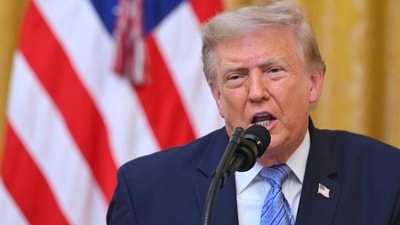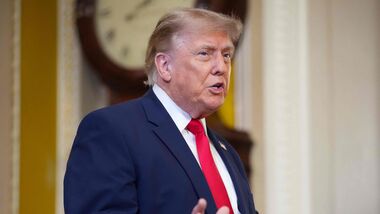
US President Donald Trump on Monday (July 27) warned that the United States could resume “very strong military action” against Iran if ongoing diplomatic efforts fail, while confirming that Washington had paused planned strikes to give negotiations another chance.
In an interview with Axios, Trump said diplomacy remained the preferred option but cautioned that the window for talks was limited.
“We are in very deep talks with Iran. If they don’t work out, we will go back to very strong military action,” the news outlet quoted Trump as saying.
Quick answers to key questions
What did President Trump say about military action against Iran if diplomacy fails?⌵
President Trump warned of ‘very strong military action’ against Iran if diplomatic efforts do not succeed, confirming the US had paused planned strikes to facilitate negotiations.
Why did the US pause military strikes against Iran?⌵
The US paused military strikes against Iran to provide space for diplomatic talks, following a request for discussions from Tehran as a response to US military pressure.
How does Iran view the current negotiations with the US?⌵
Iran has denied that it is involved in direct negotiations with the US, stating that mediators are merely relaying messages, and it has not requested a resumption of talks.
Should the US continue pursuing diplomatic efforts with Iran?⌵
Yes, Trump indicated that ongoing diplomatic efforts are preferable, stressing the importance of progress in negotiations before considering military options.
What is the significance of the Strait of Hormuz in US-Iran relations?⌵
The Strait of Hormuz is a crucial global energy route and a flashpoint in US-Iran relations, with ongoing tensions affecting maritime security and oil markets.
When asked how long he was prepared to wait for a diplomatic solution, Trump replied, “Not much time. Either it goes fast or not at all.”
The remarks came after Washington abruptly suspended a two-week campaign of air strikes against Iran, marking another shift in Trump’s approach to the five-month-old conflict.
Trump says US-Iran talks have a chance of success
Speaking to reporters aboard Air Force One, Trump said the United States and Iran were engaged in discussions and suggested that a potential agreement could emerge.
“We’re talking right now,” Trump said.
Asked about his patience for negotiations, Trump said, “I have a lot of patience… We’ll see what happens. I think there is a good chance that something could happen.”
He added that diplomacy would continue only if it showed progress.
“And if it does, good, if it doesn’t, we go back to doing what we were doing two days ago,” Trump said.
Trump claimed Iran sought discussions after facing heavy US military pressure, saying Tehran would not have agreed to talks otherwise.
“They would not have requested the meeting if we were doing poorly. The only reason they want to meet is because we’ve been hitting them very hard,” he said.
Iran approached US for meeting, Trump says
Trump said Tehran requested talks through diplomatic intermediaries as well as directly, leading Washington to pause military operations.
“They asked us very nicely, ‘Please stop, let’s meet,'” Trump said.
“And that’s where we are right now; see what happens. If we don’t make a deal, we go back to the same thing.”
According to Trump, the pause in strikes followed Iran’s request for discussions and a temporary halt in hostilities.
“They requested a meeting through their surrogates and directly, and we’re meeting,” he said.
Tehran denies direct negotiations with Washington
Despite Trump’s comments, Iran has denied that direct peace negotiations with the United States are underway.
Iranian Foreign Ministry spokesperson Esmaeil Baqaei said mediators were only passing messages between the two sides and that Tehran was not involved in formal talks.
“Mediators may convey messages from the American side to us regarding current developments in the region. But at present, we are not engaged in any negotiations with the United States,” Baqaei said.
Iran has maintained that it is not seeking a return to negotiations but would continue observing a pause in attacks as long as Trump’s ceasefire arrangement remains in place.
Fighting pauses after weeks of US-Iran escalation
The United States and Iran held their fire for a third consecutive day on Monday following nearly two weeks of intense military exchanges.
The conflict escalated after a breakdown in diplomacy over Iran’s blockade of the Strait of Hormuz, a crucial global energy route.
The US military campaign began after Washington and its allies accused Tehran of threatening regional security and disrupting maritime traffic.
Trump’s administration said the pause in strikes was intended to provide space for diplomatic efforts and assess the consequences of expanding military operations.
Saudi Arabia reports drone attacks during ceasefire pause
Despite the pause in direct US-Iran fighting, tensions continued across the region.
Saudi Arabia said it intercepted drones targeting petroleum facilities, including sites near the capital Riyadh.
The kingdom blamed Iran-backed armed groups in Iraq for launching the drones and said it reserved the right to respond.
Yemen’s Iran-aligned Houthi rebels also claimed responsibility for targeting Saudi oil infrastructure, including the East-West Pipeline that transports crude to the Red Sea port of Yanbu.
The Houthis said the attacks were retaliation for what they described as Saudi drone incursions into Yemeni airspace.
Strait of Hormuz remains key flashpoint
Iran has continued to assert control over the Strait of Hormuz, the strategically important waterway through which a significant portion of global energy supplies passes.
Trump has demanded that vessels be allowed to freely navigate through the strait, warning Iran against restricting maritime traffic.
The ongoing dispute over Hormuz has contributed to volatility in global oil markets and heightened fears of supply disruptions.
Trump addresses US missile stockpiles
Trump also addressed concerns over American weapons supplies, saying the United States had sufficient defence resources while working to increase stockpiles.
“We have a lot of ammunition, different types,” Trump said.
He criticised the previous Biden administration’s decision to send weapons to Ukraine, saying the US was rebuilding supplies.
“The Patriots, in particular, are being built,” Trump added.