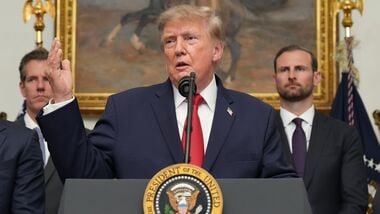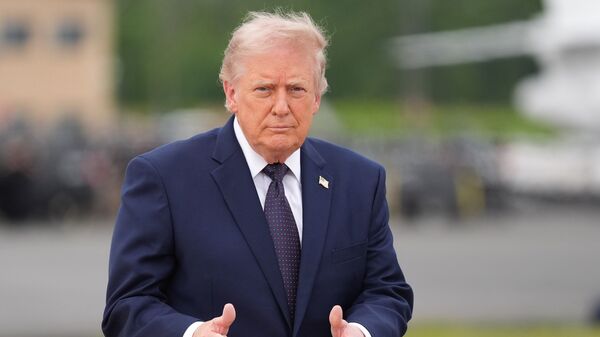
President Donald Trump declared on Thursday that the United States had “ended the war with Iran,” heralding what he called a “great settlement” and suggesting a formal signing ceremony could take place in Europe within days, with Vice President JD Vance expected to represent him.
Iran’s foreign ministry directly challenged the claim, saying no final agreement had been reached and that reports of a concluded deal amounted to “merely speculation.”
Trump’s Iran deal: key claims
Speaking from the described the emerging accord as “a very strong memorandum of understanding,” while acknowledging it remained “a little conceptual.” He told reporters the paperwork was approaching completion.
“The documents are pretty final shape, so we’ll see,” Trump said. “We’ll see. That should be done pretty quickly.”
At a telerally supporting Georgia Lieutenant Governor Burt Jones, who is running for governor, Trump framed the outcome in decisive terms.
“I don’t know if you heard, but we ended the war with Iran today,” Trump said. “They have agreed never to have a nuclear weapon, something that we insisted on; that was the whole purpose. That was 95 percent of it.”
He described Iran’s nuclear commitment as categorical and comprehensive.
“They will not have a nuclear weapon, they’ve agreed to that — there will be no, which is the whole reason, which is a big part of the reason,” Trump said. “They will not only not have, they will not purchase, develop in any way, any shape, in any way, shape or form a nuclear weapon.”
Iran strikes cancelled: Trump’s reasoning
The announcement came after that he had previewed only hours earlier. Posting on Truth Social, he said discussions had been elevated to the highest levels of Iranian leadership.
“Based on the fact that discussions with the Islamic Republic of Iran have been brought to the highest level of Iranian leadership and approved, I have, as President of the United States of America, cancelled the scheduled strikes and bombings against Iran this evening,” Trump wrote.
Trump attributed Iran’s readiness to negotiate to three days of sustained military action.
“We were hitting them very hard for the last three days. We’re going to hit them even harder tonight. They knew that. We told them exactly what we were going to do… they had no Navy, no Air Force, no weapons of detection. They have nothing… we won this war militarily very early on. The only thing we didn’t win was the fake news,” Trump said.
He added: “They’ve got a chance to build a country. Their country is largely demolished… Everything is gone. Their leadership is gone many times over. Even many people from this leadership is gone. But we found them to be rational, and they’re going to make a deal.”
Tehran pushes back: ‘merely speculation’
Iran’s foreign ministry issued a direct rebuttal. Spokesperson Esmail Baghaei, speaking to state-run news agency IRNA, said reports of a finalised agreement were “merely speculation” and that Tehran had arrived at no binding conclusion.
“So far, Iran has not reached a final decision regarding any agreement,” Baghaei said.
He confirmed that Qatar and Pakistan were “active as mediators” but contended that Washington’s shifting positions had complicated the diplomatic process.
“From the beginning, the status of the negotiations was clear to us, and a large portion of the text had already been finalized. However, the Americans kept changing their positions,” Baghaei said, according to IRNA.
He added that Iran had “proven that it does not compromise on what it has defined as its red lines,” and stated that the situation in the Strait of Hormuz had become “less secure because of .”
Iran’s Tasnim news agency, noting that Trump had declared a deal imminent on 38 separate occasions over the preceding two months, warned: “Until Iran announces the matter of a potential understanding, any news from Trump on this subject should be regarded the same as his previous messaging.”
Iran nuclear deal: terms on the table
Trump outlined what the proposed agreement would require of Tehran: permitting the US to secure its nuclear materials, ceasing enrichment activity, dismantling enrichment infrastructure, accepting limits on missile production, and ending financial and logistical support for regional armed factions. He said he believed Iran’s supreme leader had personally endorsed the terms.
“I understand the answer is yes,” Trump told reporters, when pressed on whether the supreme leader had given his approval, adding that the US blockade of ships entering and leaving Iranian ports would be lifted immediately upon signing.
Netanyahu: appreciation for Trump’s Iran commitments
Netanyahu, who was reported to be midway through a security discussion about Iran when Trump’s Truth Social post appeared, subsequently spoke with the US president and expressed support for the emerging framework.
The Office of the Prime Minister of Israel issued a formal statement: “Even though Israel is not a party to the memorandum of understanding, the Prime Minister expressed his appreciation for President Trump’s commitment that the final agreement at the conclusion of negotiations will include the removal of enriched material, the dismantling of enrichment infrastructure, limits on missile production, and the cessation of Iran’s support for its terrorist proxies in the region.”
Strait of Hormuz: reopening terms
Trump said the Strait of Hormuz, a critical global oil shipping route, would reopen the moment the settlement was formally signed, with a possible ceremony as early as Saturday or Monday.
“The Strait is going to open immediately. This signing maybe it’ll happen on Saturday or Monday. We think it’s going to go pretty quickly. I don’t want to say a deadline, because if I say a deadline, you’ll say, Oh, he didn’t meet the deadline. It’s going to get signed. And the strait is open. But the strait has been open for a number of months already, and you just didn’t know about it. I just announced yesterday that we bought a lot of ships across and millions, hundreds of millions of barrels of oil were brought across,” Trump said.
Kharg Island: off the table
against Kharg Island would be abandoned if the agreement concluded.
“Now it would be if we signed this agreement, it would be. They weren’t so thrilled when they heard that that’s what I was put in. I just don’t think I like it,” Trump said.
Qatar and Pakistan: the mediators
A earlier in the week, and US officials said those meetings helped resolve several outstanding sticking points, with mediators reported to have “hit some breakthroughs.” Iran transmitted its latest draft proposal through Qatari channels earlier this week, following Trump’s return of a revised version nearly two weeks prior in which he had sought to harden language on the nuclear provisions.
Countries involved: the full list
Trump cited broad international support, naming the United States, Israel, Saudi Arabia, the UAE, Qatar, Turkey, Pakistan, Bahrain, Kuwait, Jordan and Egypt as nations involved in the approval process.
Markets: oil falls, stocks surge
Financial markets responded sharply to news of a potential agreement. Oil prices declined and US equity indices moved significantly higher on Thursday, as investors weighed the possibility of reduced geopolitical risk across one of the world’s most consequential energy shipping corridors.