US President Donald Trump said he instructed Secretary of War Pete Hegseth to “substantially reduce” joint military exercises between the United States and South Korea, citing his relationship with North Korean leader Kim Jong Un.
In a post on Truth Social, he had been unhappy that the US had agreed to participate in the exercises.
“Based on my very good relationship with Kim Jong Un, of North Korea, I was not happy with the fact that the United States had, long ago, agreed to participate in Joint Military Exercises with South Korea,” Trump wrote.
Trump criticised the cost of the military exercises and said the United States pays a large portion of the expenses.
“These exercises are not only costly, with much of these costs paid for by the United States of America (as usual!),” he said.
Trump says drills send ‘hostile’ signal
Trump also argued that the exercises send an inappropriate message to North Korea, which he described as having remained “unthreatening and respectful” during his presidency.
The , although he noted that it was too late to cancel them altogether.
“Therefore, and based on the fact that it was too late to cancel, I instructed Secretary of War, Pete Hegseth, to substantially reduce the Joint Military Exercises!” Trump wrote.
The comments come as Washington and Seoul continue to maintain a joint military posture aimed at deterring North Korea. The annual exercises have long been criticised by Pyongyang.
Trump raises South Korea’s response on Iran
also linked his comments about the Korean Peninsula to US efforts concerning Iran.
“While somewhat unrelated (?), I recently asked the President of South Korea if they would like to join us in the Denuclearization of the Islamic Republic of Iran, and they said, ‘No thanks!’” he wrote.
has repeatedly sought to involve US allies in his foreign-policy initiatives, including efforts aimed at preventing Iran from developing nuclear weapons.
and has repeatedly expressed his willingness to resume direct engagement with the North Korean leader.
US, South Korea wrap military drill early
The United States and South Korea ended their annual military exercise on August 21, six days earlier than originally scheduled, in what appeared to be a conciliatory gesture toward North Korea as President Donald Trump seeks to revive diplomacy with leader Kim Jong Un.
South Korea’s military said the Ulchi Freedom Shield exercise concluded on Friday. The command-post exercise had initially been planned for 11 days, with a second phase focused on counteroffensive operations scheduled to continue until August 27.
The decision to shorten the exercise came after Trump ordered the Pentagon to “substantially reduce” the drills shortly before they began on Monday.
US, South Korea halve field exercises
The Ulchi Freedom Shield exercise was originally divided into two phases. The first focused on defensive operations, while the second was designed to simulate counteroffensive operations following a North Korean attack.
North Korea has historically been particularly sensitive to the second phase, viewing the drills as rehearsals for an invasion.
The US and South Korea had also planned 14 joint field-training exercises during the period. Those exercises will be cut by half, according to South Korea’s military.
The downsizing has raised concerns over whether the allies’ military readiness could be affected, given that Ulchi Freedom Shield is one of their main annual exercises for preparing to respond to potential North Korean aggression.
North Korea dismisses Trump’s gesture
The move has done little to persuade Pyongyang to return to nuclear negotiations.
Kim Yo Jong, the powerful sister of Kim Jong Un, said on Wednesday that reducing the duration and scale of the exercises did not change what North Korea considers their “provocative, aggressive nature.”
North Korea then fired about 10 short-range ballistic missiles toward the sea the following day, apparently responding to the military drills.
The US Pacific Command said the launches did not pose an immediate threat to US territory or its allies, while reaffirming Washington’s commitment to defending the United States and its partners in the region.
Kim Yo Jong’s response has dampened expectations of an immediate resumption of talks between Trump and Kim.
However, her relatively measured language was notable. She referred to the relationship between her brother and Trump as “excellent” while criticising Washington’s military cooperation with Seoul.
That could indicate that Pyongyang is keeping the possibility of future negotiations open while seeking larger concessions from Washington, including sanctions relief and potentially greater acceptance of North Korea’s nuclear status.
Trump says he will meet Kim this year
again.
Asked on Wednesday whether he would meet the North Korean leader later this year, Trump replied: “Yeah, I will be.”
Trump also said Monday that he had received a response from Kim following his attempts to reopen communication.
Kim Yo Jong, however, denied that her brother had responded to Trump’s recent outreach, saying she was unaware of any recent communication between the two leaders.
Trump claims North Korea has 57 nuclear weapons
Trump also offered an unusually specific estimate of North Korea’s nuclear arsenal.
“I know Kim Jong Un very well, and he’s going to be fine as long as we have a smart president,” Trump said Wednesday.
“The fact that I get along with him – that’s a good thing, not a bad thing. He has 57 very powerful nuclear weapons,” Trump said.
The US government does not publicly provide an official figure for North Korea’s nuclear arsenal.
From threats to diplomacy
Trump and Kim have a complicated history. During Trump’s first presidency, tensions escalated sharply, with Kim insulting Trump as a “mentally deranged U.S. dotard” and threatening the United States with nuclear weapons.
The relationship later shifted dramatically.
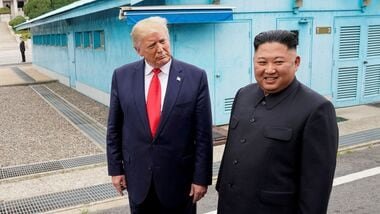
Trump and Kim held three unprecedented meetings in 2018 and 2019, including a historic encounter at the Korean Demilitarized Zone where Trump briefly stepped into North Korea, becoming the first sitting US president to do so.
Those diplomatic efforts ultimately collapsed over disagreements about North Korea’s nuclear weapons and US sanctions.
Kim has since expanded the country’s nuclear and missile capabilities and strengthened ties with Russia. He has also suggested that North Korea would not return to negotiations unless Washington abandons its demand for denuclearization as a condition for diplomacy.
Trump is now attempting to reopen that diplomatic channel, with the early conclusion of the US-South Korea drills marking a notable gesture toward Pyongyang.
But North Korea’s rejection of the move and its latest missile launches suggest that reducing military exercises alone may not be enough to bring Kim back to the negotiating table.