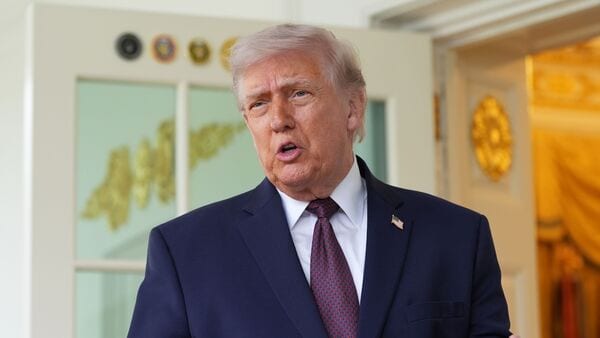
US President Donald Trump said on Sunday (April 26) that Iran could still initiate negotiations to end the ongoing conflict, emphasizing that communication channels remain open.
“If they want to talk, they can come to us, or they can call us. You know, there is a telephone. We have nice, secure lines,” Trump told Fox News.
However, Trump reiterated a non-negotiable demand: “They know what has to be in the agreement. It’s very simple: they cannot have a nuclear weapon, otherwise there’s no reason to meet.”
Diplomatic efforts continue without US presence
Iran’s foreign minister, Abbas Araqchi, continued regional diplomacy despite the absence of US envoys. Planned talks in Islamabad involving Steve Witkoff and Jared Kushner were scrapped by Washington.
Araqchi traveled between Pakistan and Oman, meeting leaders including Haitham bin Tariq al-Said to discuss de-escalation and maritime security.
Araqchi called for “a regional security framework free of outside interference,” according to Iran’s foreign ministry.
Core dispute
At the heart of the impasse is Iran’s insistence on its right to enrich uranium for peaceful purposes. Tehran maintains its program is civilian, while the US and Israel argue it could lead to nuclear weapons development.
Trump dismissed prior Iranian proposals as insufficient: “Iran offered a lot, but not enough.”
Conflict impact
Although a ceasefire has paused large-scale fighting, no agreement has been reached to formally end the war, which began with US-Israeli strikes on February 28.
The conflict has had far-reaching consequences:
-Thousands killed
-Oil prices rising
-Economic growth outlook weakening
Iran has also restricted access to the Strait of Hormuz, a critical route for roughly one-fifth of global oil shipments, while the US has imposed a naval blockade on Iranian ports.
Regional talks expand to security and compensation
Talks in Pakistan are expected to address broader demands. According to Iranian reports, discussions may include:
-A new legal framework governing the Strait of Hormuz
-Compensation for damages
-Guarantees against future military action
-Lifting the naval blockade
Earlier negotiations in Islamabad, led by US Vice President JD Vance and Iranian parliamentary speaker Mohammad Baqer Qalibaf, ended without agreement.