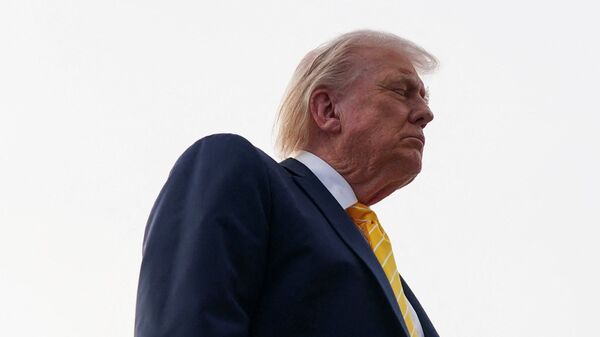
Tensions have once again started to simmer between the United States and Iran after President on Saturday (local time) warned Tehran that he could order renewed military action if it “misbehaves.”
When asked if Trump could order fresh strikes in Iran despite a nearly four-week ceasefire in place, he told reporters, “If they misbehave, if they do something bad — but right now, we’ll see. It’s a possibility that could happen, certainly,” Axios reported.
Renewed military action against Iran?
His remarks come as Washington and Tehran are still exchanging drafts of a framework agreement to end the . However, Trump has now made it clear that he is seriously considering renewed military action against Iran to break the current stalemate.
Hours before the warned Tehran, two senior Iranian officials made similar remarks, with one stating that the Islamic Republic is fully prepared to repel any aggression, and an Iranian military officer stating that a fresh clash with the US is likely.
Deputy Foreign Minister Kazem Gharibabadi told a gathering of ambassadors and heads of foreign diplomatic missions in Tehran, “Iran has presented its plan to Pakistan as a mediator with the aim of permanently ending the imposed war, and now the ball is in America’s court. Iran is ready for both paths in order to ensure its national interests and security, and in any case, it will always maintain its pessimism and distrust of America and its honesty in the path of diplomacy.”
Separately, Mohammad Jafar Asadi, a key figure in the Islamic Republic’s central command, said that “a renewed conflict between Iran and the is likely.”
Remarks from Iranian officials came a day after Trump rejected the latest , which Iran sent to Pakistani mediators to continue negotiations. Citing sources, Axios reported that under the proposal, a one-month deadline will be set for negotiations on a deal to reopen the , end the US naval blockade, and permanently end the war in Iran and Lebanon.
Per the Iranian proposal, only after such a deal is reached, another month of negotiations would be launched to try to reach a deal on the nuclear program.
Trump rejects Iranian proposal
Earlier on Friday, Trump rejected Tehran’s proposal, stating that he is ‘unhappy’ and ‘not satisfied’ with it. Speaking to reporters at the White House, the US President noted, “They want to make a deal, but I’m not satisfied with it. We just had a conversation with Iran. Let’s see what happens. But I would say that I am not happy.”
However, on Saturday, before leaving Palm Beach for Miami, Trump told reporters that he would review the 14-point proposal on the plane. “I’m looking at it. I’ll let you know about it later… They told me about the concept of the deal. They’re going to give me the exact wording now.”
Shortly after, in a Truth Social post, he wrote that he “can’t imagine that it would be acceptable” and stressed “has not yet paid a big enough price for what they have done to Humanity, and the World, over the last 47 years.”
Diplomacy possible: Iranian leaders
Days after Iran’s President Masoud Pezeshkian said that Tehran is ready to resume diplomacy with Washington, provided that the latter drops its “maximalist” demands and stops its “maritime piracy” against Iranian ships in the Persian Gulf, the Islamic Republic’s Foreign Minister Abbas Araghchi has hinted at something similar. Araghchi recently noted that diplomacy is possible, but with conditions. He added that Tehran was ready to continue diplomatic efforts only if the Americans abandoned what he called “excessive demands, threatening rhetoric, and provocative actions.” He added that Iran’s military remains “fully vigilant.”
US-Iran peace talks in limbo?
While the two sides are expressing intent for negotiations, they are also issuing warnings. After the first round of talks failed earlier in April, the US imposed a naval blockade of Iranian ports, a move that prompted Tehran not to agree to the second round of talks. Last week, Araghchi visited Pakistan, following which hopes of a peace deal were renewed. However, before the Trump team could depart for Pakistan’s capital city, Islamabad, Araghchi departed the country. The logjam over the reopening of the Strait of Hormuz, the naval blockade, and a peace deal continues, but what remains to be seen is if the US would violate a , which Trump extended indefinitely.
- The U.S. and Iran are in a precarious situation with ongoing negotiations and threats.
- Diplomatic efforts are complicated by military posturing from both sides.
- The potential for renewed conflict remains high, particularly if ceasefire conditions are violated.